Department of Economics, School of Economics and Social Sciences, Institute of Business Administration, 75270, Karachi, Pakistan.
Department of Social and Public Health, Ohio University, 45701, Athens, OH, USA.
BMC Public Health. 2024 Mar 14;24(1):801. doi: 10.1186/s12889-024-18320-4.
Pakistan is currently experiencing a double burden of disease. Families with members having both communicable and noncommunicable diseases are at a greater risk of impoverishment due to enormous out-of-pocket payments. This study examines the percentile distribution of the determinants of the out-of-pocket expenditure on the double disease burden.
The study extracted a sample of 6,775 households with at least one member experiencing both communicable and noncommunicable diseases from the Household Integrated Economic Survey 2018-19. The dataset is cross-sectional and nationally representative. Quantile regression was used to analyze the association of various socioeconomic factors with the OOP expenditure associated with double disease burden.
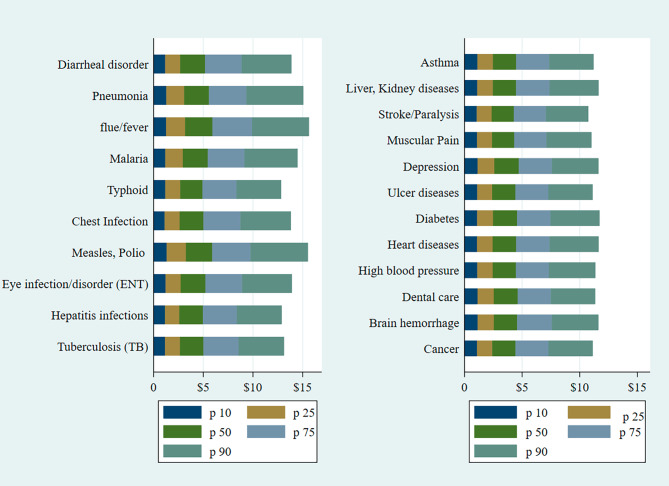
Overall, 28.5% of households had double disease in 2018-19. The households with uneducated heads, male heads, outpatient healthcare, patients availing public sector healthcare services, and rural and older members showed a significant association with the prevalence of double disease. The out-of-pocket expenditure was higher for depression, liver and kidney disease, hepatitis, and pneumonia in the upper percentiles. The quantile regression results showed that an increased number of communicable and noncommunicable diseases was associated with higher monthly OOP expenditure in the lower percentiles (10th percentile, coefficient 312, 95% CI: 92-532), and OOP expenditure was less pronounced among the higher percentiles (75th percentile, coefficient 155, 95% CI: 30-270). The households with older members were associated with higher OOP expenditure at higher tails (50th and 75th percentiles) compared to lower (10th and 25th percentiles). Family size was associated with higher OOPE at lower percentiles than higher ones.
The coexistence of communicable and noncommunicable diseases is associated with excessive private healthcare costs in Pakistan. The results call for addressing the variations in financial costs associated with double diseases.
目前,巴基斯坦正面临着双重疾病负担。由于巨额自付费用,同时患有传染性和非传染性疾病的家庭面临更大的贫困风险。本研究旨在分析双重疾病负担自付支出决定因素的百分位数分布。
本研究从 2018-19 年家庭综合经济调查中抽取了一个至少有一名成员患有传染性和非传染性疾病的 6775 户家庭样本。该数据集为横截面且具有全国代表性。使用分位数回归分析了各种社会经济因素与双重疾病负担相关的自付支出之间的关联。
2018-19 年,总体上有 28.5%的家庭患有双重疾病。户主未受教育、户主为男性、门诊医疗、利用公共部门医疗服务的患者以及农村和老年成员的家庭与双重疾病的患病率显著相关。在上百分位数中,抑郁、肝脏和肾脏疾病、肝炎和肺炎的自付支出较高。分位数回归结果表明,在较低百分位数(第 10 百分位数,系数 312,95%CI:92-532)中,传染性和非传染性疾病数量的增加与每月自付支出的增加相关,而在较高百分位数(第 75 百分位数,系数 155,95%CI:30-270)中,自付支出的增幅较小。与较低(第 10 分位数和第 25 分位数)相比,较高(第 50 分位数和第 75 分位数)的老年成员家庭的自付支出较高。家庭规模与较低百分位数的自付支出高于较高百分位数相关。
在巴基斯坦,传染性和非传染性疾病的共存与私人医疗保健费用过高有关。研究结果呼吁解决与双重疾病相关的财务成本差异。