Department of Medicine, Rheumatology Unit, University of Verona, Verona, Italy.
Italian Bone Disease Research Foundation (FIRMO), Florence, Italy.
Aging Clin Exp Res. 2024 Mar 18;36(1):74. doi: 10.1007/s40520-024-02728-4.
Osteoporosis in males is largely under-diagnosed and under-treated, with most of the diagnosis confirmed only after an osteoporotic fracture. Therefore, there is an urgent need for highly accurate and precise technologies capable of identifying osteoporosis earlier, thereby avoiding complications from fragility fractures.
This study aimed to evaluate the diagnostic accuracy and precision of the non-ionizing technology Radiofrequency Echographic Multi Spectrometry (REMS) for the diagnosis of osteoporosis in a male population in comparison with conventional Dual-energy X-ray Absorptiometry (DXA).
A cohort of 603 Caucasian males aged between 30 and 90 years were involved in the study. All the enrolled patients underwent lumbar and femoral scans with both DXA and REMS. The diagnostic agreement between REMS and DXA-measured BMD was expressed by Pearson correlation coefficient and Bland-Altman method. The accuracy of the diagnostic classification was evaluated by the assessment of sensitivity and specificity considering DXA as reference.
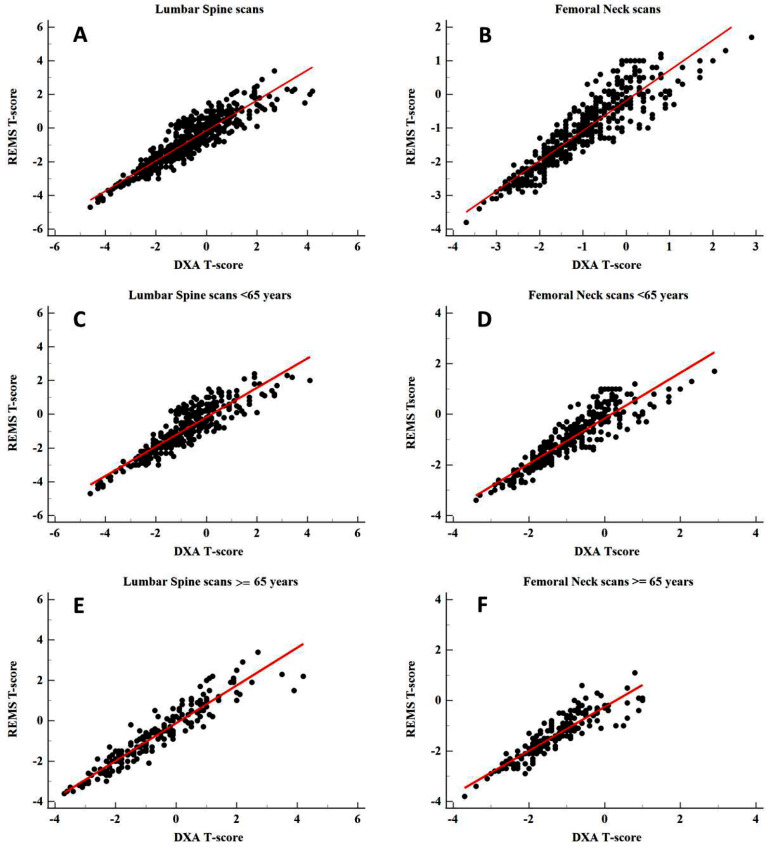
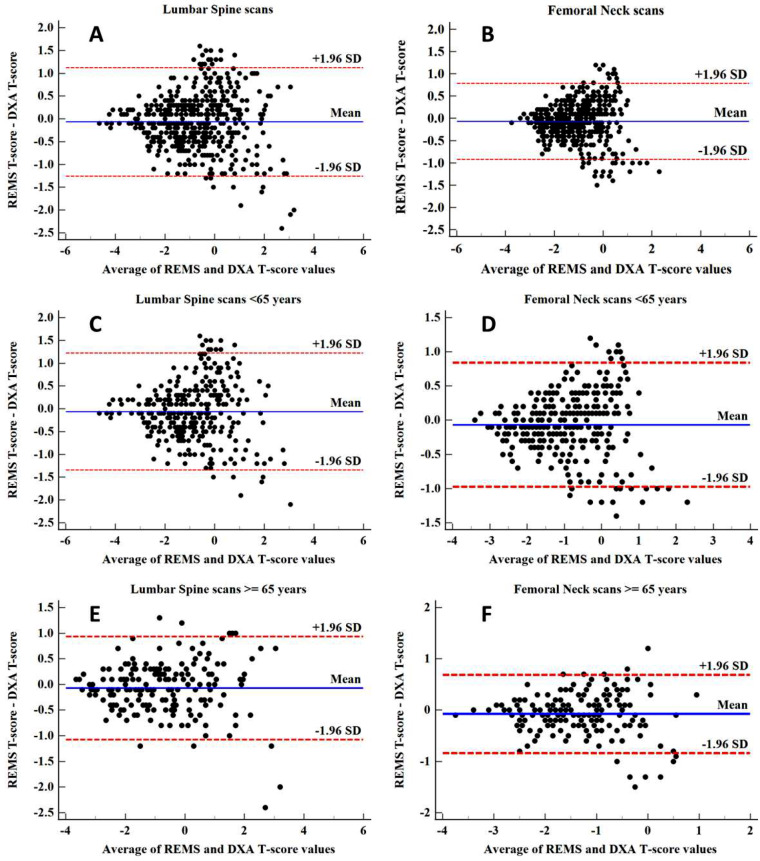
A significant correlation between REMS- and DXA-measured T-score values (r = 0.91, p < 0.0001) for lumbar spine and for femoral neck (r = 0.90, p < 0.0001) documented the substantial equivalence of the two measurement techniques. Bland-Altman outcomes showed that the average difference in T-score measurement is very close to zero (-0.06 ± 0.60 g/cm for lumbar spine and - 0.07 ± 0.44 g/cm for femoral neck) confirming the agreement between the two techniques. Furthermore, REMS resulted an effective technique to discriminate osteoporotic patients from the non-osteoporotic ones on both lumbar spine (sensitivity = 90.1%, specificity = 93.6%) and femoral neck (sensitivity = 90.9%, specificity = 94.6%). Precision yielded RMS-CV = 0.40% for spine and RMS-CV = 0.34% for femur.
REMS, is a reliable technology for the diagnosis of osteoporosis also in men. This evidence corroborates its high diagnostic performance already observed in previous studies involving female populations.
男性骨质疏松症的诊断和治疗严重不足,大多数诊断仅在发生骨质疏松性骨折后才得到确认。因此,迫切需要高度准确和精确的技术,以便更早地识别骨质疏松症,从而避免脆性骨折的并发症。
本研究旨在评估非电离技术射频超声多谱仪(REMS)在男性人群中诊断骨质疏松症的诊断准确性和精密度,并与传统双能 X 射线吸收法(DXA)进行比较。
本研究纳入了 603 名年龄在 30 岁至 90 岁之间的白种人男性。所有入组患者均接受 DXA 和 REMS 腰椎和股骨扫描。通过 Pearson 相关系数和 Bland-Altman 方法表达 REMS 和 DXA 测量的 BMD 之间的诊断一致性。通过评估以 DXA 为参考的诊断分类的敏感性和特异性来评估诊断分类的准确性。
REMS 和 DXA 测量的腰椎(r = 0.91,p < 0.0001)和股骨颈(r = 0.90,p < 0.0001)T 评分值之间存在显著相关性,证明了两种测量技术的高度等效性。Bland-Altman 结果表明,T 评分测量的平均差值非常接近零(腰椎为-0.06±0.60 g/cm,股骨颈为-0.07±0.44 g/cm),证实了两种技术之间的一致性。此外,REMS 是一种有效的技术,可以区分腰椎(敏感性=90.1%,特异性=93.6%)和股骨颈(敏感性=90.9%,特异性=94.6%)的骨质疏松患者和非骨质疏松患者。腰椎的精密度为 RMS-CV=0.40%,股骨的精密度为 RMS-CV=0.34%。
REMS 是一种可靠的男性骨质疏松症诊断技术。这一证据支持了其在先前涉及女性人群的研究中已经观察到的高诊断性能。