Joshi Saurabh, Forjaz André, Han Kyu Sang, Shen Yu, Queiroga Vasco, Xenes Daniel, Matelsk Jordan, Wester Brock, Barrutia Arrate Munoz, Kiemen Ashley L, Wu Pei-Hsun, Wirtz Denis
Department of Chemical & Biomolecular Engineering, Johns Hopkins University, Baltimore MD.
The Johns Hopkins Institute for NanoBioTechnology, Johns Hopkins University, Baltimore, MD.
bioRxiv. 2024 Mar 28:2024.03.07.583909. doi: 10.1101/2024.03.07.583909.
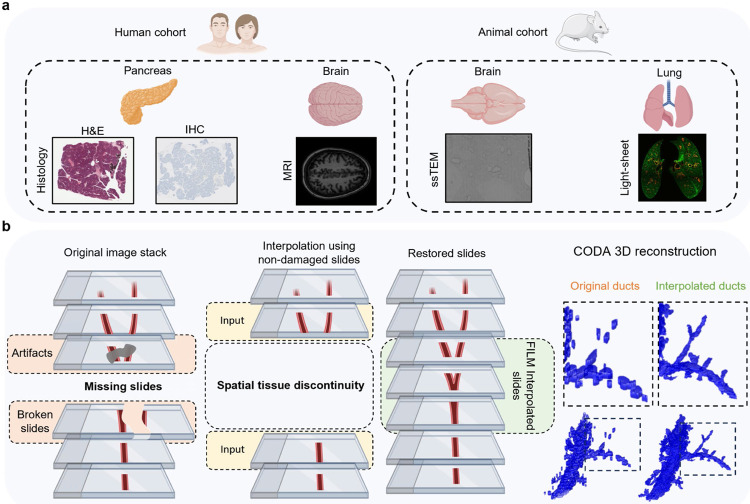
The development of novel imaging platforms has improved our ability to collect and analyze large three-dimensional (3D) biological imaging datasets. Advances in computing have led to an ability to extract complex spatial information from these data, such as the composition, morphology, and interactions of multi-cellular structures, rare events, and integration of multi-modal features combining anatomical, molecular, and transcriptomic (among other) information. Yet, the accuracy of these quantitative results is intrinsically limited by the quality of the input images, which can contain missing or damaged regions, or can be of poor resolution due to mechanical, temporal, or financial constraints. In applications ranging from intact imaging (e.g. light-sheet microscopy and magnetic resonance imaging) to sectioning based platforms (e.g. serial histology and serial section transmission electron microscopy), the quality and resolution of imaging data has become paramount. Here, we address these challenges by leveraging frame interpolation for large image motion (FILM), a generative AI model originally developed for temporal interpolation, for spatial interpolation of a range of 3D image types. Comparative analysis demonstrates the superiority of FILM over traditional linear interpolation to produce functional synthetic images, due to its ability to better preserve biological information including microanatomical features and cell counts, as well as image quality, such as contrast, variance, and luminance. FILM repairs tissue damages in images and reduces stitching artifacts. We show that FILM can decrease imaging time by synthesizing skipped images. We demonstrate the versatility of our method with a wide range of imaging modalities (histology, tissue-clearing/light-sheet microscopy, magnetic resonance imaging, serial section transmission electron microscopy), species (human, mouse), healthy and diseased tissues (pancreas, lung, brain), staining techniques (IHC, H&E), and pixel resolutions (8 nm, 2 μm, 1mm). Overall, we demonstrate the potential of generative AI in improving the resolution, throughput, and quality of biological image datasets, enabling improved 3D imaging.
新型成像平台的发展提高了我们收集和分析大型三维(3D)生物成像数据集的能力。计算技术的进步使我们有能力从这些数据中提取复杂的空间信息,例如多细胞结构的组成、形态和相互作用、罕见事件,以及结合解剖学、分子和转录组学(以及其他)信息的多模态特征的整合。然而,这些定量结果的准确性本质上受到输入图像质量的限制,输入图像可能包含缺失或受损区域,或者由于机械、时间或经济限制而分辨率较低。在从完整成像(如光片显微镜和磁共振成像)到基于切片的平台(如连续组织学和连续切片透射电子显微镜)的各种应用中,成像数据的质量和分辨率已变得至关重要。在这里,我们通过利用用于大图像运动的帧插值(FILM)来应对这些挑战,FILM是一种最初为时间插值而开发的生成式人工智能模型,用于一系列3D图像类型的空间插值。对比分析表明,FILM在生成功能合成图像方面优于传统线性插值,因为它能够更好地保留包括微观解剖特征和细胞计数在内的生物信息,以及图像质量,如对比度、方差和亮度。FILM修复图像中的组织损伤并减少拼接伪影。我们表明,FILM可以通过合成跳过的图像来减少成像时间。我们用广泛的成像模态(组织学、组织清除/光片显微镜、磁共振成像、连续切片透射电子显微镜)、物种(人类、小鼠)、健康和患病组织(胰腺、肺、脑)、染色技术(免疫组化、苏木精和伊红染色)和像素分辨率(8纳米、2微米、1毫米)证明了我们方法的通用性。总体而言,我们展示了生成式人工智能在提高生物图像数据集的分辨率、通量和质量方面的潜力,从而实现改进的3D成像。