The Hormel Institute, University of Minnesota, Austin, Minnesota, USA.
Faculty of Land and Food Systems, The University of British Columbia, Vancouver, British Columbia, Canada.
mBio. 2024 Apr 10;15(4):e0041924. doi: 10.1128/mbio.00419-24. Epub 2024 Mar 19.
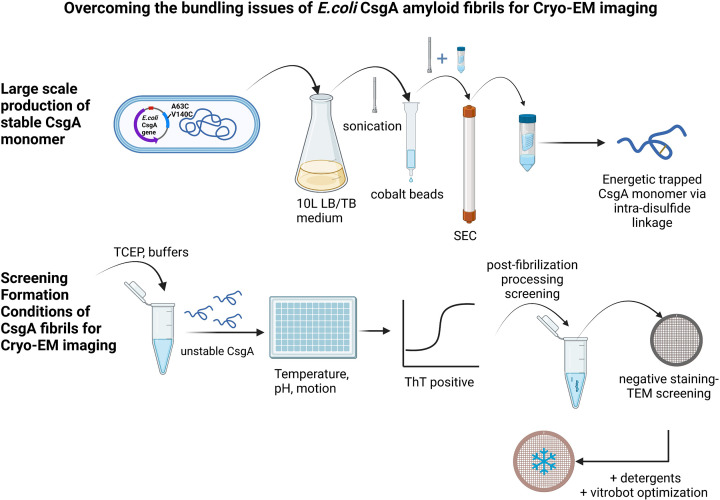
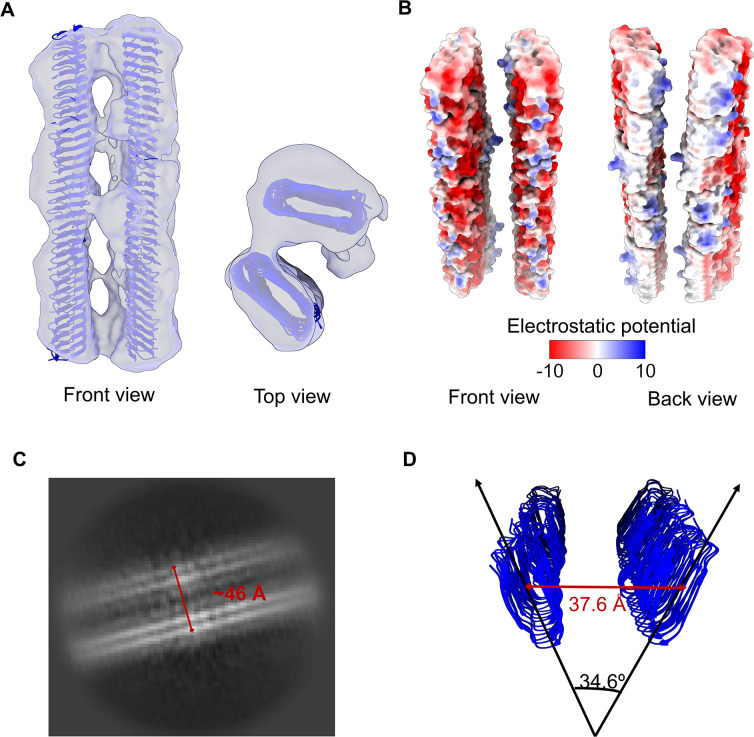
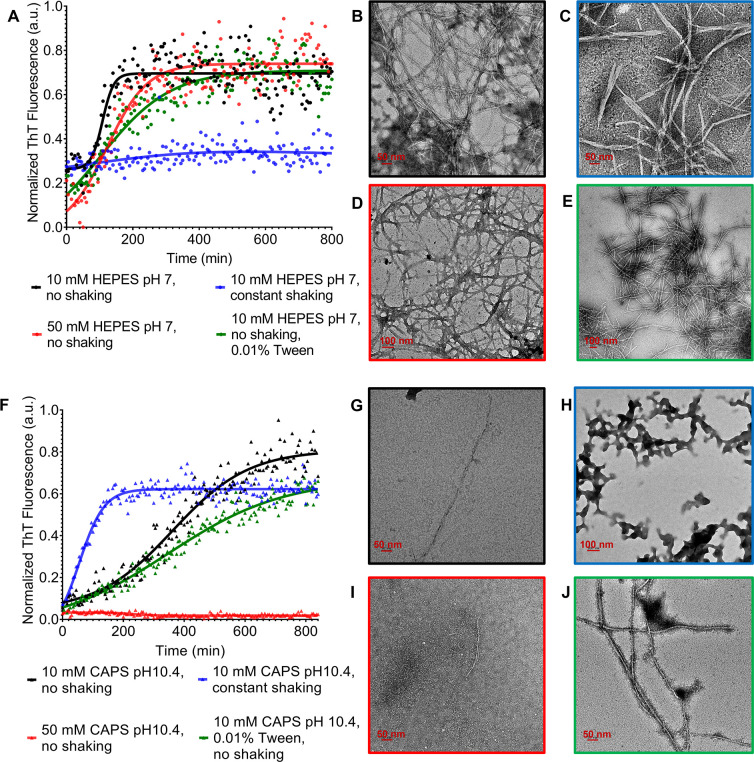
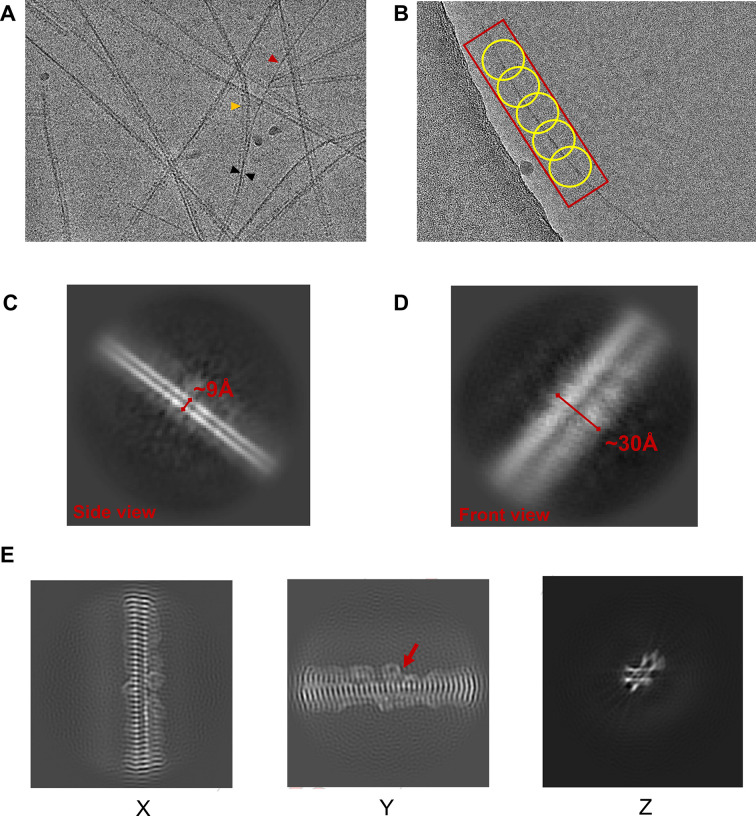
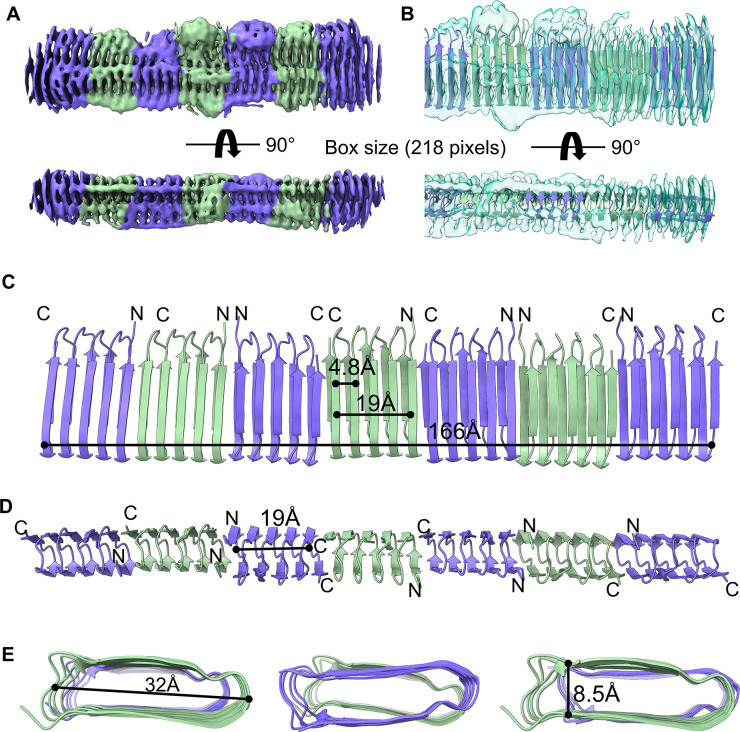
The discovery of functional amyloids in bacteria dates back several decades, and our understanding of the curli biogenesis system has gradually expanded over time. However, due to its high aggregation propensity and intrinsically disordered nature, CsgA, the main structural component of curli fibrils, has eluded comprehensive structural characterization. Recent advancements in cryo-electron microscopy (cryo-EM) offer a promising tool to achieve high-resolution structural insights into CsgA fibrils. In this study, we outline an approach to addressing the colloidal instability challenges associated with CsgA, achieved through engineering and electrostatic repulsion. Then, we present the cryo-EM structure of CsgA fibrils at 3.62 Å resolution. This structure provides new insights into the cross-β structure of CsgA. Additionally, our study identifies two distinct spatial arrangements within several CsgA fibrils, a 2-CsgA-fibril pair and a 3-CsgA-fibril bundle, shedding light on the intricate hierarchy of the biofilm extracellular matrix and laying the foundation for precise manipulation of CsgA-derived biomaterials.IMPORTANCEThe visualization of the architecture of CsgA amyloid fibril has been a longstanding research question, for which a high-resolution structure is still unavailable. CsgA serves as a major subunit of curli, the primary component of the extracellular matrix generated by bacteria. The support provided by this extracellular matrix enables bacterial biofilms to resist antibiotic treatment, significantly impacting human health. CsgA has been identified in members of , with pathogenic being the most well-known model system. Our novel insights into the structure of CsgA protofilaments form the basis for drug design targeting diseases associated with biofilms. Additionally, CsgA is widely researched in biomaterials due to its self-assembly characteristics. The resolved spatial arrangements of CsgA amyloids revealed in our study will further enhance the precision design of functional biomaterials. Therefore, our study uniquely contributes to the understanding of CsgA amyloids for both microbiology and material science.
细菌中功能性淀粉样蛋白的发现可以追溯到几十年前,我们对卷曲生物发生系统的理解也随着时间的推移逐渐扩展。然而,由于其高聚集倾向和固有无序性质,卷曲原纤维的主要结构成分 CsgA 一直难以进行全面的结构表征。最近,低温电子显微镜 (cryo-EM) 的进展为实现对 CsgA 原纤维的高分辨率结构洞察提供了有希望的工具。在这项研究中,我们概述了一种解决与 CsgA 相关的胶体不稳定性挑战的方法,该方法通过工程和静电排斥来实现。然后,我们呈现了 CsgA 原纤维在 3.62Å分辨率下的 cryo-EM 结构。该结构提供了 CsgA 的交叉-β结构的新见解。此外,我们的研究还确定了几个 CsgA 原纤维内的两种不同空间排列,即 2-CsgA-原纤维对和 3-CsgA-原纤维束,揭示了生物膜细胞外基质的复杂层次结构,并为精确操纵 CsgA 衍生的生物材料奠定了基础。
重要性:CsgA 淀粉样纤维结构的可视化一直是一个长期存在的研究问题,目前仍缺乏高分辨率结构。CsgA 是卷曲的主要亚基,卷曲是细菌细胞外基质的主要成分。该细胞外基质的支持使细菌生物膜能够抵抗抗生素治疗,对人类健康产生重大影响。CsgA 已在 属的成员中被发现,其中致病性 是最著名的模型系统。我们对 CsgA 原纤维结构的新见解为针对与生物膜相关疾病的药物设计提供了基础。此外,由于其自组装特性,CsgA 在生物材料中得到了广泛研究。我们的研究中揭示的 CsgA 淀粉样蛋白的空间排列将进一步增强功能生物材料的精确设计。因此,我们的研究为微生物学和材料科学领域的 CsgA 淀粉样蛋白理解做出了独特贡献。