Pfeil Alexander, Lange Uwe
Klinik für Innere Medizin III, Funktionsbereich Rheumatologie und Osteologie, Universitätsklinikum Jena, Am Klinikum 1, 07747, Jena, Deutschland.
Kerckhoff-Klinik GmbH, Abteilung Rheumatologie und Klinische Immunologie, Justus-Liebig-Universität Gießen, Benekestraße 2-8, 61231, Bad Nauheim, Deutschland.
Z Rheumatol. 2024 Jun;83(5):401-406. doi: 10.1007/s00393-024-01495-x. Epub 2024 Mar 21.
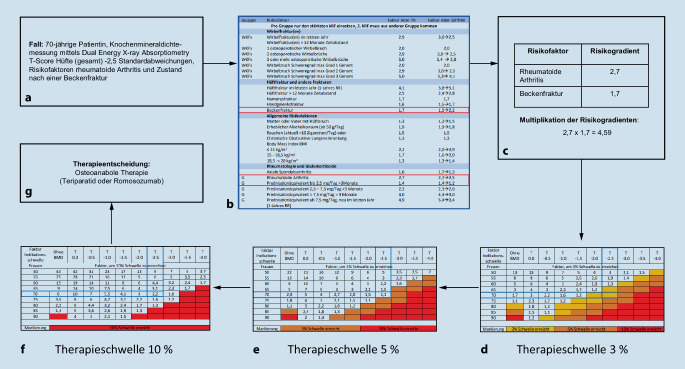
In October 2023, the organization of the German-speaking scientific osteological societies (DVO) published the revised guideline on the "Prophylaxis, diagnosis and treatment of osteoporosis in postmenopausal women and in men aged over 50." This review article reflects the new features of the guideline and their relevance in the care of patients with inflammatory rheumatic diseases.A key innovation is the change from the 10-year fracture risk to the 3‑year fracture risk. Basic diagnostics are currently performed without a defined fracture threshold. Treatment thresholds for specific osteological therapy constitute another key innovation, defined as 3% to < 5%, 5% to < 10%, and from 10% for vertebral body and femoral neck fractures. If the 3‑year fracture risk is > 10%, osteoanabolic therapy should primarily be carried out and antiresorptive therapy is initiated following osteoanabolic therapy. In addition, patients with osteoporosis and prolonged glucocorticoid therapy should primarily be treated osteoanabolically with teriparatide. In summary, the changes to the DVO guideline reflect the latest scientific study findings in osteology and lead to detailed differential therapy for osteoporosis.
2023年10月,德语区科学骨科学会组织(DVO)发布了关于“绝经后女性和50岁以上男性骨质疏松症的预防、诊断和治疗”的修订指南。这篇综述文章反映了该指南的新特点及其在炎症性风湿性疾病患者护理中的相关性。一个关键的创新是从10年骨折风险转变为3年骨折风险。目前基本诊断是在没有明确骨折阈值的情况下进行的。特定骨科学治疗的治疗阈值是另一项关键创新,定义为椎体和股骨颈骨折的3%至<5%、5%至<10%以及10%及以上。如果3年骨折风险>10%,应主要进行骨合成代谢治疗,并在骨合成代谢治疗后启动抗吸收治疗。此外,患有骨质疏松症且长期接受糖皮质激素治疗的患者应主要使用特立帕肽进行骨合成代谢治疗。总之,DVO指南的这些变化反映了骨科学的最新科学研究结果,并导致了针对骨质疏松症的详细差异化治疗。