Yao Yufan, Hu Haoran, Chen Longhao, Zheng Hong
College of Basic Medical Science, Zhejiang Chinese Medical University, Hangzhou, China.
Hangzhou TCM Hospital of Zhejiang Chinese Medical University (Hangzhou Hospital of Traditional Chinese Medicine), Hangzhou, China.
Front Microbiol. 2024 Mar 7;15:1321268. doi: 10.3389/fmicb.2024.1321268. eCollection 2024.
Evidence from observational studies and clinical trials suggests that the gut microbiota is associated with gynecological diseases. However, the causal relationship between gut microbiota and menstrual disorders remains to be determined.
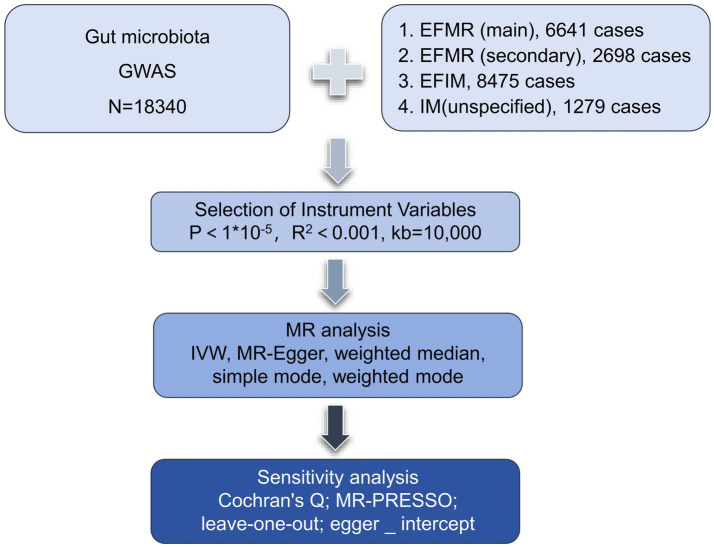
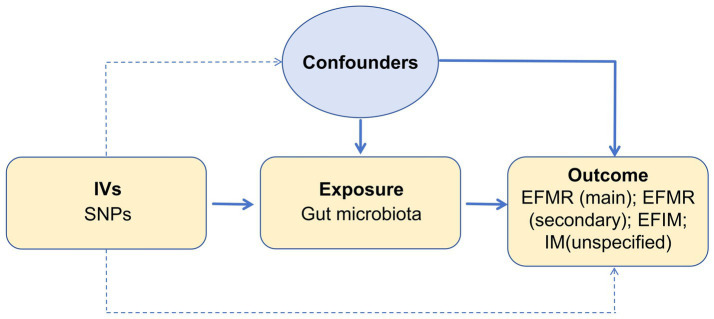
We obtained summary data of gut microbiota from the global consortium MiBio-Gen's genome-wide association study (GWAS) dataset and data on menstrual disorders from the IEU Open GWAS project. MR-Egger, weighted median, inverse variance weighted, simple mode, and weighted mode were used to examine the causal association between gut microbiota and menstrual disorders. Thorough sensitivity studies were performed to confirm the data's horizontal pleiotropy, heterogeneity, and robustness.
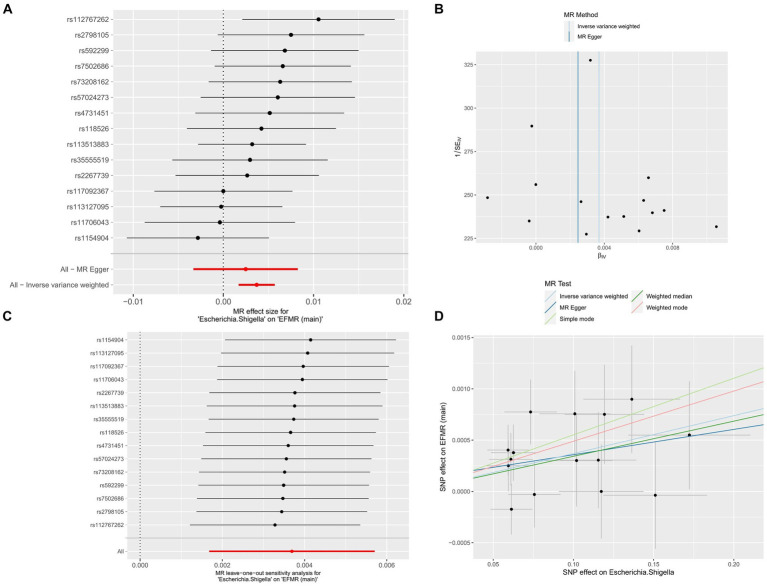
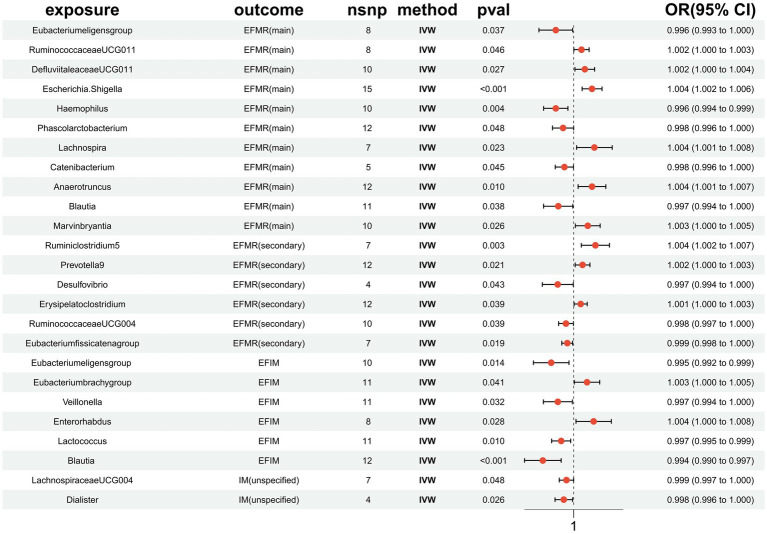
Through MR analysis of 119 kinds of gut microbiota and 4 kinds of clinical phenotypes, it was discovered that 23 different kinds of gut microbiota were loosely connected to menstrual disorders. After FDR correction, the results showed that only Escherichia/Shigella ( = 0.00032, = 0.0382, OR = 1.004, 95%CI = 1.002-1.006) is related to menstrual disorders.
According to our MR Analysis, there are indications of a causal relationship between menstrual disorders and gut microbiota. This finding could lead to new discoveries into the mechanisms behind menstrual disorders and clinical research involving the microbiota.
观察性研究和临床试验的证据表明,肠道微生物群与妇科疾病有关。然而,肠道微生物群与月经紊乱之间的因果关系仍有待确定。
我们从全球联盟MiBio-Gen的全基因组关联研究(GWAS)数据集中获得了肠道微生物群的汇总数据,并从IEU开放GWAS项目中获得了月经紊乱的数据。采用MR-Egger、加权中位数、逆方差加权、简单模式和加权模式来检验肠道微生物群与月经紊乱之间的因果关系。进行了全面的敏感性研究,以确认数据的水平多效性、异质性和稳健性。
通过对119种肠道微生物群和4种临床表型的MR分析,发现23种不同的肠道微生物群与月经紊乱存在松散关联。经FDR校正后,结果显示只有大肠埃希菌/志贺菌属(P = 0.00032,β = 0.0382,OR = 1.004,95%CI = 1.002 - 1.006)与月经紊乱有关。
根据我们的MR分析,有迹象表明月经紊乱与肠道微生物群之间存在因果关系。这一发现可能会为月经紊乱背后的机制以及涉及微生物群的临床研究带来新的发现。