Struttura Semplice Dipartimentale Igiene Alimenti E Nutrizione, Dipartimento Di Igiene E Prevenzione Sanitaria, Azienda Di Tutela Della Salute (ATS) Brescia, Via Duca Degli Abruzzi, 15, 25124, Brescia, Italy.
Department of Biomedical Sciences for Health, University of Milan, Via Pascal, 36, 20133, Milan, Italy.
Aging Clin Exp Res. 2024 Mar 22;36(1):77. doi: 10.1007/s40520-024-02718-6.
Dementia affects 5-8% of the population aged over 65 years (~50 million worldwide). Several factors are associated with increased risk, including diet. The Mediterranean diet (MedDiet) has shown potential protective effects against several chronic diseases.
This systematic review with meta-analysis aim was to assess the association between adherence to the MedDiet and the risk of dementia in the elderly.
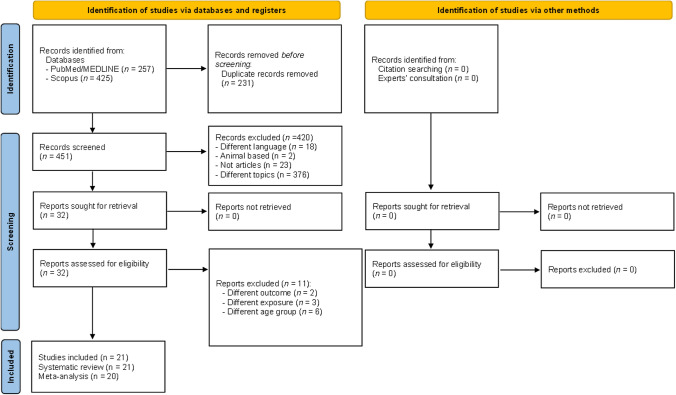
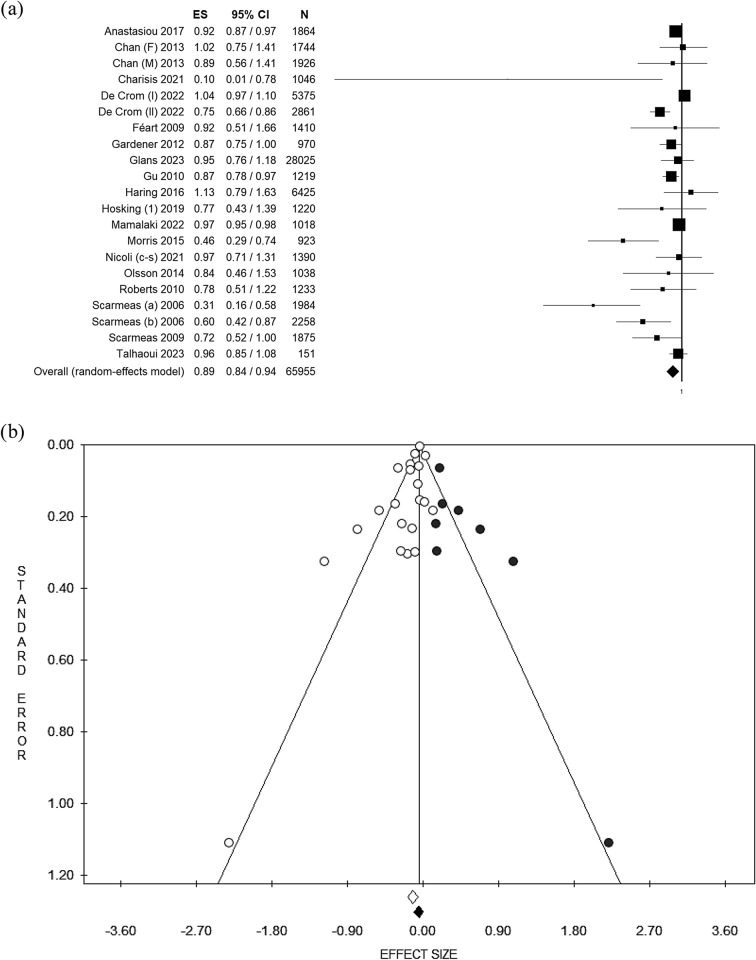
PRISMA-2020 guidelines were followed. PubMed/MEDLINE and Scopus were searched on 17 July 2023. The Newcastle-Ottawa Scale tool was used to assess the risk of bias. The protocol was pre-registered in PROSPERO (registration number: CRD 42023444368). Heterogeneity was assessed using the I test. Publication bias was assessed by visual inspection of the funnel plot and by Egger's regression asymmetry test. The final effect size was reported as OR or HR, depending on the study design of the included studies.
Out of 682 records, 21 were included in the analysis. The pooled OR was 0.89 (95% CI = 0.84-0.94) based on 65,955 participants (I = 69.94). When only cohort studies were included, HR was 0.84 (95% CI = 0.76-0.94) based on 55,205 participants (I = 89.70). When only Alzheimer Disease was considered OR was 0.73 (95% CI = 0.62-0.85) based on 38,292 participants (I = 63.85).
Despite the relatively low risk reduction associated with higher adherence to MedDiet among elderly, it should be considered that this population is the most affected.
Adherence to MedDiet could be an effective non-pharmacological measure to reduce the burden of dementia, even among elderly.
痴呆影响着全球超过 65 岁人群的 5-8%(约 5000 万)。多种因素与风险增加相关,包括饮食。地中海饮食(MedDiet)已显示出对多种慢性疾病的潜在保护作用。
本系统评价和荟萃分析旨在评估老年人遵循地中海饮食与痴呆风险之间的关联。
遵循 PRISMA-2020 指南。于 2023 年 7 月 17 日在 PubMed/MEDLINE 和 Scopus 进行检索。使用纽卡斯尔-渥太华量表工具评估偏倚风险。该方案已在 PROSPERO(注册号:CRD 42023444368)上预先注册。使用 I 检验评估异质性。通过漏斗图和 Egger 回归不对称检验评估发表偏倚。最终的效应大小以 OR 或 HR 报告,具体取决于纳入研究的研究设计。
在 682 条记录中,有 21 条被纳入分析。基于 65955 名参与者,汇总的 OR 为 0.89(95%CI=0.84-0.94)(I=69.94)。当仅纳入队列研究时,基于 55205 名参与者,HR 为 0.84(95%CI=0.76-0.94)(I=89.70)。当仅考虑阿尔茨海默病时,OR 为 0.73(95%CI=0.62-0.85),基于 38292 名参与者(I=63.85)。
尽管老年人遵循地中海饮食与痴呆风险降低相关,但风险降低幅度相对较低,考虑到这一人群的受影响程度最大,仍应将其作为一种有效的非药物干预措施。
遵循地中海饮食可能是降低痴呆负担的有效非药物措施,即使是在老年人中。