Department of Dermatology, Tri-Service General Hospital, National Defense Medical Center, No.325, Sec. 2, Chenggong Rd., Neihu Dist., 114, Taipei, Taiwan.
Graduate Institute of Medical Sciences, National Defense Medical Center, Taipei, Taiwan.
BMC Med Educ. 2024 Mar 22;24(1):326. doi: 10.1186/s12909-024-05311-7.
The abrupt onset of the COVID-19 pandemic compelled universities to swiftly establish online teaching and learning environments that were not only immediately deployable but also conducive to high-quality education. This study aimed to compare the effectiveness of the online synchronous and asynchronous teaching formats in the dermatology lecture for undergraduate medical students, including academic performance, self-efficacy, and cognitive load.
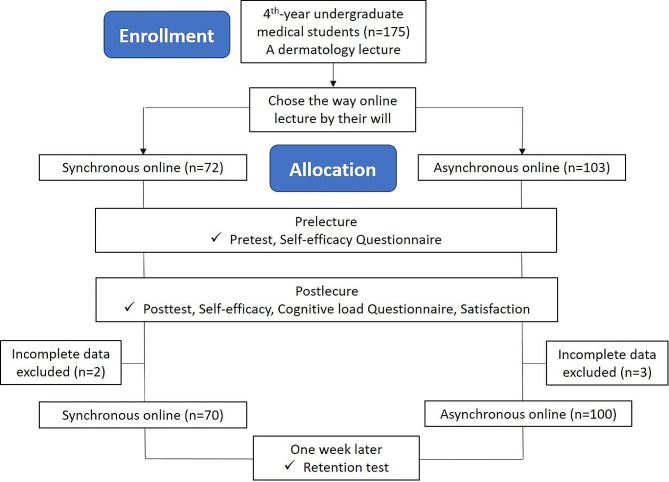
A total of 170 fourth-year undergraduate medical students attending the dermatology lecture were included. The lecture was delivered using both the synchronous method (live online lecture via Webex meeting) and the asynchronous method (lecture videos shared on YouTube). The students had the freedom to choose their preferred method of attending the online lecture. The study assessed three main aspects: (1) learning outcomes measured through pretest, posttest, and retention test scores; (2) cognitive load experienced by students, including mental load and mental effort measured using eight items; and (3) satisfaction levels with each online teaching format.
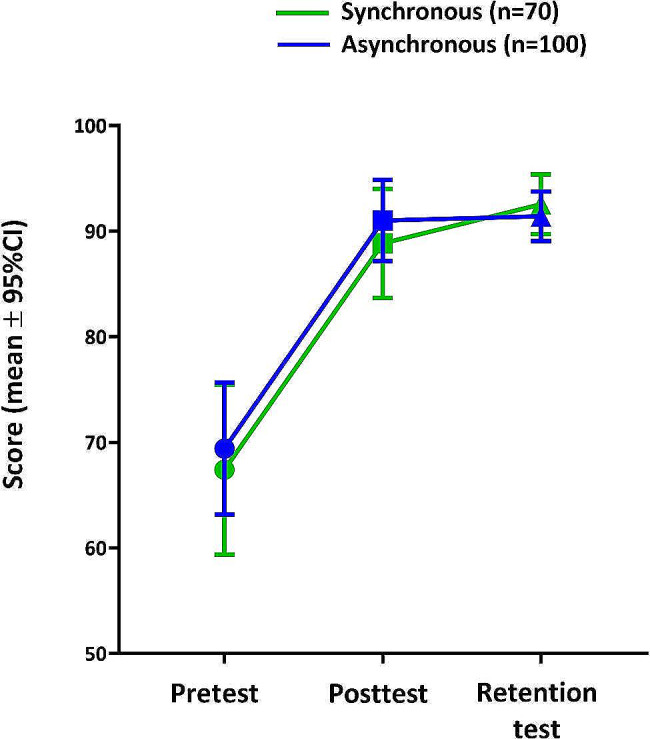
In this study, 70 students opted for the synchronous online lecture, while 100 students chose the asynchronous online lecture. Both synchronous and asynchronous teaching methods exhibited significant improvements in post and retention test scores compared to the pretest. Satisfaction levels, rated on a scale of 0-5, were generally high for both teaching methods, with no significant differences observed (4.6 for synchronous, 4.53 for asynchronous; p =.350). Regarding cognitive load, the synchronous method showed a significantly lower level than the asynchronous method (p =.0001). Subgroup analysis revealed no difference in mental effort (p =.0662), but the level of mental load was lower in the synchronous method (p =.0005).
Both synchronous and asynchronous online teaching methods demonstrated improvements in learning outcomes and high levels of student satisfaction. However, the cognitive load experienced by students was lower in the synchronous setting compared to the asynchronous setting. These findings remind health professions educators that they would consider the students' cognitive load when designing online curricula.
COVID-19 大流行的突然爆发迫使各大学迅速建立不仅可以立即部署,而且有利于高质量教育的在线教学环境。本研究旨在比较本科医学生皮肤病学讲座中在线同步和异步教学模式的效果,包括学业成绩、自我效能感和认知负荷。
共有 170 名四年级本科医学生参加了皮肤病学讲座。讲座采用同步方法(通过 Webex 会议进行在线实时讲座)和异步方法(在 YouTube 上共享讲座视频)进行。学生可以自由选择参加在线讲座的首选方式。该研究评估了三个主要方面:(1)通过前测、后测和保留测试分数衡量的学习成果;(2)学生经历的认知负荷,包括使用八项量表衡量的心理负荷和心理努力;(3)对每种在线教学模式的满意度。
在这项研究中,70 名学生选择了同步在线讲座,而 100 名学生选择了异步在线讲座。与前测相比,同步和异步教学方法在后测和保留测试中的分数均有显著提高。两种教学方法的满意度评分(0-5 分)普遍较高,差异无统计学意义(同步 4.6,异步 4.53;p =.350)。关于认知负荷,同步方法显著低于异步方法(p =.0001)。亚组分析显示心理努力无差异(p =.0662),但同步方法的心理负荷水平较低(p =.0005)。
同步和异步在线教学方法均显示出学习成果的提高和学生满意度的提高。然而,与异步设置相比,学生在同步设置中经历的认知负荷较低。这些发现提醒健康职业教育者,在设计在线课程时,应考虑学生的认知负荷。