Department of Health Sciences, Faculty of Science and Amsterdam Public Health Research Institute, Vrije Universiteit Amsterdam, Amsterdam, The Netherlands.
Department of Healthy Living, Public Health Service (GGD), Sarphati Amsterdam, City of Amsterdam, The Netherlands.
Int J Behav Nutr Phys Act. 2024 Mar 22;21(1):34. doi: 10.1186/s12966-024-01571-0.
Healthy sleep is crucial for the physical and mental wellbeing of adolescents. However, many adolescents suffer from poor sleep health. Little is known about how to effectively improve adolescent sleep health as it is shaped by a complex adaptive system of many interacting factors. This study aims to provide insights into the system dynamics underlying adolescent sleep health and to identify impactful leverage points for sleep health promotion interventions.
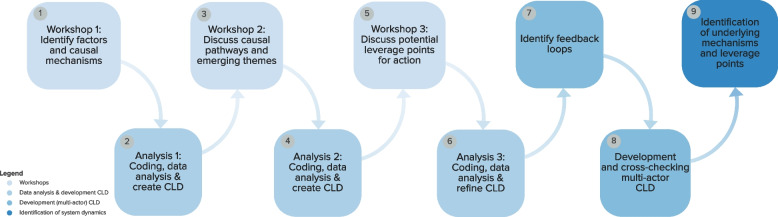
Three rounds of single-actor workshops, applying Group Model Building techniques, were held with adolescents (n = 23, 12-15 years), parents (n = 14) and relevant professionals (n = 26). The workshops resulted in a multi-actor Causal Loop Diagram (CLD) visualizing the system dynamics underlying adolescent sleep health. This CLD was supplemented with evidence from the literature. Subsystems, feedback loops and underlying causal mechanisms were identified to understand overarching system dynamics. Potential leverage points for action were identified applying the Action Scales Model (ASM).
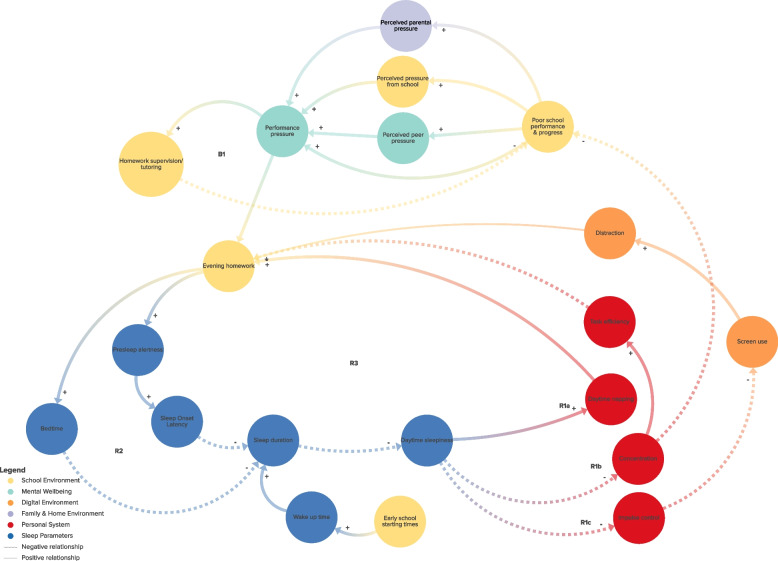
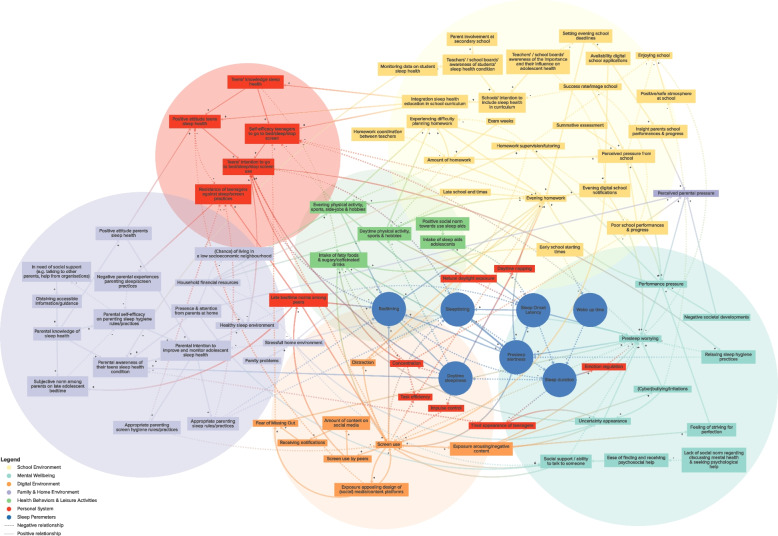
The resulting CLD comprised six subsystems around the following themes: (1) School environment; (2) Mental wellbeing; (3) Digital environment; (4) Family & Home environment; (5) Health behaviors & Leisure activities; (6) Personal system. Within and between these subsystems, 16 reinforcing and 7 balancing feedback loops were identified. Approximately 60 potential leverage points on different levels of the system were identified as well.
The multi-actor CLD and identified system dynamics illustrate the complexity of adolescent sleep health and supports the need for developing a coherent package of activities targeting different leverage points at all system levels to induce system change.
健康的睡眠对青少年的身心健康至关重要。然而,许多青少年都存在睡眠健康问题。由于青少年的睡眠健康受到许多相互作用因素的复杂自适应系统的影响,因此,人们对于如何有效地改善青少年的睡眠健康知之甚少。本研究旨在深入了解青少年睡眠健康的系统动态,并确定促进睡眠健康干预的有效杠杆作用点。
对青少年(n=23,12-15 岁)、家长(n=14)和相关专业人员(n=26)进行了三轮单角色研讨会,应用群体建模技术。研讨会产生了一个多主体因果关系图(CLD),可视化了青少年睡眠健康的系统动态。该 CLD 补充了文献中的证据。确定子系统、反馈回路和潜在的因果机制,以了解整体系统动态。应用行动尺度模型(ASM)确定潜在的行动杠杆作用点。
生成的 CLD 围绕以下主题包含六个子系统:(1)学校环境;(2)心理健康;(3)数字环境;(4)家庭和家庭环境;(5)健康行为和休闲活动;(6)个人系统。在这些子系统内部和之间,确定了 16 个增强反馈回路和 7 个平衡反馈回路。还确定了大约 60 个在系统不同层次上的潜在杠杆作用点。
多主体 CLD 和确定的系统动态说明了青少年睡眠健康的复杂性,并支持需要制定一套连贯的活动方案,针对所有系统层次的不同杠杆作用点,以诱导系统变化。