Laboratory of Medical Genetics, Translational Cytogenomics Research Unit, Bambino Gesù Children Hospital, IRCCS, 00146, Rome, Italy.
Operative Unit of Medical Genetics, Great Metropolitan Hospital of Reggio Calabria, 89100, Reggio Calabria, Italy.
Hum Genomics. 2024 Mar 22;18(1):29. doi: 10.1186/s40246-024-00600-0.
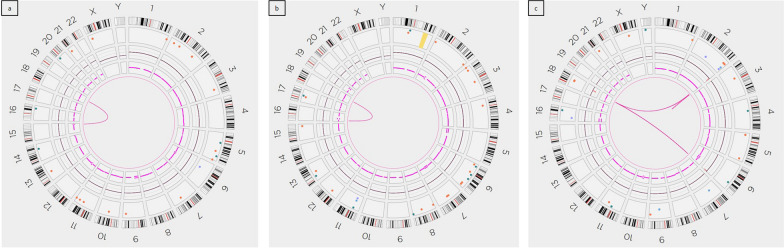
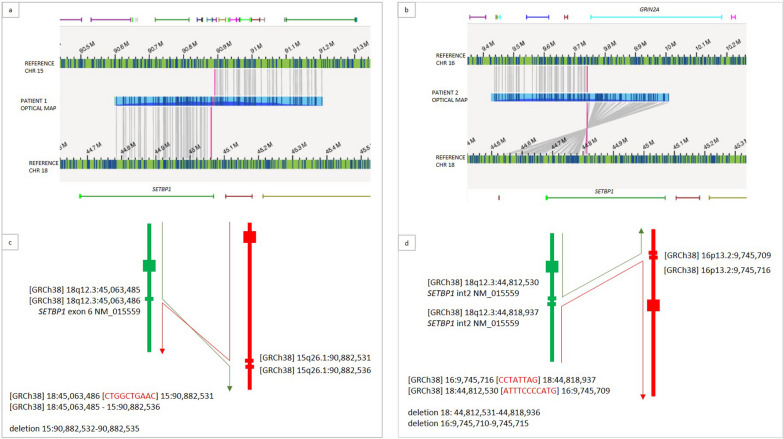
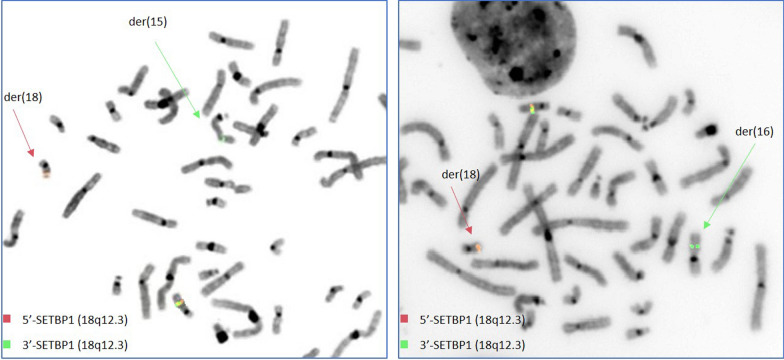
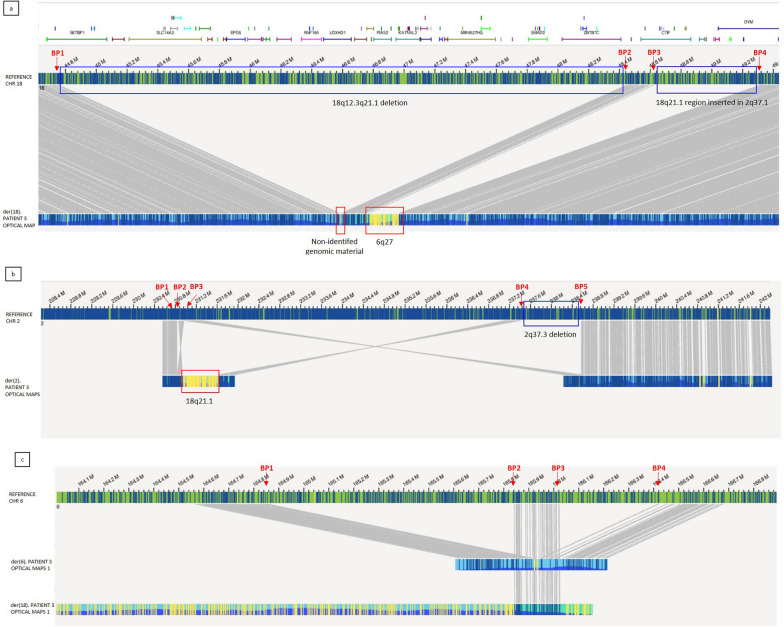
Chromosomal structural rearrangements consist of anomalies in genomic architecture that may or may not be associated with genetic material gain and loss. Evaluating the precise breakpoint is crucial from a diagnostic point of view, highlighting possible gene disruption and addressing to appropriate genotype-phenotype association. Structural rearrangements can either occur randomly within the genome or present with a recurrence, mainly due to peculiar genomic features of the surrounding regions. We report about three non-related individuals, harboring chromosomal structural rearrangements interrupting SETBP1, leading to gene haploinsufficiency. Two out of them resulted negative to Chromosomal Microarray Analysis (CMA), being the rearrangement balanced at a microarray resolution. The third one, presenting with a complex three-chromosome rearrangement, had been previously diagnosed with SETBP1 haploinsufficiency due to a partial gene deletion at one of the chromosomal breakpoints. We thoroughly characterized the rearrangements by means of Optical Genome Mapping (OGM) and Whole Genome Sequencing (WGS), providing details about the involved sequences and the underlying mechanisms. We propose structural variants as a recurrent event in SETBP1 haploinsufficiency, which may be overlooked by laboratory routine genomic analyses (CMA and Whole Exome Sequencing) or only partially determined when associated with genomic losses at breakpoints. We finally introduce a possible role of SETBP1 in a Noonan-like phenotype.
染色体结构重排包括基因组结构的异常,这些异常可能与遗传物质的获得和丢失有关,也可能无关。从诊断的角度来看,评估精确的断点至关重要,这突出了可能的基因中断,并解决了适当的基因型-表型相关性。结构重排可以在基因组内随机发生,也可以重现,主要是由于周围区域的特殊基因组特征。我们报告了三个非相关个体,他们携带的染色体结构重排中断了 SETBP1 基因,导致基因单倍不足。其中两个个体的染色体微阵列分析(CMA)结果为阴性,这是由于微阵列分辨率下的重排是平衡的。第三个个体,表现出复杂的三染色体重排,由于其中一个染色体断点处的部分基因缺失,之前被诊断为 SETBP1 单倍不足。我们通过光学基因组图谱(OGM)和全基因组测序(WGS)彻底描述了这些重排,提供了有关涉及序列和潜在机制的详细信息。我们提出结构变体是 SETBP1 单倍不足的一种复发性事件,这可能被实验室常规基因组分析(CMA 和全外显子组测序)忽略,或者仅在与断点处的基因组缺失部分确定时部分确定。我们最后介绍了 SETBP1 在类似努南综合征表型中的可能作用。