Biomedical Research Division, Korea Institute of Science and Technology (KIST), Seoul, 02792, Republic of Korea.
Department of Life Sciences, Korea University, Seoul, 02841, Republic of Korea.
Adv Sci (Weinh). 2024 Jun;11(22):e2309917. doi: 10.1002/advs.202309917. Epub 2024 Mar 23.
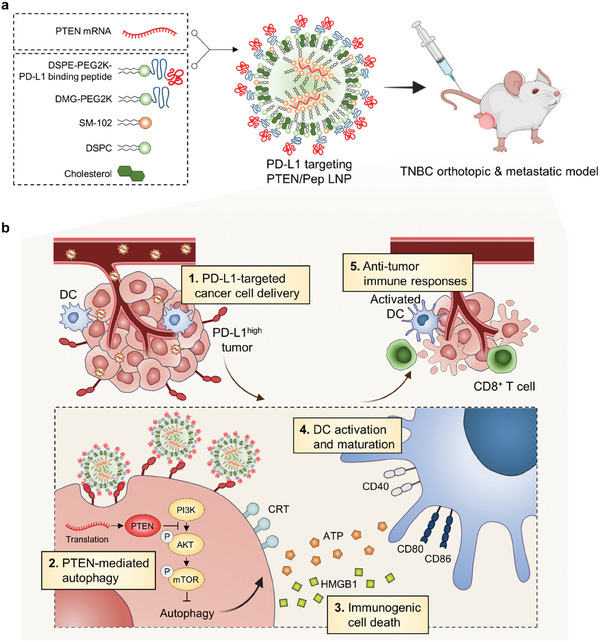
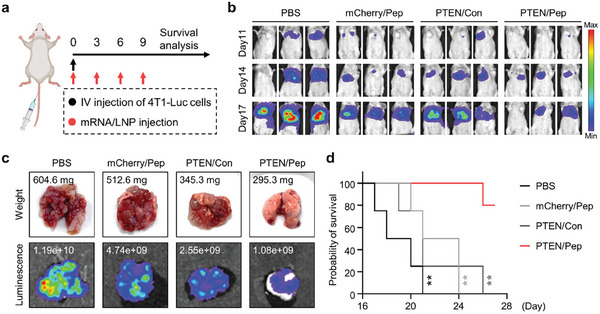
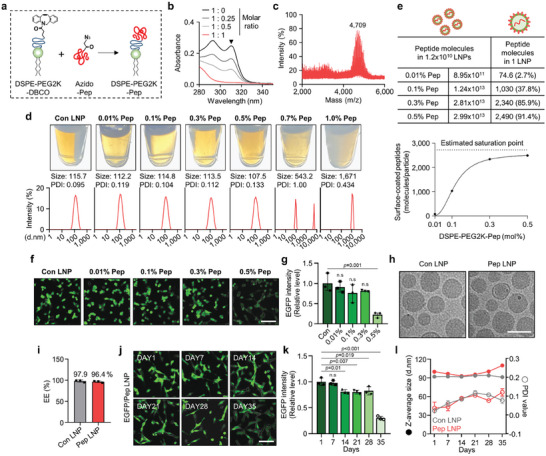
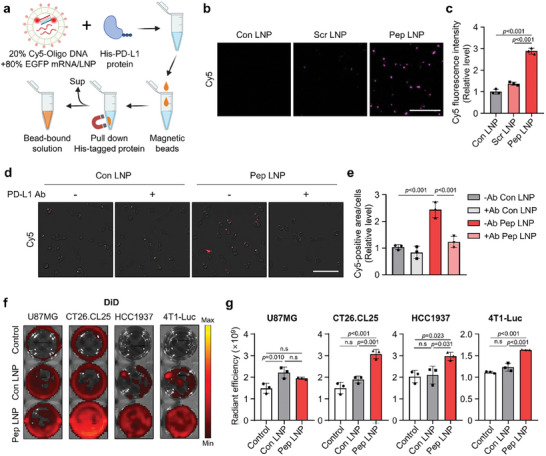
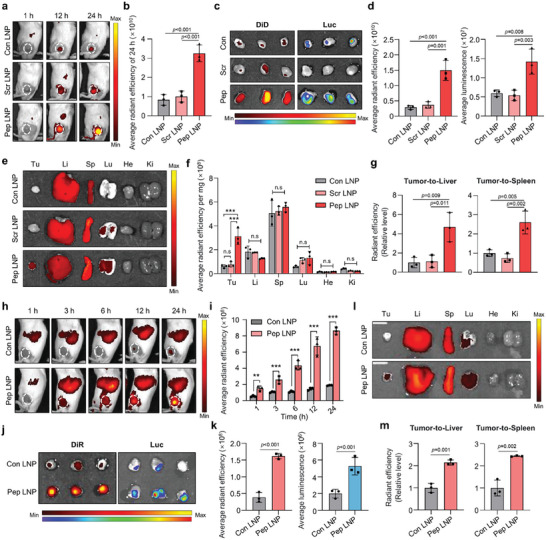
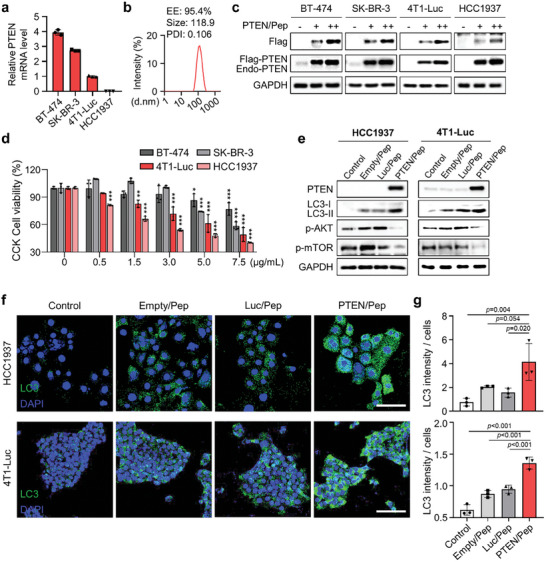
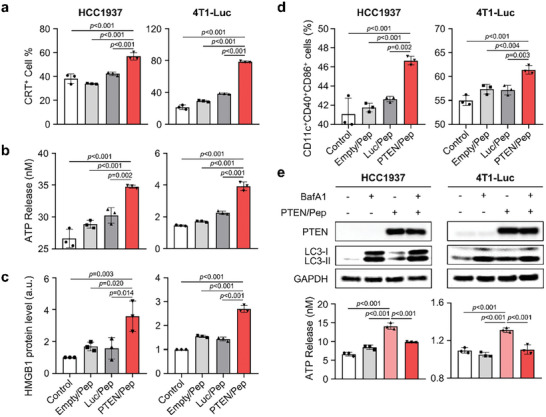
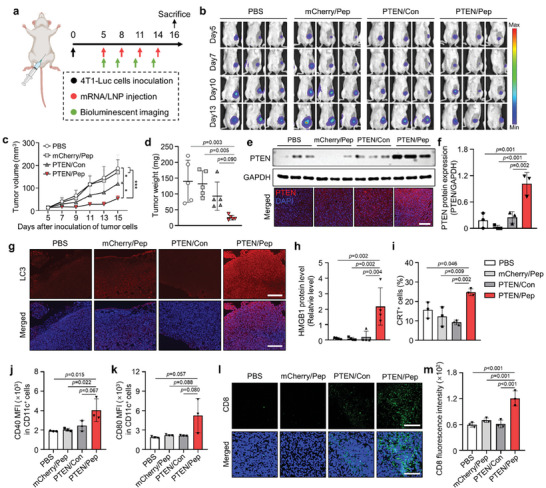
Lipid nanoparticles (LNPs) exhibit remarkable mRNA delivery efficiency, yet their majority accumulate in the liver or spleen after injection. Tissue-specific mRNA delivery can be achieved through modulating LNP properties, such as tuning PEGylation or varying lipid components systematically. In this paper, a streamlined method is used for incorporating tumor-targeting peptides into the LNPs; the programmed death ligand 1 (PD-L1) binding peptides are conjugated to PEGylated lipids via a copper-free click reaction, and directly incorporated into the LNP composition (Pep LNPs). Notably, Pep LNPs display robust interaction with PD-L1 proteins, which leads to the uptake of LNPs into PD-L1 overexpressing cancer cells both in vitro and in vivo. To evaluate anticancer immunotherapy mediated by restoring tumor suppressor, mRNA encoding phosphatase and tensin homolog (PTEN) is delivered via Pep LNPs to PTEN-deficient triple-negative breast cancers (TNBCs). Pep LNPs loaded with PTEN mRNA specifically promotes autophagy-mediated immunogenic cell death in 4T1 tumors, resulting in effective anticancer immune responses. This study highlights the potential of tumor-targeted LNPs for mRNA-based cancer therapy.
脂质纳米颗粒 (LNPs) 表现出显著的 mRNA 递呈效率,但在注射后,它们大多数会在肝脏或脾脏中积累。通过调节 LNP 的特性,如调整聚乙二醇化或系统地改变脂质成分,可以实现组织特异性的 mRNA 递呈。在本文中,使用一种简化的方法将肿瘤靶向肽整合到 LNPs 中;通过无铜点击反应将程序性死亡配体 1 (PD-L1) 结合肽与聚乙二醇化脂质连接,并直接纳入 LNP 组成部分(Pep LNPs)。值得注意的是,Pep LNPs 与 PD-L1 蛋白表现出强烈的相互作用,这导致 LNPs 在体外和体内被 PD-L1 过表达的癌细胞摄取。为了评估通过恢复肿瘤抑制因子介导的抗癌免疫治疗,通过 Pep LNPs 递呈编码磷酸酶和张力蛋白同系物 (PTEN) 的 mRNA 以治疗 PTEN 缺失的三阴性乳腺癌 (TNBC)。负载有 PTEN mRNA 的 Pep LNPs 特异性地促进了 4T1 肿瘤中自噬介导的免疫原性细胞死亡,从而产生有效的抗癌免疫反应。本研究强调了肿瘤靶向 LNPs 在基于 mRNA 的癌症治疗中的潜力。