Sparks Nicholas E, Smith Cameron, Stahl Terrence, Amarasekara Dhanush L, Hamadani Christine, Lambert Ethan, Tang Sheng Wei, Kulkarni Anuja, Derbigny Blaine M, Dasanayake Gaya S, Taylor George, Ghazala Maryam, Hammer Nathan I, Sokolov Alexander Y, Fitzkee Nicholas C, Tanner Eden E L, Watkins Davita L
Department of Chemistry and Biochemistry, The Ohio State University Columbus Ohio 43210 USA
Department of Chemistry and Biochemistry, University of Mississippi University Oxford MS USA.
J Mater Chem C Mater. 2024 Feb 23;12(12):4369-4383. doi: 10.1039/d3tc04747d. eCollection 2024 Mar 21.
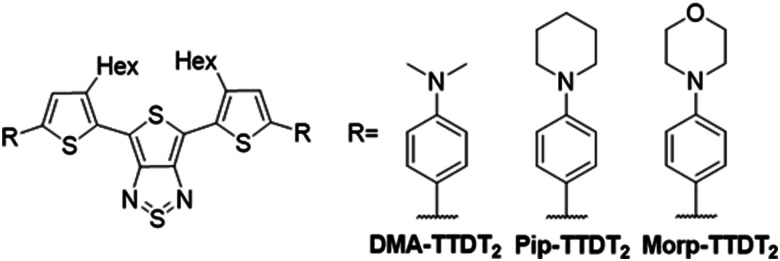
Fluorescence bioimaging with near-infrared II (NIR-II) emissive organic fluorophores has proven to be a viable noninvasive diagnostic technique. However, there is still the need for the development of fluorophores that possess increased stability as well as functionalities that impart stimuli responsiveness. Through strategic design, we can synthesize fluorophores that possess not only NIR-II optical profiles but also pH-sensitivity and the ability to generate heat upon irradiation. In this work, we employ a donor-acceptor-donor (D-A-D) design to synthesize a series of NIR-II fluorophores. Here we use thienothiadiazole (TTD) as the acceptor, 3-hexylthiophene (HexT) as the π-spacer and vary the alkyl amine donor units: ,-dimethylaniline (DMA), phenylpiperidine (Pip), and phenylmorpholine (Morp). Spectroscopic analysis shows that all three derivatives exhibit emission in the NIR-II region with ranging from 1030 to 1075 nm. Upon irradiation, the fluorophores exhibited noticeable heat generation through non-radiative processes. The ability to generate heat indicates that these fluorophores will act as theranostic (combination therapeutic and diagnostic) agents in which simultaneous visualization and treatment can be performed. Additionally, biosensing capabilities were supported by changes in the absorbance properties while under acidic conditions as a result of protonation of the alkyl amine donor units. The fluorophores also show minimal toxicity in a human mammary cell line and with murine red blood cells. Overall, initial results indicate viable NIR-II materials for multiple biomedical applications.
使用近红外二区(NIR-II)发射有机荧光团的荧光生物成像已被证明是一种可行的非侵入性诊断技术。然而,仍然需要开发具有更高稳定性以及赋予刺激响应功能的荧光团。通过策略性设计,我们可以合成不仅具有NIR-II光学特性,还具有pH敏感性和照射时产生热量能力的荧光团。在这项工作中,我们采用供体-受体-供体(D-A-D)设计来合成一系列NIR-II荧光团。在这里,我们使用噻吩并噻二唑(TTD)作为受体,3-己基噻吩(HexT)作为π-间隔基,并改变烷基胺供体单元:N,N-二甲基苯胺(DMA)、苯基哌啶(Pip)和苯基吗啉(Morp)。光谱分析表明,所有三种衍生物在NIR-II区域均有发射,波长范围为1030至1075nm。照射后,荧光团通过非辐射过程表现出明显的发热现象。产生热量的能力表明这些荧光团将作为治疗诊断(治疗与诊断相结合)剂,可同时进行可视化和治疗。此外,由于烷基胺供体单元质子化,在酸性条件下吸光度特性的变化支持了生物传感能力。这些荧光团在人乳腺细胞系和小鼠红细胞中也显示出最小的毒性。总体而言,初步结果表明这些NIR-II材料在多种生物医学应用中具有可行性。