Bochatay Naike, Ju Mindy, O'Brien Bridget C, van Schaik Sandrijn M
From the University of California San Francisco, San Francisco, CA.
Simul Healthc. 2025 Feb 1;20(1):33-41. doi: 10.1097/SIH.0000000000000792. Epub 2024 Mar 25.
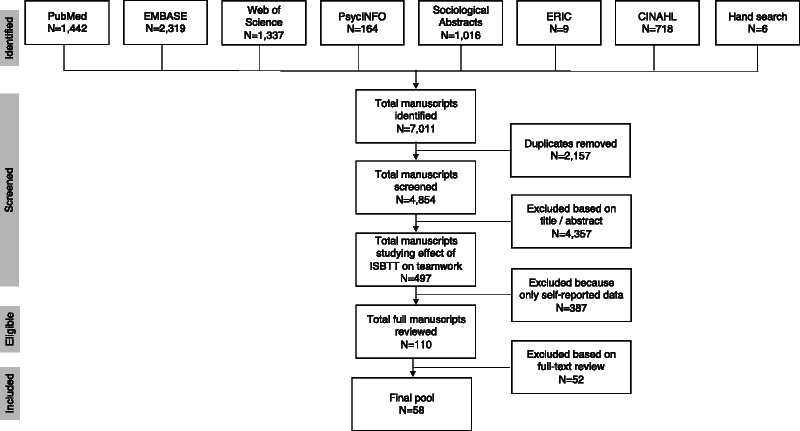
Interprofessional simulation-based team training (ISBTT) is promoted as a strategy to improve collaboration in healthcare, and the literature documents benefits on teamwork and patient safety. Teamwork training in healthcare is traditionally grounded in crisis resource management (CRM), but it is less clear whether ISBTT programs explicitly take the interprofessional context into account, with complex team dynamics related to hierarchy and power. This scoping review examined key aspects of published ISBTT programs including (1) underlying theoretical frameworks, (2) design features that support interprofessional learning, and (3) reported behavioral outcomes. Of 4854 titles identified, 58 articles met inclusion criteria. Most programs were based on CRM and related frameworks and measured CRM outcomes. Only 12 articles framed ISBTT as interprofessional education and none measured all interprofessional competencies. The ISBTT programs may be augmented by integrating theoretical concepts related to power and intergroup relations in their design to empower participants to navigate complex interprofessional dynamics.
跨专业模拟团队培训(ISBTT)被视为一种改善医疗保健领域协作的策略,文献记载了其在团队合作和患者安全方面的益处。传统上,医疗保健领域的团队合作培训以危机资源管理(CRM)为基础,但尚不清楚ISBTT项目是否明确考虑了跨专业背景以及与等级制度和权力相关的复杂团队动态。本范围综述考察了已发表的ISBTT项目的关键方面,包括(1)潜在的理论框架,(2)支持跨专业学习的设计特征,以及(3)报告的行为结果。在识别出的4854个标题中,有58篇文章符合纳入标准。大多数项目基于CRM及相关框架并衡量CRM结果。只有12篇文章将ISBTT界定为跨专业教育,且没有一篇衡量了所有跨专业能力。ISBTT项目可通过在设计中整合与权力和群体间关系相关的理论概念来加以完善,以使参与者能够应对复杂的跨专业动态。