Ludwig Institute for Cancer Research, San Diego Branch, La Jolla, CA 92093-0669, USA.
Department of Cellular and Molecular Medicine, University of California San Diego, La Jolla, CA 92093-0669, USA.
G3 (Bethesda). 2024 Jun 5;14(6). doi: 10.1093/g3journal/jkae064.
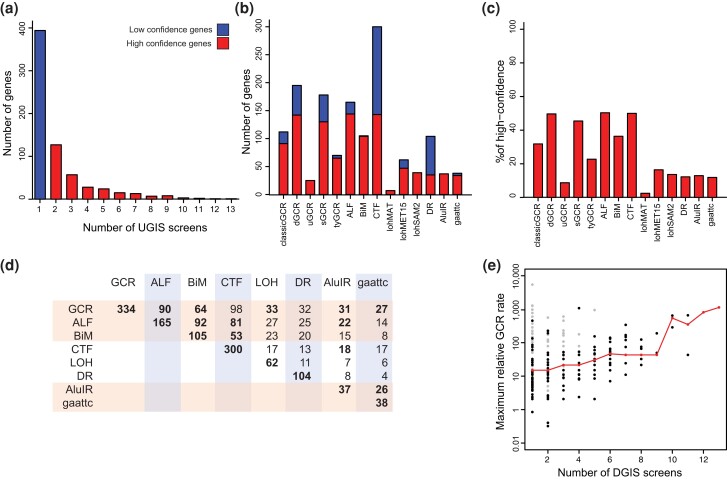
Cellular pathways that detect DNA damage are useful for identifying genes that suppress DNA damage, which can cause genome instability and cancer predisposition syndromes when mutated. We identified 199 high-confidence and 530 low-confidence DNA damage-suppressing (DDS) genes in Saccharomyces cerevisiae through a whole-genome screen for mutations inducing Hug1 expression, a focused screen for mutations inducing Ddc2 foci, and data from previous screens for mutations causing Rad52 foci accumulation and Rnr3 induction. We also identified 286 high-confidence and 394 low-confidence diverse genome instability-suppressing (DGIS) genes through a whole-genome screen for mutations resulting in increased gross chromosomal rearrangements and data from previous screens for mutations causing increased genome instability as assessed in a diversity of genome instability assays. Genes that suppress both pathways (DDS+ DGIS+) prevent or repair DNA replication damage and likely include genes preventing collisions between the replication and transcription machineries. DDS+ DGIS- genes, including many transcription-related genes, likely suppress damage that is normally repaired properly or prevent inappropriate signaling, whereas DDS- DGIS+ genes, like PIF1, do not suppress damage but likely promote its proper, nonmutagenic repair. Thus, induction of DNA damage markers is not a reliable indicator of increased genome instability, and the DDS and DGIS categories define mechanistically distinct groups of genes.
细胞内检测 DNA 损伤的途径有助于识别抑制 DNA 损伤的基因,这些基因在发生突变时会导致基因组不稳定和癌症易感性综合征。我们通过全基因组筛选诱导 Hug1 表达的突变体、针对诱导 Ddc2 焦点的突变体的焦点筛选以及先前筛选导致 Rad52 焦点积累和 Rnr3 诱导的突变体的数据,在酿酒酵母中鉴定了 199 个高可信度和 530 个低可信度的 DNA 损伤抑制 (DDS) 基因。我们还通过全基因组筛选导致大量染色体重排的突变体和先前筛选导致多种基因组不稳定性检测中基因组不稳定性增加的突变体的数据,鉴定了 286 个高可信度和 394 个低可信度的广泛基因组不稳定抑制 (DGIS) 基因。抑制这两种途径的基因(DDS+DGIS+)可预防或修复 DNA 复制损伤,可能包括防止复制和转录机器之间碰撞的基因。DDS+DGIS-基因,包括许多与转录相关的基因,可能抑制正常正确修复的损伤或防止不适当的信号转导,而 DDS-DGIS+基因,如 PIF1,则不抑制损伤,但可能促进其适当的非诱变修复。因此,DNA 损伤标志物的诱导并不是基因组不稳定性增加的可靠指标,而 DDS 和 DGIS 类别定义了机制上不同的基因群。