Department of Parasitology, Harbin Medical University, Harbin, 150081, Heilongjiang, China.
Parasit Vectors. 2024 Mar 25;17(1):155. doi: 10.1186/s13071-024-06219-3.
Cryptosporidiosis and giardiasis are significant parasitic diseases shared between humans and domestic animals. Due to the close contact between humans and domestic animals in rural areas, it is important to consider the potential transmission of zoonotic parasites from infected domestic animals to humans. This investigation aimed to determine the prevalence and molecular characteristics of Cryptosporidium spp. and Giardia duodenalis in domestic animals and villagers.
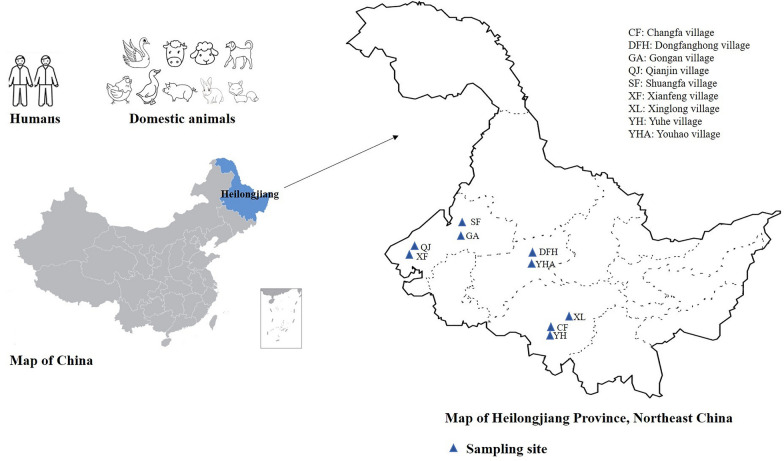
A total of 116 fecal samples from villagers and 686 fecal samples from domestic animals in Heilongjiang Province, China, were analyzed for two parasites using nested polymerase chain reaction (PCR) targeting various genetic loci and DNA sequence analysis of the PCR products.
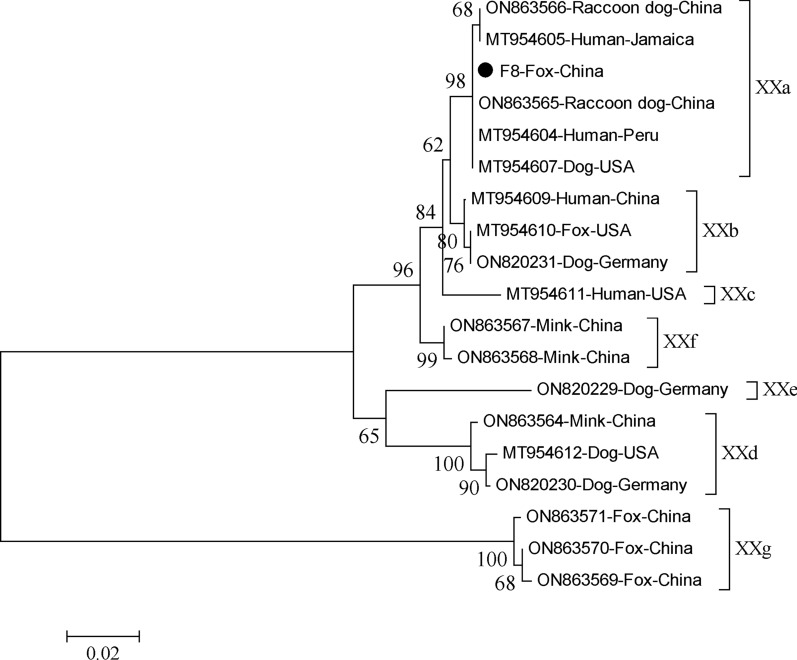
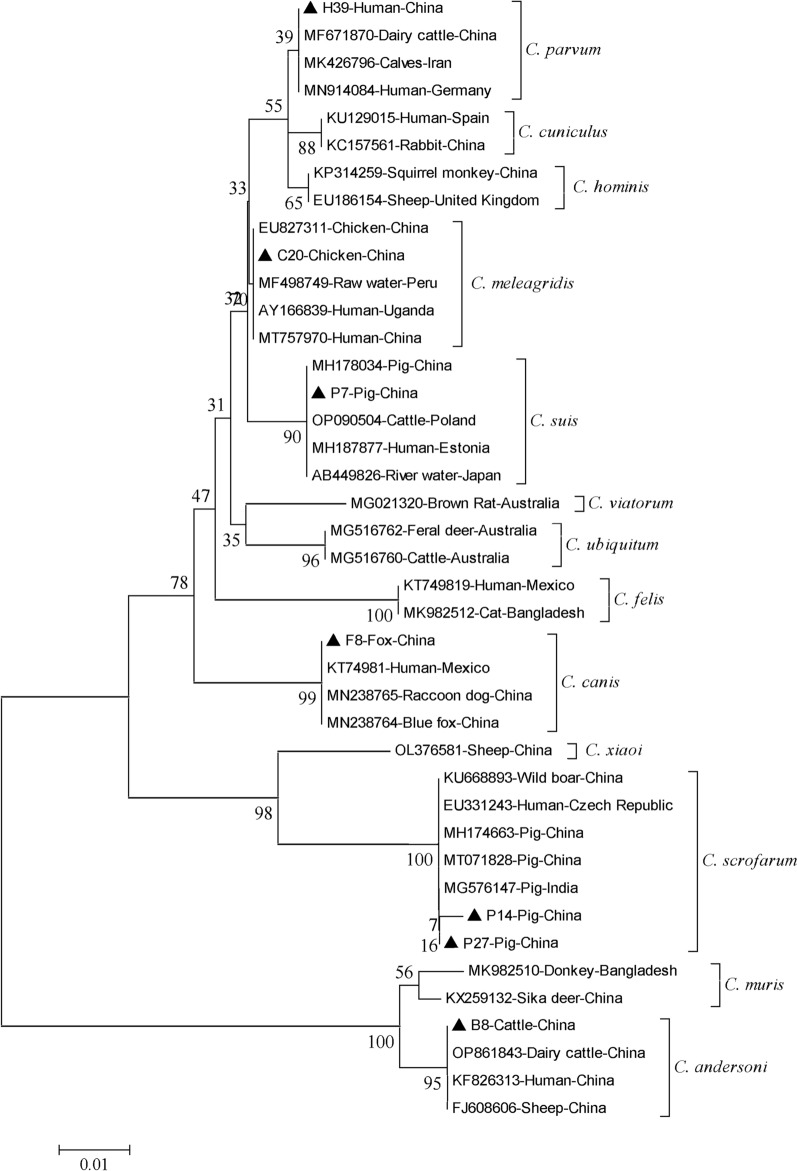
By sequence analysis of the SSU rRNA gene, the prevalence of Cryptosporidium in humans was 0.9% (1/116), with one species of C. parvum (n = 1) detected; among domestic animals, the prevalence was 2.6% (18/686), with five species identified: C. suis (n = 7) and C. scrofarum (n = 7) in pigs, C. meleagridis (n = 1) in chickens, C. andersoni (n = 1) in cattle, and C. canis (n = 2) in foxes. C. parvum and C. canis were further subtyped as IIdA19G1 and XXa4 on the basis of gp60 gene. Regarding G. duodenalis, based on the SSU rRNA, bg, gdh, and tpi genes, the prevalence in domestic animals was 5.1% (31/608), with three assemblages identified: A (n = 1) in pigs, D (n = 1) in foxes, and E (n = 27) in geese, cattle, pigs, ducks, and sheep, along with mixed infection of A + E (n = 1) in one pig and B + E (n = 1) in one sheep. No G. duodenalis was detected in humans (0/116).
The present results show that no overlap of subtypes between animals and villagers was found in Cryptosporidium spp. and G. duodenalis, indicating a minor role of domestic animals in infecting humans in this population. However, the presence of zoonotic protozoa in domestic animals highlights the need for special attention to high-risk individuals during close contact with domestic animals.
隐孢子虫病和贾第虫病是人类和家畜之间共患的重要寄生虫病。由于农村地区人类与家畜密切接触,因此有必要考虑从受感染的家畜向人类传播人畜共患寄生虫的潜在风险。本研究旨在确定黑龙江省家畜和村民中隐孢子虫属和贾第虫属的流行率和分子特征。
使用针对各种遗传基因座的巢式聚合酶链反应(PCR)对中国黑龙江省的 116 份村民粪便样本和 686 份家畜粪便样本进行了两种寄生虫的分析,并对 PCR 产物进行 DNA 序列分析。
通过对 SSU rRNA 基因的序列分析,发现人类隐孢子虫的流行率为 0.9%(1/116),检测到一种 C. parvum(n=1);家畜的流行率为 2.6%(18/686),鉴定出 5 种:猪中 C. suis(n=7)和 C. scrofarum(n=7),鸡中 C. meleagridis(n=1),牛中 C. andersoni(n=1),狐狸中 C. canis(n=2)。根据 gp60 基因,进一步将 C. parvum 和 C. canis 亚分为 IIdA19G1 和 XXa4。关于 G. duodenalis,根据 SSU rRNA、bg、gdh 和 tpi 基因,家畜的流行率为 5.1%(31/608),鉴定出 3 个组合:猪中 A(n=1),狐狸中 D(n=1),鹅、牛、猪、鸭和羊中 E(n=27),以及猪中 1 例 A+E 混合感染和绵羊中 1 例 B+E 混合感染。在人类中未检测到 G. duodenalis(0/116)。
本研究结果表明,隐孢子虫属和贾第虫属在动物和村民中没有发现亚群重叠,这表明在该人群中,家畜在感染人类方面的作用较小。然而,家畜中存在人畜共患原生动物,这突出表明在与家畜密切接触时,需要特别关注高危个体。