Rafiq Manahil, Khan Naimat Ullah, Khan Imad, Ahmad Mansoor, Bibi Aiman, Ben Said Mourad, Belkahia Hanène, Tariq Muhammad, Saeed Silwat, Abdel-Maksoud Mostafa A, El-Tayeb Mohamed A, Fatima Sabiha, Kiani Bushra Hafeez, Alfuraydi Akram A, Badshah Farhad
Department of Zoology, Abdul Wali Khan University, Mardan, Pakistan.
College of Veterinary Sciences and Animal Husbandry, Abdul Wali Khan University, Mardan, Pakistan.
Front Vet Sci. 2024 Dec 19;11:1498682. doi: 10.3389/fvets.2024.1498682. eCollection 2024.
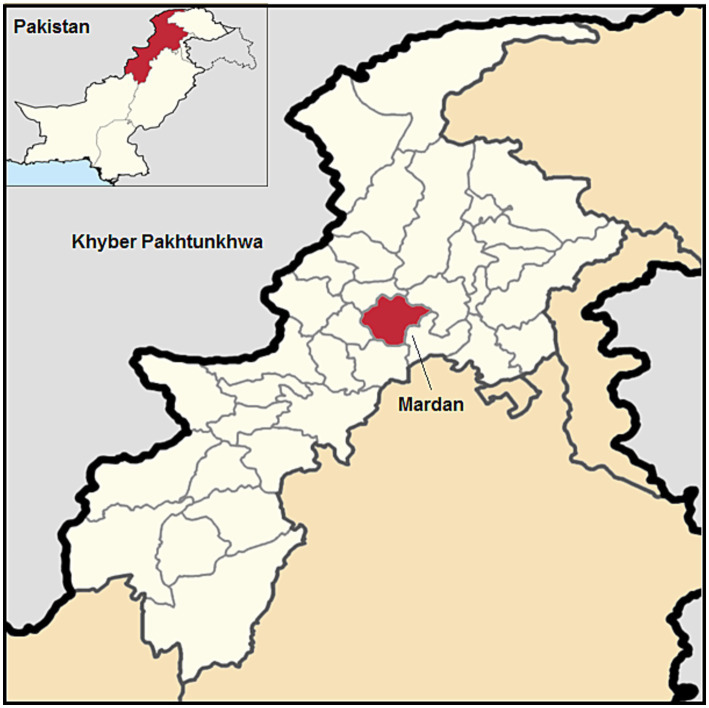
spp. are protozoan parasites that infect the gastrointestinal tract of various animals, including goats, and can also contaminate water sources, posing a significant public health risk. Detecting oocysts in fecal and water samples is critical for understanding the epidemiology of cryptosporidiosis and implementing appropriate control measures. Various staining methods, such as the Modified Ziehl-Neelsen (ZN) and Kenyon's Acid-Fast (KAF) staining techniques, are employed to identify these oocysts. This study compared the effectiveness of these two staining methods in detecting oocysts in goat feces and water samples across different geographic regions in district of Mardan, Khyber Pakhtunkhwa, Pakistan, and other factors such as genders, age groups, diarrheal statuses, and feeding regimes.
A total of 300 fecal and 300 water samples were collected from goats and water sources in four geographic regions: Tehsil Katlang, Tehsil Takhtbhai, Tehsil Mardan, and Tehsil Lundkhwarh. Samples were categorized based on gender, age group (<1 year, 1-2 years, and >2 years), diarrheal status, and feeding regime (stall feeding, grazing). The two staining methods, ZN and KAF staining, were employed to detect oocysts. The detection rates were calculated, and statistical analyses were performed to compare the effectiveness of the two methods across different categories.
The overall detection rates of oocysts for fecal samples were 61.00% (95% CI: 55.22-66.55%) using the ZN method and 63.33% (95% CI: 57.60-68.79%) using KAF method, with no significant difference ( > 0.05). The highest detection rate was observed in Tehsil Katlang (70.66%) with the ZN method and in both Tehsil Katlang and Takhtbhai (66.66%) with the KAF staining method, having no significant difference ( > 0.05). Gender-wise analysis in fecal samples showed similar detection rates for males and females, with no significant differences. Age-wise, the highest detection rates were found in the youngest age group (<1 year) using the ZN method, and in the oldest age group (>2 years) using KAF staining, with no significant differences between age groups. Diarrheal status analysis indicated higher detection rates in diarrheic goats for both methods, with the highest detection rate in the diarrheic group of Tehsil Katlang (84.61%) using the ZN method. Feeding regime analysis showed no significant differences between stall-fed and grazing goats. For water samples, the detection rates of oocysts were significantly different between the two methods. The ZN technique had a significantly higher overall detection rate of 16.00% (95% CI: 12.03-20.64%) compared to 1.00% (95% CI: 0.20-2.89%) for KAF staining ( < 0.001). The performance of the two staining methods for the detection of oocysts in contaminated water samples from different geographic regions was also presented.
Both ZN and KAF staining methods are effective for detecting oocysts in goat feces. However, in water samples, the ZN method showed a significantly higher detection rate compared to KAF staining method, suggesting its suitability for environmental surveillance. These findings highlight the importance of integrating reliable diagnostic techniques with public health interventions to mitigate the zoonotic risks of cryptosporidiosis.
隐孢子虫属是原生动物寄生虫,可感染包括山羊在内的各种动物的胃肠道,还会污染水源,对公众健康构成重大风险。检测粪便和水样中的卵囊对于了解隐孢子虫病的流行病学以及实施适当的控制措施至关重要。采用了各种染色方法,如改良齐尔-尼尔森(ZN)染色法和凯尼恩抗酸(KAF)染色技术来鉴定这些卵囊。本研究比较了这两种染色方法在巴基斯坦开伯尔-普赫图赫瓦省马尔丹地区不同地理区域的山羊粪便和水样中检测隐孢子虫卵囊的有效性,以及其他因素,如性别、年龄组、腹泻状况和饲养方式。
从四个地理区域(卡特朗乡、塔克特拜乡、马尔丹乡和伦德赫瓦尔乡)的山羊和水源中总共采集了300份粪便样本和300份水样。样本根据性别、年龄组(<1岁、1 - 2岁和>2岁)、腹泻状况和饲养方式(圈养、放牧)进行分类。采用ZN和KAF两种染色方法检测卵囊。计算检测率,并进行统计分析以比较两种方法在不同类别中的有效性。
粪便样本中,ZN方法检测隐孢子虫卵囊的总体检出率为61.00%(95%置信区间:55.22 - 66.55%),KAF方法为63.33%(95%置信区间:57.60 - 68.79%),差异无统计学意义(P>0.05)。ZN方法在卡特朗乡的检出率最高(70.66%),KAF染色法在卡特朗乡和塔克特拜乡的检出率最高(均为66.66%),差异无统计学意义(P>0.05)。粪便样本按性别分析显示,雄性和雌性的检测率相似,差异无统计学意义。按年龄分析,ZN方法在最年轻年龄组(<1岁)检出率最高,KAF染色法在最年长年龄组(>2岁)检出率最高,各年龄组之间差异无统计学意义。腹泻状况分析表明,两种方法在腹泻山羊中的检出率均较高,ZN方法在卡特朗乡腹泻组的检出率最高(84.61%)。饲养方式分析显示,圈养山羊和放牧山羊之间差异无统计学意义。对于水样,两种方法检测隐孢子虫卵囊的检出率有显著差异。ZN技术的总体检出率显著高于KAF染色法,分别为16.00%(95%置信区间:12.03 - 20.64%)和1.00%(95%置信区间:0.20 - 2.89%)(P<0.001)。还展示了两种染色方法在不同地理区域受污染水样中检测隐孢子虫卵囊的性能。
ZN和KAF染色方法在检测山羊粪便中的隐孢子虫卵囊方面均有效。然而,在水样中,ZN方法的检出率显著高于KAF染色法,表明其适用于环境监测。这些发现凸显了将可靠的诊断技术与公共卫生干预措施相结合以减轻隐孢子虫病的人畜共患病风险的重要性。