Environmental Health and Ecological Sciences Department, Ifakara Health Institute, Morogoro, Tanzania.
School of Biodiversity, One Health and Veterinary Medicine, University of Glasgow, Glasgow, G12 8QQ, UK.
Malar J. 2024 Mar 26;23(1):86. doi: 10.1186/s12936-024-04915-0.
The degree to which Anopheles mosquitoes prefer biting humans over other vertebrate hosts, i.e. the human blood index (HBI), is a crucial parameter for assessing malaria transmission risk. However, existing techniques for identifying mosquito blood meals are demanding in terms of time and effort, involve costly reagents, and are prone to inaccuracies due to factors such as cross-reactivity with other antigens or partially digested blood meals in the mosquito gut. This study demonstrates the first field application of mid-infrared spectroscopy and machine learning (MIRS-ML), to rapidly assess the blood-feeding histories of malaria vectors, with direct comparison to PCR assays.
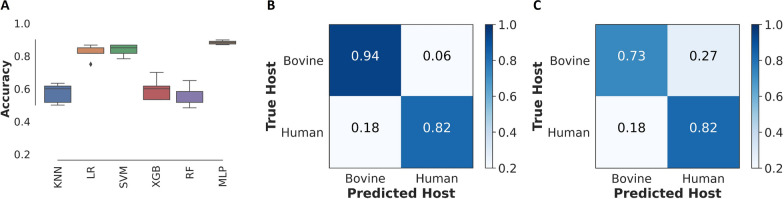
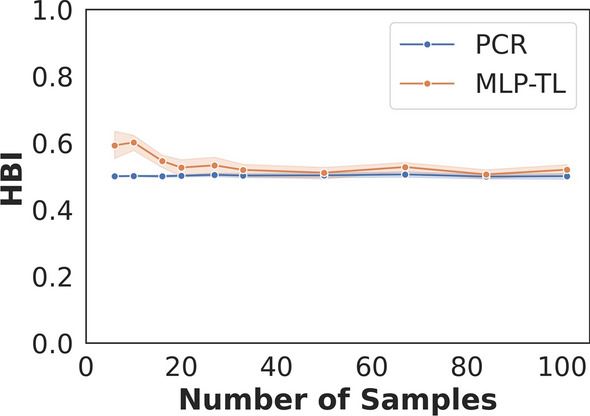
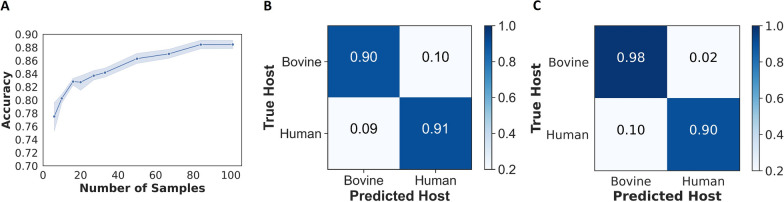
Female Anopheles funestus mosquitoes (N = 1854) were collected from rural Tanzania and desiccated then scanned with an attenuated total reflectance Fourier-transform Infrared (ATR-FTIR) spectrometer. Blood meals were confirmed by PCR, establishing the 'ground truth' for machine learning algorithms. Logistic regression and multi-layer perceptron classifiers were employed to identify blood meal sources, achieving accuracies of 88%-90%, respectively, as well as HBI estimates aligning well with the PCR-based standard HBI.
This research provides evidence of MIRS-ML effectiveness in classifying blood meals in wild Anopheles funestus, as a potential complementary surveillance tool in settings where conventional molecular techniques are impractical. The cost-effectiveness, simplicity, and scalability of MIRS-ML, along with its generalizability, outweigh minor gaps in HBI estimation. Since this approach has already been demonstrated for measuring other entomological and parasitological indicators of malaria, the validation in this study broadens its range of use cases, positioning it as an integrated system for estimating pathogen transmission risk and evaluating the impact of interventions.
按蚊对人类的吸血偏好程度,即人类血液指数(HBI),是评估疟疾传播风险的关键参数。然而,现有的鉴定蚊虫血餐的技术在时间和精力上要求较高,涉及昂贵的试剂,并且由于与其他抗原的交叉反应或在蚊虫肠道中部分消化的血餐等因素,容易出现不准确的情况。本研究首次将中红外光谱和机器学习(MIRS-ML)应用于快速评估疟疾媒介的吸血史,并与 PCR 检测进行直接比较。
从坦桑尼亚农村采集了 1854 只雌性疟蚊(Anopheles funestus)并使其干燥,然后用衰减全反射傅里叶变换红外(ATR-FTIR)光谱仪进行扫描。通过 PCR 确认血餐,为机器学习算法建立“真实数据”。采用逻辑回归和多层感知器分类器来识别血餐来源,准确率分别达到 88%-90%,同时 HBI 估计与基于 PCR 的标准 HBI 吻合较好。
本研究为 MIRS-ML 在分类野生疟蚊的血餐方面的有效性提供了证据,作为在常规分子技术不切实际的情况下的潜在补充监测工具。MIRS-ML 的成本效益、简单性和可扩展性,以及其通用性,弥补了 HBI 估计中的微小差距。由于这种方法已经被证明可以用于测量其他蚊虫和寄生虫学的疟疾指标,本研究的验证拓宽了其使用案例的范围,将其定位为一个用于估计病原体传播风险和评估干预措施影响的综合系统。