Department of Nephrology, Hunan Key Laboratory of Kidney Disease and Blood Purification, Institute of Nephrology, The Second Xiangya Hospital at Central South University, Changsha, China.
Department of Orthopaedics, The Second Xiangya Hospital of Central South University, Changsha, Hunan, China.
Front Immunol. 2024 Mar 8;15:1332757. doi: 10.3389/fimmu.2024.1332757. eCollection 2024.
Emerging evidence has provided compelling evidence linking gut microbiota (GM) and diabetic nephropathy (DN) via the "gut-kidney" axis. But the causal relationship between them hasn't been clarified yet. We perform a Two-Sample Mendelian randomization (MR) analysis to reveal the causal connection with GM and the development of DN, type 1 diabetes nephropathy (T1DN), type 2 diabetes nephropathy (T2DN), type 1 diabetes mellitus (T1DM), and type 2 diabetes mellitus (T2DM).
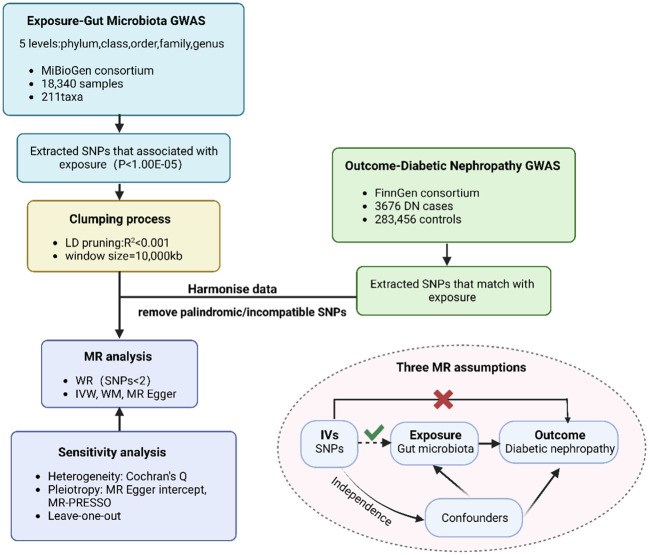
We used summary data from MiBioGen on 211 GM taxa in 18340 participants. Generalized MR analysis methods were conducted to estimate their causality on risk of DN, T1DN, T2DN, T1DM and T2DM from FinnGen. To ensure the reliability of the findings, a comprehensive set of sensitivity analyses were conducted to confirm the resilience and consistency of the results.
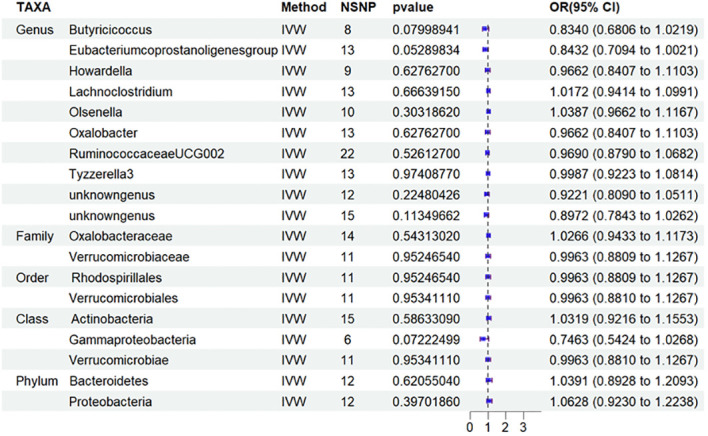
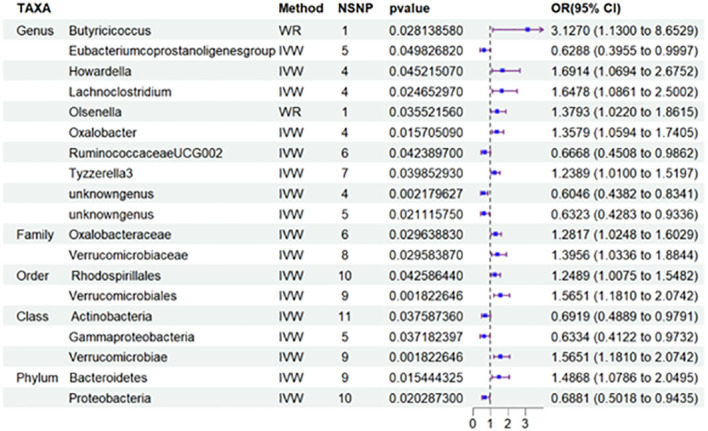
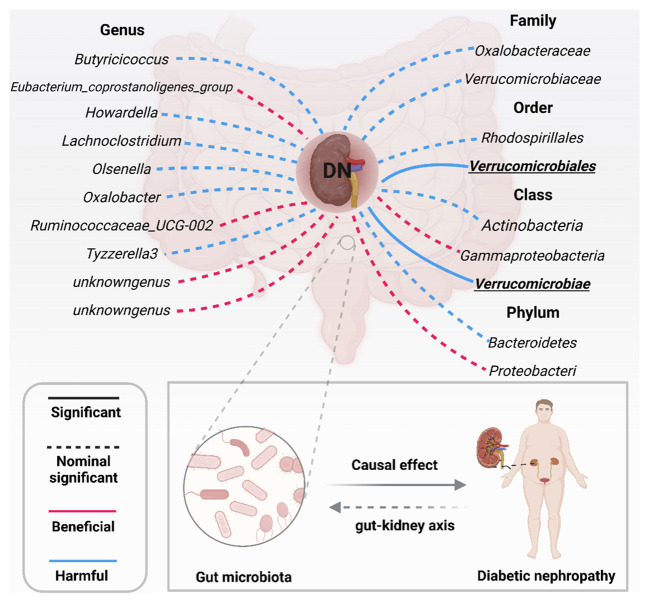
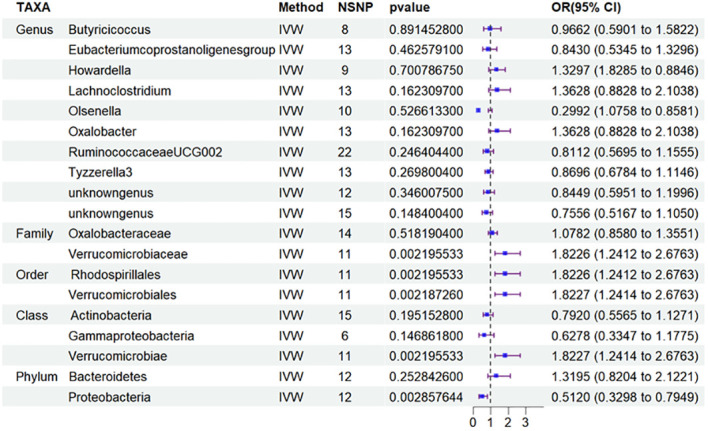
It was showed that Class [odds ratio (OR) =1.5651, 95%CI:1.1810-2.0742,FDR=0.0018], Order (OR=1.5651, 95%CI: 1.1810-2.0742, FDR=0.0018) and Family (OR=1.3956, 95%CI:1.0336-1.8844, FDR=0.0296) had significant risk of DN. Our analysis found significant associations between GM and T2DN, including Class (OR=1.8227, 95% CI: 1.2414-2.6763, PFDR=0.0139), Order (OR=1.5651, 95% CI: 1.8227-2.6764, PFDR=0.0024), (OR=1.8226, 95% CI: 1.2412-2.6763, PFDR=0.0026), and Family (OR=1.8226, 95% CI: 1.2412-2.6763, PFDR=0.0083). The (OR=0.4076, 95% CI: 0.2415-0.6882, PFDR=0.0021) exhibited a protection against T1DN. Sensitivity analyses confirmed that there was no significant heterogeneity and pleiotropy.
At the gene prediction level, we identified the specific GM that is causally linked to DN in both T1DM and T2DM patients. Moreover, we identified distinct microbial changes in T1DN that differed from those seen in T2DN, offering valuable insights into GM signatures associated with subtype of nephropathy.
越来越多的证据表明,通过“肠-肾”轴,肠道微生物群(GM)与糖尿病肾病(DN)之间存在关联。但它们之间的因果关系尚未阐明。我们进行了双样本孟德尔随机化(MR)分析,以揭示 GM 与 DN、1 型糖尿病肾病(T1DN)、2 型糖尿病肾病(T2DN)、1 型糖尿病(T1DM)和 2 型糖尿病(T2DM)发展之间的因果关系。
我们使用了来自 MiBioGen 的 18340 名参与者的 211 种 GM 分类群的汇总数据。使用广义 MR 分析方法,从 FinnGen 中估计 GM 对 DN、T1DN、T2DN、T1DM 和 T2DM 风险的因果关系。为了确保研究结果的可靠性,进行了一系列全面的敏感性分析,以确认结果的稳健性和一致性。
结果表明,类(OR=1.5651,95%CI:1.1810-2.0742,FDR=0.0018)、目(OR=1.5651,95%CI:1.1810-2.0742,FDR=0.0018)和科(OR=1.3956,95%CI:1.0336-1.8844,FDR=0.0296)与 DN 有显著的风险关联。我们的分析发现 GM 与 T2DN 之间存在显著关联,包括类(OR=1.8227,95%CI:1.2414-2.6763,PFDR=0.0139)、目(OR=1.5651,95%CI:1.8227-2.6764,PFDR=0.0024)、科(OR=1.8226,95%CI:1.2412-2.6763,PFDR=0.0026)和科(OR=1.8226,95%CI:1.2412-2.6763,PFDR=0.0083)与 T2DN 有显著关联。属(OR=0.4076,95%CI:0.2415-0.6882,PFDR=0.0021)与 T1DN 呈保护关系。敏感性分析证实,不存在显著的异质性和多效性。
在基因预测水平上,我们确定了与 T1DM 和 T2DM 患者 DN 有因果关系的特定 GM。此外,我们在 T1DN 中发现了与 T2DN 不同的微生物变化,为与肾病亚型相关的 GM 特征提供了有价值的见解。