Hertig-Godeschalk Anneke, Perret Claudio
Institute of Sports Medicine, Swiss Paraplegic Centre, 6207 Nottwil, Switzerland.
Swiss Paraplegic Research, 6207 Nottwil, Switzerland.
Sports (Basel). 2024 Mar 14;12(3):81. doi: 10.3390/sports12030081.
Sweat and thermal responses in individuals with spinal cord injury (SCI) are impaired depending on lesion characteristics. This is particularly problematic for athletes and may ultimately lead to reduced performance. This exploratory study investigated the feasibility of field-usable methods to objectively collect data relevant to sweat response in elite athletes with SCI. Differences in sweat response were also evaluated for different athlete characteristics.
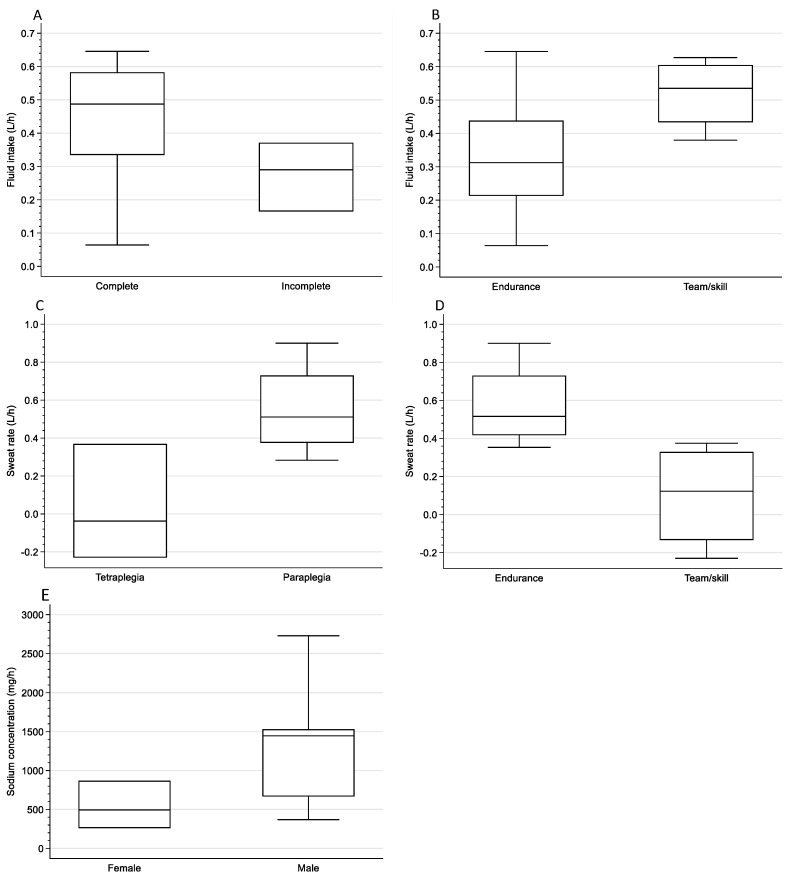
Measurements were performed during exercise and included core temperature (Tc), heart rate, urine specific gravity, fluid intake, sweat rate, and sweat electrolyte concentration. Differences for sex, lesion level (tetraplegia versus paraplegia), motor impairment (complete versus incomplete), and sport type (endurance versus team/skill) were evaluated.
Fifteen athletes (median (Q1-Q3) age, 30 (28-36) years; three females; 11 with complete lesions) were included. Endurance athletes were measured during indoor performance tests (n = 10), whereas team/skill athletes were measured during training sessions (n = 5). In the mixed exercise intensities, the average Tc was 37.7 (37.3-37.8) °C and the average heart rate was 126 (100-146) bpm. Dehydration, defined as a urine specific gravity > 1.020 ng/mL, was prevalent in six athletes before exercise and in five athletes after exercise. The sweat rate was lower in athletes with tetraplegia ( = 0.02) and in team/skill athletes ( = 0.008).
Collecting sweat and thermal response data from athletes with SCI in the field is feasible. Given the suboptimal hydration status of many athletes, raising awareness of the importance of hydration seems valuable.
脊髓损伤(SCI)患者的出汗和热反应会因损伤特征而受损。这对运动员来说尤其成问题,最终可能导致运动表现下降。这项探索性研究调查了在野外使用的方法客观收集与精英SCI运动员出汗反应相关数据的可行性。还评估了不同运动员特征的出汗反应差异。
在运动期间进行测量,包括核心体温(Tc)、心率、尿比重、液体摄入量、出汗率和汗液电解质浓度。评估了性别、损伤水平(四肢瘫与截瘫)、运动障碍(完全性与不完全性)和运动类型(耐力型与团队/技能型)的差异。
纳入了15名运动员(年龄中位数(Q1-Q3)为30(28-36)岁;3名女性;11名有完全性损伤)。耐力型运动员在室内性能测试期间进行测量(n = 10),而团队/技能型运动员在训练期间进行测量(n = 5)。在混合运动强度下,平均Tc为37.7(37.3-37.8)°C,平均心率为126(100-146)次/分钟。定义为尿比重>1.020 ng/mL的脱水在6名运动员运动前和5名运动员运动后普遍存在。四肢瘫运动员(= 0.02)和团队/技能型运动员(= 0.008)的出汗率较低。
在野外从SCI运动员收集出汗和热反应数据是可行的。鉴于许多运动员的水合状态不理想,提高对水合重要性的认识似乎很有价值。