Center for Applied Social Research, University of Oklahoma, Norman, Oklahoma, United States of America.
Department of Anthropology, University of Oklahoma, Norman, Oklahoma, United States of America.
PLoS One. 2024 Mar 27;19(3):e0300872. doi: 10.1371/journal.pone.0300872. eCollection 2024.
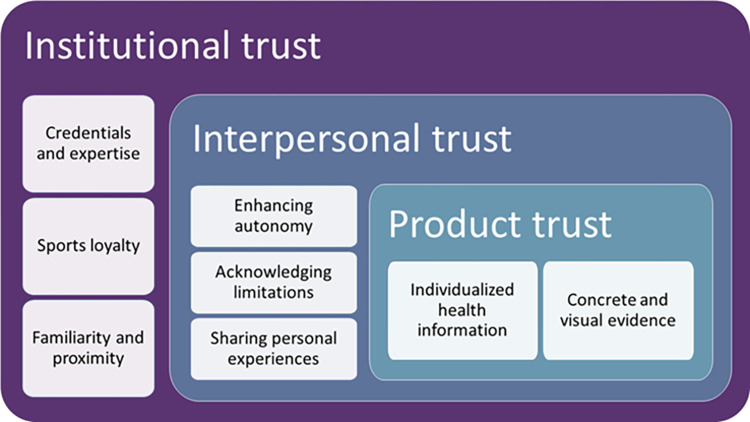
Prior research identifies trust as critical to increase vaccine acceptance and uptake. However, few intervention studies have sought to develop or test strategies for bolstering vaccine-related trust. To address this gap, this exploratory study identifies features of COVID-19 vaccine hesitancy interventions that can promote or undermine trust across three interconnected domains: institutional, interpersonal, and product (the vaccine itself). We draw on focus groups (N = 27 participants) with community and university partners involved with hosting COVID-19 testing and vaccine events in underserved Oklahoma communities. Focus groups explored participants' experiences serving community health needs and elicited feedback on proposed vaccine hesitancy interventions. Proposed interventions included two technology-based strategies (text message reminders and tablet-based testimonials and education) and one dialogue-based strategy (anti-body test interpretation). We find that community partners perceived local universities as trustworthy institutions because of their association with popular sports programs, academic credentials, and proximity, creating opportunities to address vaccine-related distrust through community-university partnerships. The most promising intervention strategies for building interpersonal trust included engaging in one-on-one dialogue and using autonomy enhancing approaches. Finally, interventions that successfully encouraged vaccine trust did so by incorporating personalized health information about individuals' potential level of protection and susceptibility to the COVID-19 virus. These findings can inform future public health efforts to create trustworthy vaccine hesitancy interventions.
先前的研究表明,信任对于提高疫苗接种率至关重要。然而,很少有干预研究试图开发或测试增强与疫苗相关的信任的策略。为了解决这一差距,本探索性研究确定了 COVID-19 疫苗犹豫干预措施的特征,这些特征可以在三个相互关联的领域(机构、人际和产品(疫苗本身))促进或破坏信任。我们借鉴了与在俄克拉荷马州服务不足的社区举办 COVID-19 检测和疫苗活动有关的社区和大学合作伙伴的焦点小组(N=27 名参与者)。焦点小组探讨了参与者服务社区健康需求的经验,并就拟议的疫苗犹豫干预措施征求了反馈意见。拟议的干预措施包括两种基于技术的策略(短信提醒和基于平板电脑的证言和教育)和一种基于对话的策略(抗体测试解释)。我们发现,社区合作伙伴认为当地大学是值得信赖的机构,因为它们与受欢迎的体育项目、学术证书和地理位置有关,这为通过社区-大学伙伴关系解决与疫苗相关的不信任问题创造了机会。建立人际信任最有前途的干预策略包括进行一对一的对话和使用增强自主性的方法。最后,通过纳入个人潜在保护水平和对 COVID-19 病毒易感性的个性化健康信息,成功增强疫苗信任的干预措施也这样做了。这些发现可以为未来的公共卫生努力提供信息,以创建值得信赖的疫苗犹豫干预措施。