Department of Hematology, Erasmus Medical Center Cancer Institute, Erasmus University Medical Center, Rotterdam, the Netherlands.
Department of Biostatistics, Erasmus MC, Rotterdam, the Netherlands.
Blood Cancer J. 2024 Mar 27;14(1):56. doi: 10.1038/s41408-024-01037-3.
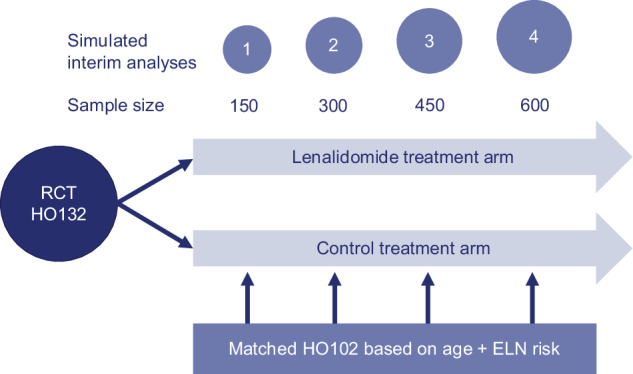
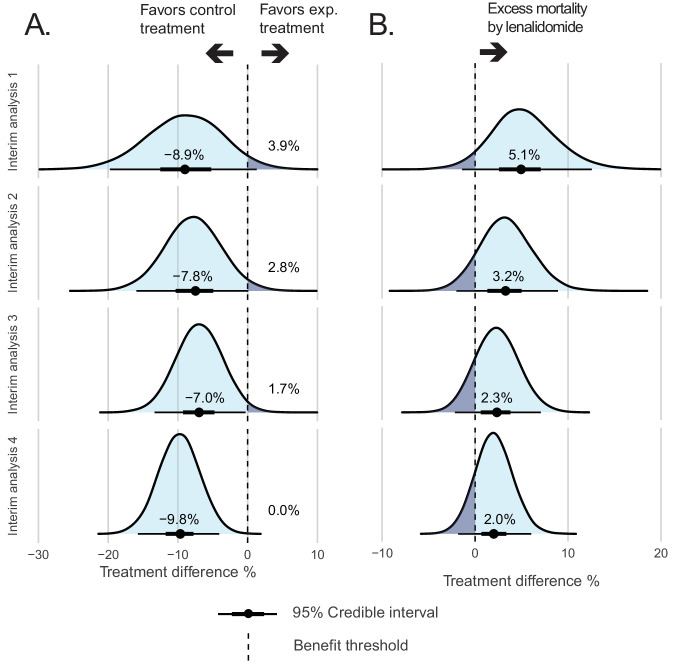
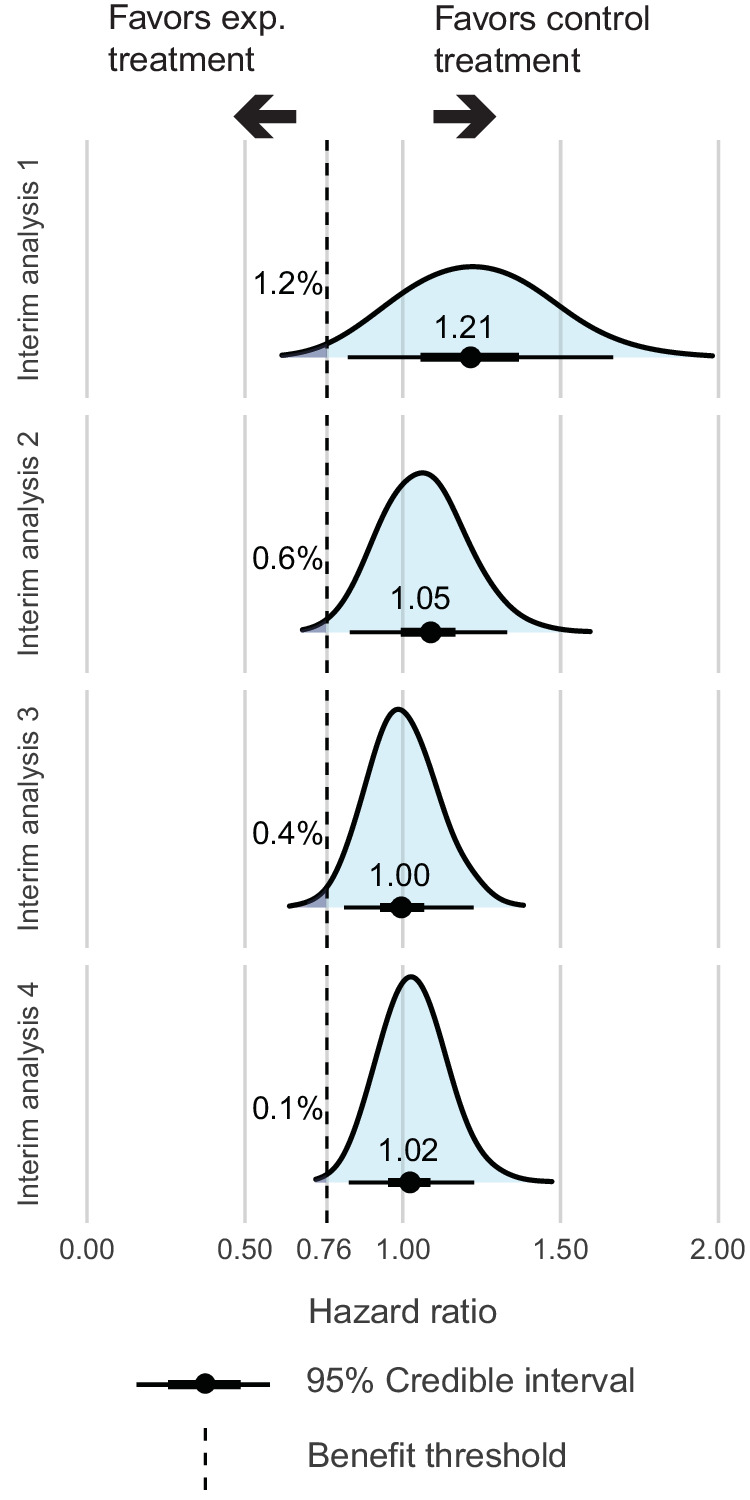
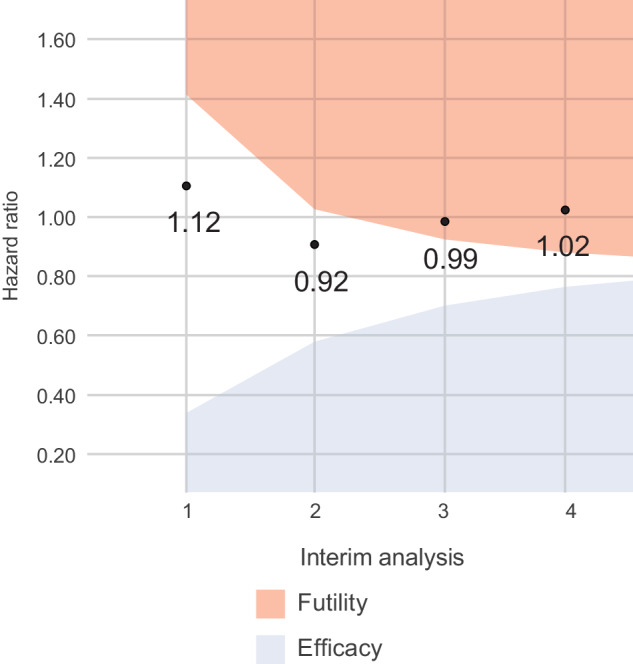
Randomized controlled trials (RCTs) are the gold standard to establish the benefit-risk ratio of novel drugs. However, the evaluation of mature results often takes many years. We hypothesized that the addition of Bayesian inference methods at interim analysis time points might accelerate and enforce the knowledge that such trials may generate. In order to test that hypothesis, we retrospectively applied a Bayesian approach to the HOVON 132 trial, in which 800 newly diagnosed AML patients aged 18 to 65 years were randomly assigned to a "7 + 3" induction with or without lenalidomide. Five years after the first patient was recruited, the trial was negative for its primary endpoint with no difference in event-free survival (EFS) between experimental and control groups (hazard ratio [HR] 0.99, p = 0.96) in the final conventional analysis. We retrospectively simulated interim analyses after the inclusion of 150, 300, 450, and 600 patients using a Bayesian methodology to detect early lack of efficacy signals. The HR for EFS comparing the lenalidomide arm with the control treatment arm was 1.21 (95% CI 0.81-1.69), 1.05 (95% CI 0.86-1.30), 1.00 (95% CI 0.84-1.19), and 1.02 (95% CI 0.87-1.19) at interim analysis 1, 2, 3 and 4, respectively. Complete remission rates were lower in the lenalidomide arm, and early deaths more frequent. A Bayesian approach identified that the probability of a clinically relevant benefit for EFS (HR < 0.76, as assumed in the statistical analysis plan) was very low at the first interim analysis (1.2%, 0.6%, 0.4%, and 0.1%, respectively). Similar observations were made for low probabilities of any benefit regarding CR. Therefore, Bayesian analysis significantly adds to conventional methods applied for interim analysis and may thereby accelerate the performance and completion of phase III trials.
随机对照试验(RCT)是确定新药获益-风险比的金标准。然而,成熟结果的评估往往需要多年时间。我们假设,在中期分析时间点增加贝叶斯推断方法可能会加速并强化此类试验可能产生的知识。为了验证这一假设,我们回顾性地将贝叶斯方法应用于 HOVON 132 试验,该试验纳入了 800 名年龄在 18 至 65 岁之间的新发 AML 患者,随机分配至接受或不接受来那度胺的“7+3”诱导治疗。在第一个患者入组 5 年后,该试验在其主要终点上为阴性,实验组与对照组之间无无事件生存(EFS)差异(风险比 [HR] 0.99,p=0.96),这是最终的常规分析结果。我们使用贝叶斯方法回顾性模拟了在纳入 150、300、450 和 600 名患者后的中期分析,以检测早期缺乏疗效的信号。与对照组相比,来那度胺组 EFS 的 HR 分别为 1.21(95% CI 0.81-1.69)、1.05(95% CI 0.86-1.30)、1.00(95% CI 0.84-1.19)和 1.02(95% CI 0.87-1.19),分别为中期分析 1、2、3 和 4。来那度胺组的完全缓解率较低,早期死亡较为频繁。贝叶斯方法发现,EFS 临床相关获益的概率(HR<0.76,如统计分析计划中假设)在第一次中期分析时非常低(分别为 1.2%、0.6%、0.4%和 0.1%)。对于任何关于 CR 的获益的低概率也有类似的观察结果。因此,贝叶斯分析显著增加了应用于中期分析的常规方法,并可能因此加速 III 期试验的开展和完成。