Guan Zhixin, Pang Linlin, Ouyang Yan, Jiang Yifeng, Zhang Junjie, Qiu Yafeng, Li Zongjie, Li Beibei, Liu Ke, Shao Donghua, Ma Zhiyong, Wei Jianchao
Shanghai Veterinary Research Institute, Chinese Academy of Agricultural Science, No. 518, Ziyue Road, Shanghai 200241, China.
College of Agriculture, Hubei Three Gorges Polytechnic, Yichang 443000, China.
Vet Sci. 2023 May 20;10(5):365. doi: 10.3390/vetsci10050365.
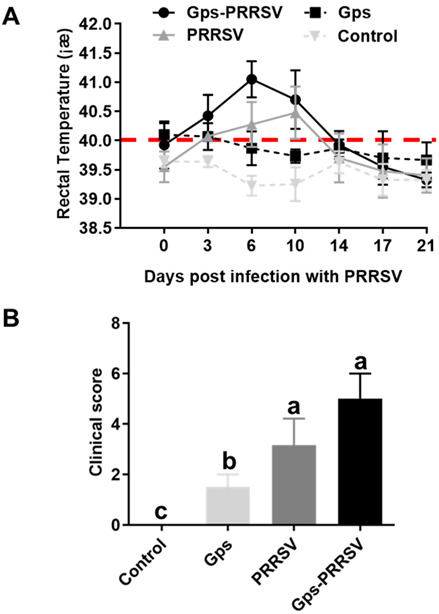
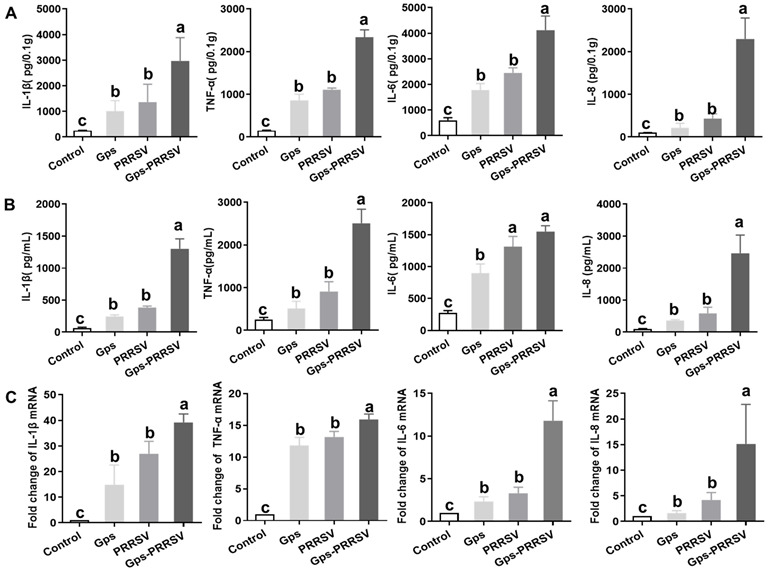
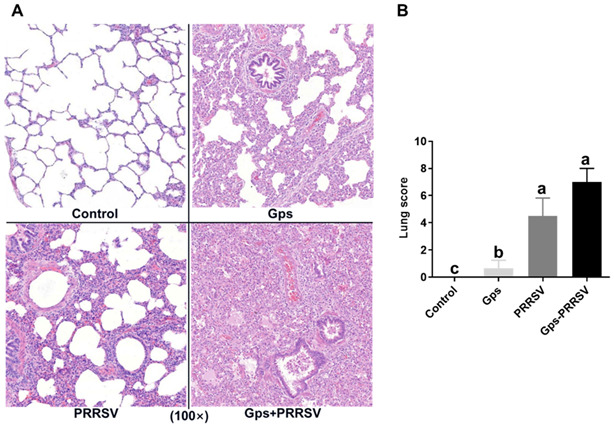
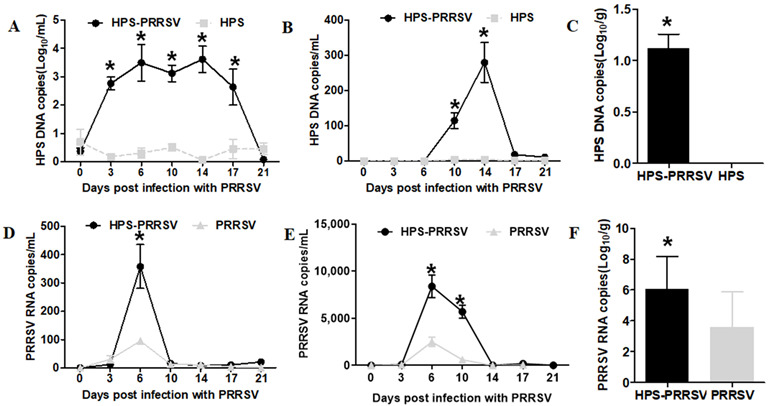
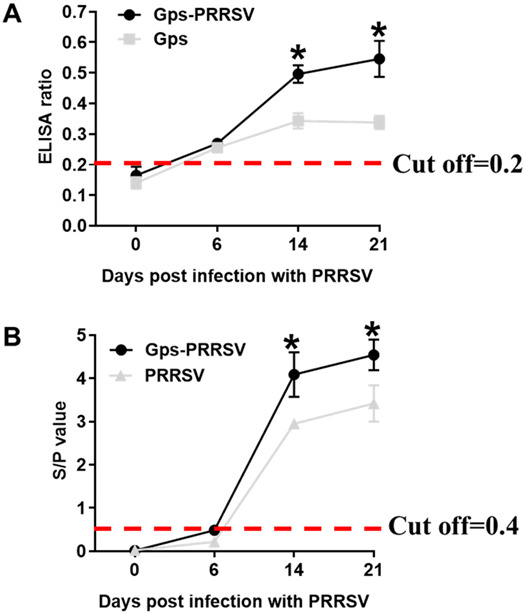
(Gps), Gram-negative bacteria, are a universal respiratory-disease-causing pathogen in swine that colonize the upper respiratory tract. Highly Pathogenic Porcine Reproductive and Respiratory Syndrome Virus (HP-PRRSV2HP-PRRSV2) and Gps coinfections are epidemics in China, but little is known about the influence of concurrent coinfection on disease severity and inflammatory responses. Herein, we studied the effects of secondary HP-PRRS infection on clinical symptoms, pathological changes, pathogen load, and inflammatory response of Gps coinfection in the upper respiratory tract of piglets. All coinfected piglets (HP-PRRSV2 + Gps) displayed fever and severe lesions in the lungs, while fever was present in only a few animals with a single infection (HP-PRRSV2 or Gps). Additionally, HP-PRRSV2 and Gps loading in nasal swabs and blood and lung tissue samples was significantly increased in the coinfected group. Necropsy data showed that coinfected piglets suffered from severe lung damage and had significantly higher antibody titers of HP-PRRSV2 or Gps than single-infected piglets. Moreover, the serum and lung concentrations of inflammatory cytokines (TNF-α, IL-1β, IL-6, and IL-8) were also significantly higher in coinfected piglets than in those infected with HP-PRRSV2 or Gps alone. In conclusion, our results show that HP-PRRSV2 promotes the shedding and replication of Gps, and their coinfection in the upper respiratory tract aggravates the clinical symptoms and inflammatory responses, causing lung damage. Therefore, in the unavoidable situation of Gps infection in piglets, necessary measures must be made to prevent and control secondary infection with HP-PRRSV2, which can save huge economic losses to the pork industry.
革兰氏阴性菌(Gps)是猪群中一种普遍存在的引起呼吸道疾病的病原体,可在上呼吸道定植。高致病性猪繁殖与呼吸综合征病毒2型(HP-PRRSV2)与Gps的共感染在中国呈流行态势,但关于同时发生的共感染对疾病严重程度和炎症反应的影响知之甚少。在此,我们研究了继发HP-PRRS感染对仔猪上呼吸道Gps共感染的临床症状、病理变化、病原体载量和炎症反应的影响。所有共感染仔猪(HP-PRRSV2 + Gps)均出现发热和肺部严重病变,而仅少数单一感染(HP-PRRSV2或Gps)的动物出现发热。此外,共感染组鼻拭子、血液和肺组织样本中的HP-PRRSV2和Gps载量显著增加。尸检数据显示,共感染仔猪肺部受损严重,HP-PRRSV2或Gps的抗体滴度显著高于单一感染仔猪。此外,共感染仔猪血清和肺中炎症细胞因子(TNF-α、IL-1β、IL-6和IL-8)的浓度也显著高于仅感染HP-PRRSV2或Gps的仔猪。总之,我们的结果表明,HP-PRRSV2促进了Gps的脱落和复制,它们在上呼吸道的共感染加剧了临床症状和炎症反应,导致肺部损伤。因此,在仔猪不可避免感染Gps的情况下,必须采取必要措施预防和控制HP-PRRSV2的继发感染,这可为猪肉行业挽回巨大经济损失。