
代谢组学分析揭示不同贮藏年限的柚子(琯溪蜜柚品种)果皮在感染“亚洲韧皮杆菌”后的品质变化
Metabolomic Profiling Reveals the Quality Variations in Pericarpium ( Blanco cv. Chachiensis) with Different Storage Ages in Response to " Liberibacter Asiaticus" Infection.
作者信息
Liang Jiayin, Xi Yuqing, Li Jiaming, Xu Shugui, Zheng Yongqin, Xu Meirong, Zheng Zheng, Deng Xiaoling
机构信息
National Key Laboratory of Green Pesticide, South China Agricultural University, Guangzhou 510642, China.
Guangdong Province Key Laboratory of Microbial Signals and Disease Control, South China Agricultural University, Guangzhou 510642, China.
出版信息
Foods. 2024 Mar 8;13(6):827. doi: 10.3390/foods13060827.
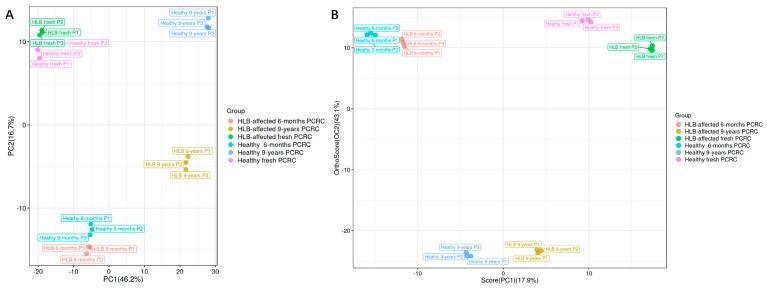
Pericarpium, especially the pericarp of Blanco cv. Chachiensis (PCRC), is an important edible and medicinal ingredient for health and pharmacological properties. Citrus Huanglongbing, a devastating disease that currently threatens the citrus industry worldwide, is caused by a phloem-limited alpha-proteobacterium, " Liberibacter asiaticus" (CLas). The industry of cultivar Chachiensis has been suffering from HLB. Although HLB affected the quality of citrus fruit, whether the quality of PCRC was affected by HLB remains unclear. In this study, we compared the metabolite profiles between HLB-affected and healthy PCRC from three sources: fresh, 6-month-old, and 9-year-old PCRC, through the untargeted LC-MS method. Compared to healthy controls, various types of bioactive compounds, mainly flavonoids, terpenoids, alkaloids, coumarins, polysaccharides, and phenolic acids, accumulated in HLB-affected PCRC, especially in the HLB-affected 9-year PCRC. In particular, isorhamnetin, isoliquiritigenin, luteolin 7-O-beta-D-glucoside, limonin, geniposide, pyrimidodiazepine, scoparone, chitobiose, m-coumaric acid, malonate, and pantothenic acid, which contributed to the pharmacological activity and health care effects of PCRC, were highly accumulated in HLB-affected 9-year-old PCRC compared to the healthy control. Multibioassay analyses revealed that HLB-affected 9-year-old PCRC had a higher content of total flavonoids and total polyphenols and exhibited similar antioxidant capacity as compared to healthy controls. The results of this study provided detailed information on the quality of HLB-affected PCRC.
陈皮,尤其是布兰科品种“茶枝柑”(PCRC)的果皮,是一种具有重要保健和药理特性的可食用和药用成分。柑橘黄龙病是一种目前威胁全球柑橘产业的毁灭性病害,由韧皮部限制性α-变形菌“亚洲韧皮杆菌”(CLas)引起。茶枝柑产业一直受到黄龙病的困扰。尽管黄龙病影响了柑橘果实的品质,但PCRC的品质是否受到黄龙病的影响仍不清楚。在本研究中,我们通过非靶向液相色谱-质谱法比较了来自三个来源(新鲜、6个月龄和9年生)的受黄龙病影响和健康的PCRC之间的代谢物谱。与健康对照相比,各种生物活性化合物,主要是黄酮类、萜类、生物碱、香豆素、多糖和酚酸,在受黄龙病影响的PCRC中积累,尤其是在受黄龙病影响的9年生PCRC中。特别是,对PCRC的药理活性和保健作用有贡献的异鼠李素、异甘草素、木犀草素7-O-β-D-葡萄糖苷、柠檬苦素、栀子苷、嘧啶并二氮杂卓、滨蒿内酯、壳二糖、间香豆酸、丙二酸和泛酸,在受黄龙病影响的9年生PCRC中与健康对照相比高度积累。多重生物测定分析表明,受黄龙病影响的9年生PCRC总黄酮和总多酚含量较高,与健康对照相比具有相似的抗氧化能力。本研究结果提供了受黄龙病影响的PCRC质量的详细信息。




 Zotero 插件