Mamis Edgars, Duchemin Charlotte, Berlin Valentina, Bernerd Cyril, Bovigny Mathieu, Chevallay Eric, Crepieux Bernard, Gadelshin Vadim Maratovich, Heinke Reinhard, Hernandez Ronaldo Mendez, Johnson Jake David, Kalniņa Patrīcija, Koliatos Alexandros, Lambert Laura, Rossel Ralf Erik, Rothe Sebastian, Thiboud Julien, Weber Felix, Wendt Klaus, Zabolockis Rudolfs Jānis, Pajuste Elīna, Stora Thierry
European Organization for Nuclear Research (CERN), Esplanade des Particules 1, 1211 Geneva, Switzerland.
Institute of Chemical Physics (ICP), University of Latvia, Jelgavas Street 1, LV-1004 Riga, Latvia.
Pharmaceuticals (Basel). 2024 Mar 18;17(3):390. doi: 10.3390/ph17030390.
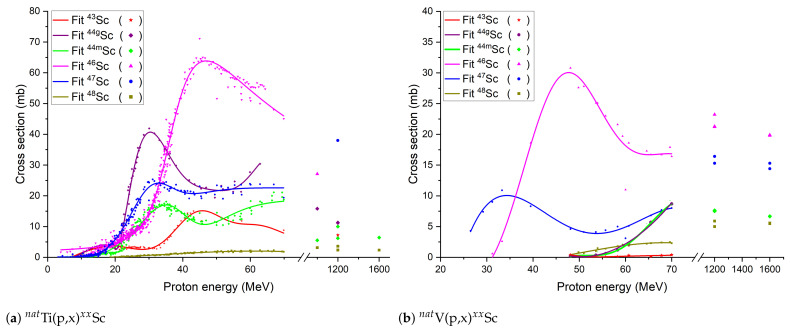
The radionuclides Sc, 44g/mSc, and Sc can be produced cost-effectively in sufficient yield for medical research and applications by irradiating natTi and natV target materials with protons. Maximizing the production yield of the therapeutic Sc in the highest cross section energy range of 24-70 MeV results in the co-production of long-lived, high-γ-ray-energy Sc and Sc contaminants if one does not use enriched target materials. Mass separation can be used to obtain high molar activity and isotopically pure Sc radionuclides from natural target materials; however, suitable operational conditions to obtain relevant activity released from irradiated natTi and natV have not yet been established at CERN-MEDICIS and ISOLDE. The objective of this work was to develop target units for the production, release, and purification of Sc radionuclides by mass separation as well as to investigate target materials for the mass separation that are compatible with high-yield Sc radionuclide production in the 9-70 MeV proton energy range. In this study, the in-target production yield obtained at MEDICIS with 1.4 GeV protons is compared with the production yield that can be reached with commercially available cyclotrons. The thick-target materials were irradiated at MEDICIS and comprised of metallic natTi, natV metallic foils, and natTiC pellets. The produced radionuclides were subsequently released, ionized, and extracted from various target and ion source units and mass separated. Mono-atomic Sc laser and molecule ionization with forced-electron-beam-induced arc-discharge ion sources were investigated. Sc radionuclide production in thick natTi and natV targets at MEDICIS is equivalent to low- to medium-energy cyclotron-irradiated targets at medically relevant yields, furthermore benefiting from the mass separation possibility. A two-step laser resonance ionization scheme was used to obtain mono-atomic Sc ion beams. Sc radionuclide release from irradiated target units most effectively could be promoted by volatile scandium fluoride formation. Thus, isotopically pure 44g/mSc, Sc, and Sc were obtained as mono-atomic and molecular ScF 2+ ion beams and collected for the first time at CERN-MEDICIS. Among all the investigated target materials, natTiC is the most suitable target material for Sc mass separation as molecular halide beams, due to high possible operating temperatures and sustained release.
通过用质子辐照天然钛(natTi)和天然钒(natV)靶材,可经济高效地生产出放射性核素钪(Sc)、44g/mSc和Sc,其产量足以满足医学研究和应用的需求。如果不使用富集靶材,在24 - 70 MeV的最高截面能量范围内使治疗用Sc的产量最大化,会导致长寿命、高γ射线能量的Sc和Sc污染物的联产。质量分离可用于从天然靶材中获得高摩尔活度和同位素纯的Sc放射性核素;然而,在欧洲核子研究中心的医用同位素分离与产额测量装置(CERN - MEDICIS)和同位素分离在线装置(ISOLDE)中,尚未确定获得辐照天然钛和天然钒释放的相关活度的合适操作条件。这项工作的目的是开发用于通过质量分离生产、释放和纯化Sc放射性核素的靶单元,并研究与9 - 70 MeV质子能量范围内高产Sc放射性核素生产兼容的质量分离靶材。在本研究中,将在MEDICIS用1.4 GeV质子获得的靶内产量与商用回旋加速器可达到的产量进行了比较。在MEDICIS对厚靶材进行了辐照,厚靶材包括金属天然钛、天然钒金属箔和天然碳化钛颗粒。随后将产生的放射性核素从各种靶和离子源单元中释放、电离并提取出来,进行质量分离。研究了单原子Sc激光和利用强制电子束诱导弧光放电离子源的分子电离。在MEDICIS中,厚天然钛和天然钒靶中Sc放射性核素的产量与在医学相关产额下低至中能回旋加速器辐照的靶相当,而且受益于质量分离的可能性。采用两步激光共振电离方案获得单原子Sc离子束。通过形成挥发性氟化钪,最有效地促进了辐照靶单元中Sc放射性核素的释放。因此,首次在CERN - MEDICIS获得了同位素纯的44g/mSc、Sc和Sc,它们以单原子和分子ScF₂⁺离子束的形式被收集。在所有研究的靶材中,天然碳化钛是作为分子卤化物束进行Sc质量分离最合适的靶材,因为其可能的工作温度高且释放持续。