Loveless C Shaun, Radford Lauren L, Ferran Samuel J, Queern Stacy L, Shepherd Matthew R, Lapi Suzanne E
Department of Radiology, University of Alabama at Birmingham, Birmingham, AL, 35233, USA.
Department of Chemistry, Washington University in St. Louis, St. Louis, MO, 63134, USA.
EJNMMI Res. 2019 May 16;9(1):42. doi: 10.1186/s13550-019-0515-8.
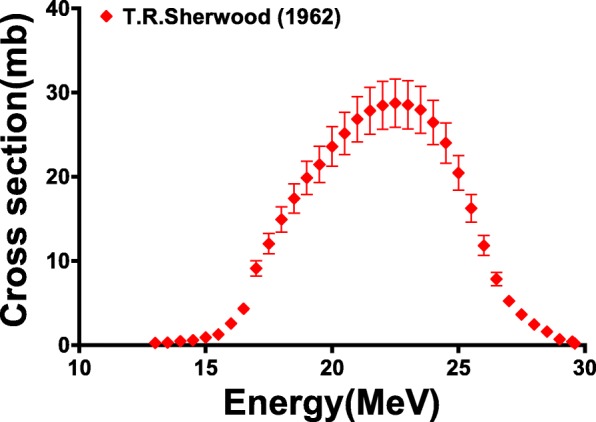
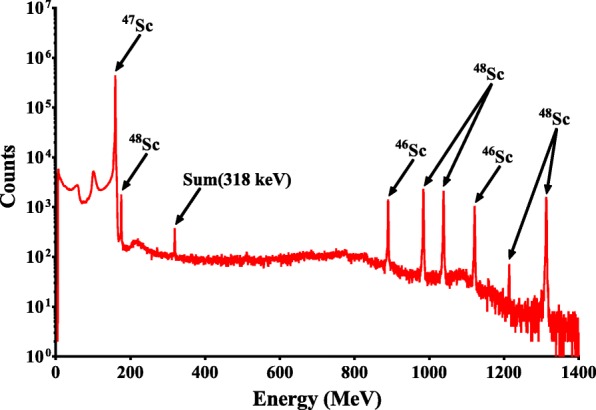
In molecular imaging and nuclear medicine, theranostic agents that integrate radionuclide pairs are successfully being used for individualized care, which has led to rapidly growing interest in their continued development. These compounds, which are radiolabeled with one radionuclide for imaging and a chemically identical or similar radionuclide for therapy, may improve patient-specific treatment and outcomes by matching the properties of different radionuclides with a targeting vector for a particular tumor type. One proposed theranostic radionuclide is scandium-47 (Sc, T = 3.35 days), which can be used for targeted radiotherapy and may be paired with the positron emitting radionuclides, Sc (T = 3.89 h) and Sc (T = 3.97 h) for imaging. The aim of this study was to investigate the photonuclear production of Sc via the Ti(γ,p)Sc reaction using an electron linear accelerator (eLINAC), separation and purification of Sc, the radiolabeling of somatostatin receptor-targeting peptide DOTATOC with Sc, and in vitro receptor-mediated binding of [Sc]Sc-DOTATOC in AR42J somatostatin receptor subtype two (SSTR2) expressing rat pancreatic tumor cells.
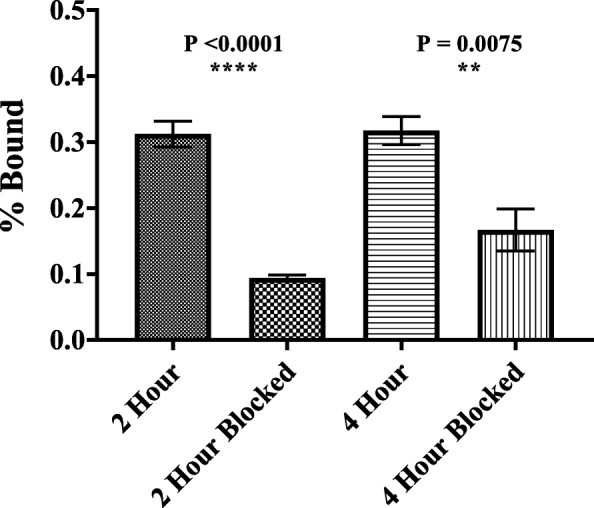
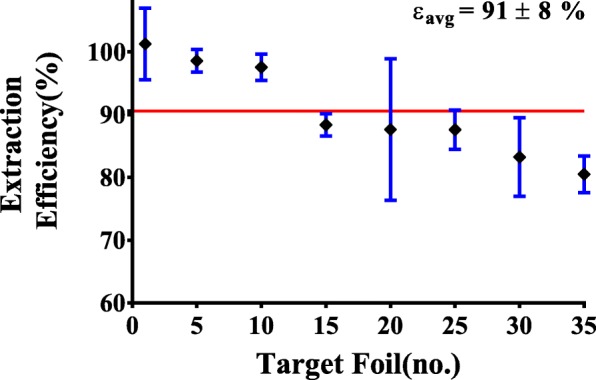
The rate of Sc production in a stack of natural titanium foils (n = 39) was 8 × 10 Bq/mA·h (n = 3). Irradiated target foils were dissolved in 2.0 M HSO under reflux. After dissolution, trivalent Sc ions were separated from natural Ti using AG MP-50 cation exchange resin. The recovered Sc was then purified using CHELEX 100 ion exchange resin. The average decay-corrected two-step Sc recovery (n = 9) was (77 ± 7)%. A radiolabeling yield of > 99.9% of [Sc]Sc-DOTATOC (0.384 mg in 0.3 mL) was achieved using 1.7 MBq of Sc. Blocking studies using Octreotide illustrated receptor-mediated uptake of [Sc]Sc-DOTATOC in AR42J cells.
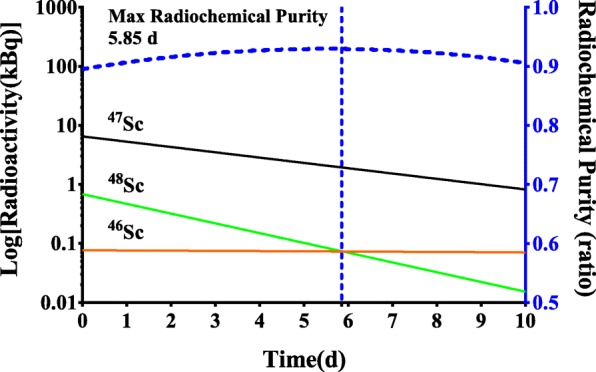
Sc can be produced via the Ti(γ,p)Sc reaction and separated from natural Ti targets with a yield and radiochemical purity suitable for radiolabeling of peptides for in vitro studies. The data in this work supports the potential use of eLINACs for studies of photonuclear production of medical radionuclides and the future development of high-intensity eLINAC facilities capable of producing relevant quantities of carrier-free radionuclides currently inaccessible via routine production pathways or limited due to costly enriched targets.
在分子成像和核医学中,整合放射性核素对的诊疗剂已成功用于个体化医疗,这使得人们对其持续研发的兴趣迅速增长。这些化合物用一种放射性核素进行放射性标记用于成像,并用化学性质相同或相似的放射性核素进行治疗,通过将不同放射性核素的特性与针对特定肿瘤类型的靶向载体相匹配,可能改善针对患者的治疗及疗效。一种提议的诊疗放射性核素是钪 - 47(Sc,半衰期(T = 3.35)天),它可用于靶向放射治疗,并且可与发射正电子的放射性核素钪(半衰期(T = 3.89)小时)和钪(半衰期(T = 3.97)小时)配对用于成像。本研究的目的是研究利用电子直线加速器(eLINAC)通过(Ti(γ,p)Sc)反应光核产生钪 - 47,钪 - 47的分离和纯化,用钪 - 47对靶向生长抑素受体的肽段奥曲肽(DOTATOC)进行放射性标记,以及在表达生长抑素受体亚型2(SSTR2)的大鼠胰腺肿瘤细胞AR42J中[钪 - 47]钪 - DOTATOC的体外受体介导结合。
一堆天然钛箔((n = 39))中钪 - 47的产生速率为(8×10)贝克勒尔/毫安·小时((n = 3))。辐照后的靶箔在回流条件下溶解于(2.0)摩尔/升的硫酸中。溶解后,使用AG MP - 50阳离子交换树脂从天然钛中分离出三价钪离子。然后使用CHELEX 100离子交换树脂对回收的钪进行纯化。经衰变校正后的两步钪回收平均产率((n = 9))为((77 ± 7)%)。使用(1.7)兆贝克勒尔的钪 - 47实现了[钪 - 47]钪 - DOTATOC((0.3)毫升中含(0.384)毫克)的放射性标记产率> (99.9%)。使用奥曲肽进行的阻断研究表明[钪 - 47]钪 - DOTATOC在AR42J细胞中存在受体介导的摄取。
钪 - 47可通过(Ti(γ,p)Sc)反应产生,并能从天然钛靶中分离出来,其产率和放射化学纯度适用于肽段的放射性标记以用于体外研究。本研究中的数据支持电子直线加速器在医用放射性核素光核产生研究中的潜在应用,以及未来高强度电子直线加速器设施的开发,这种设施能够生产目前通过常规生产途径无法获得或因昂贵的富集靶材而产量受限的相关无载体放射性核素量。