Key Laboratory of Oasis Agricultural Pest Management and Plant Protection Resources Utilization, College of Agriculture, Xinjiang Uygur Autonomous Region, Shihezi University, Shihezi 832003, China.
Agricultural Technology Extension Station of the First Division, Alaer 843300, China.
Viruses. 2024 Feb 25;16(3):355. doi: 10.3390/v16030355.
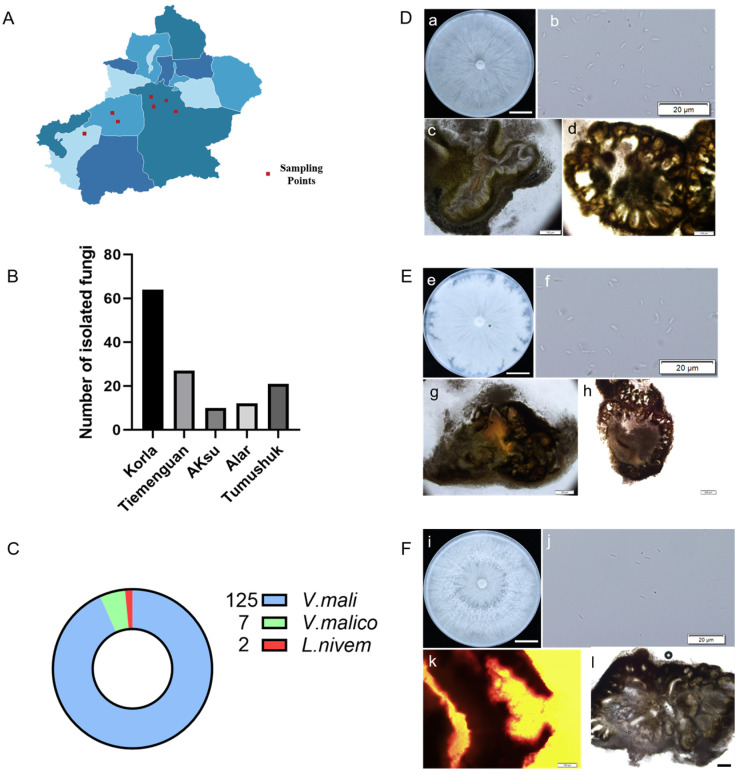
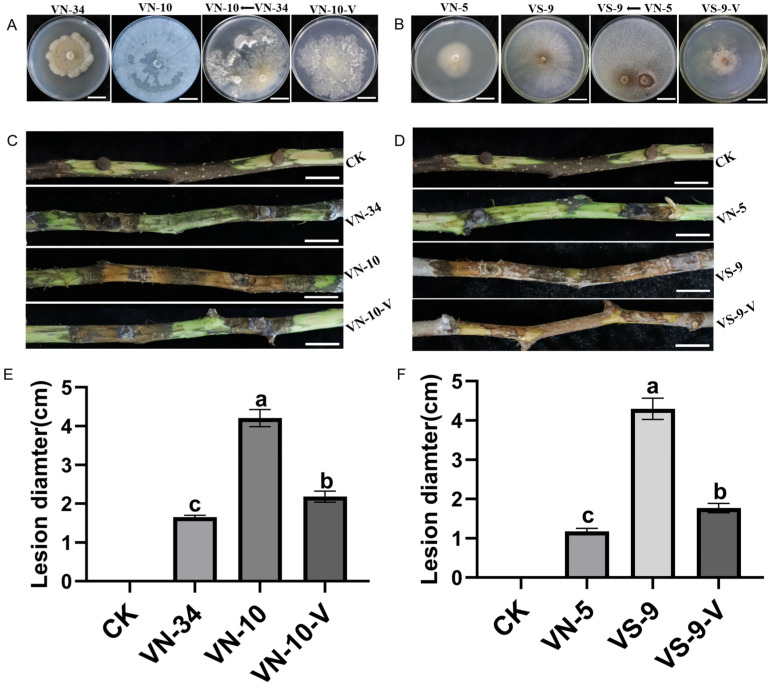
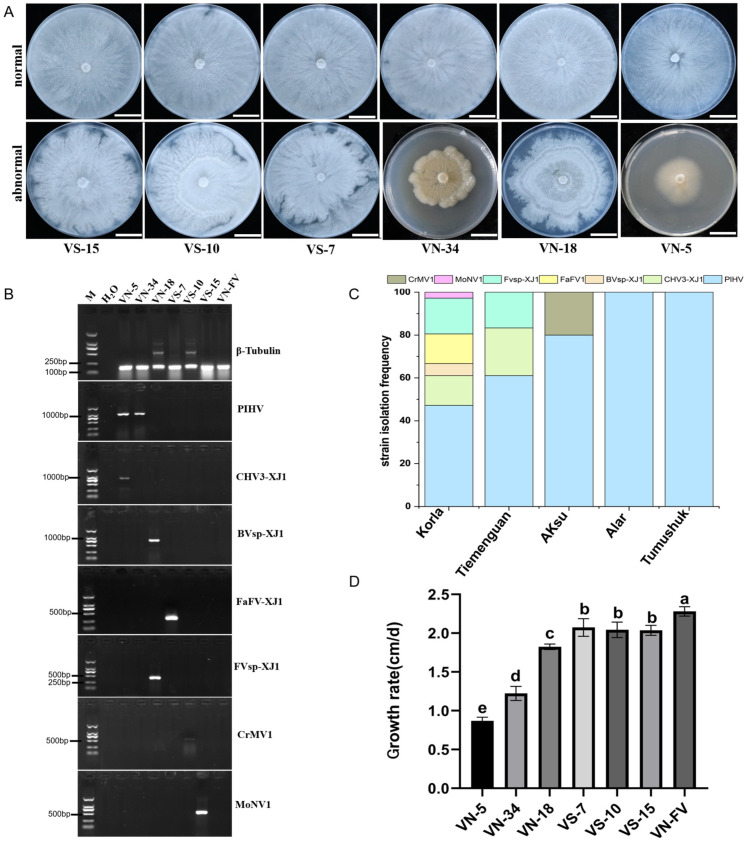
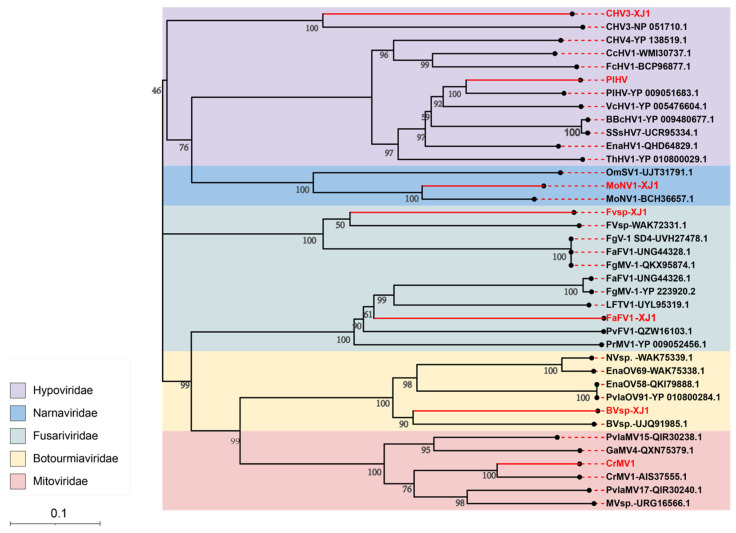
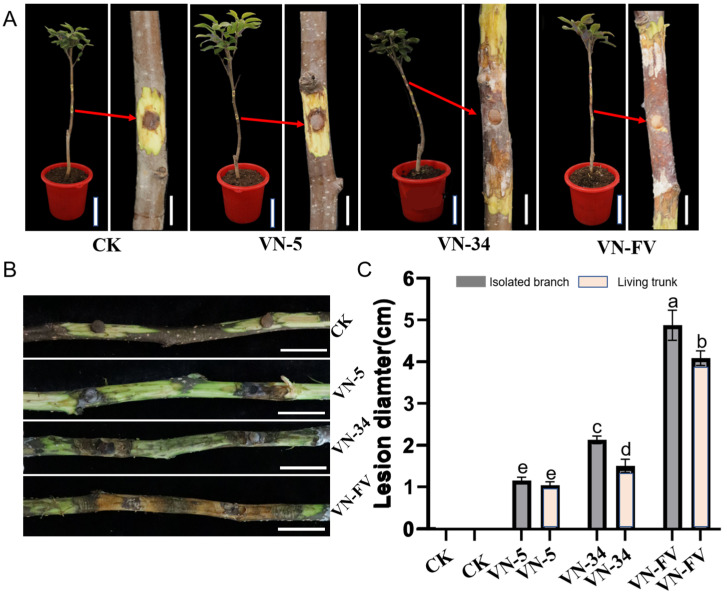
As a common disease, canker seriously affects the yield and quality of fragrant pear due to the lack of effective control measures. Some fungi have been reported to harbor rich reservoirs of viral resources, and some mycoviruses can be used as biocontrol agents against plant diseases. In this study, 199 isolates were obtained from diseased branches of fragrant pear in the main production areas of Xinjiang. Among them, 134 belonged to spp., identified using morphological and molecular biological techniques, in which was the dominant species. The mycoviruses in spp. were further identified using metatranscriptomic sequencing and RT-PCR. The results revealed that a total of seven mycoviruses were identified, belonging to , , , , , and , among which Phomopsis longicolla hypovirus (PlHV) was dominant in all the sample collection regions. The Cryphonectria hypovirus 3-XJ1 (CHV3-XJ1), Botourmiaviridae sp.-XJ1 (BVsp-XJ1), and Fusariviridae sp.-XJ1 (Fvsp-XJ1) were new mycoviruses discovered within the spp. More importantly, compared with those in the virus-free spp. strain, the growth rate and virulence of the VN-5 strain co-infected with PlHV and CHV3-XJ1 were reduced by 59% and 75%, respectively, and the growth rate and virulence of the VN-34 strain infected with PlHV were reduced by 42% and 55%, respectively. On the other hand, the horizontal transmission efficiency of PlHV decreased when PlHV was co-infected with CHV3-XJ1, indicating that PlHV and CHV3-XJ1 were antagonistic. In summary, the mycoviruses in spp. were identified in Xinjiang for the first time, and three of them were newly discovered mycoviruses, with two strains yielding good results. These results will offer potential biocontrol resources for managing pear canker disease and provide a theoretical basis for the control of fruit tree Valsa canker disease.
作为一种常见病,梨火疫病菌严重影响了香梨的产量和品质,但其缺乏有效的防治措施。一些真菌被报道拥有丰富的病毒资源库,一些真菌病毒可以被用作植物病害的生物防治剂。本研究从新疆主要产区香梨发病的枝条中获得了 199 个分离物。其中,134 个属于 spp.,通过形态学和分子生物学技术鉴定,其中 是优势种。通过宏转录组测序和 RT-PCR 进一步鉴定了 spp.中的真菌病毒。结果表明,共鉴定出 7 种真菌病毒,属于 、 、 、 、 和 ,其中 Phomopsis longicolla hypovirus (PlHV)在所有采样区域均占优势。Cryphonectria hypovirus 3-XJ1 (CHV3-XJ1)、Botourmiaviridae sp.-XJ1 (BVsp-XJ1)和 Fusariviridae sp.-XJ1 (Fvsp-XJ1)是在 spp.中发现的新的真菌病毒。更重要的是,与无病毒的 spp.菌株相比,VN-5 菌株同时感染 PlHV 和 CHV3-XJ1后,生长速度和毒力分别降低了 59%和 75%,VN-34 菌株感染 PlHV 后,生长速度和毒力分别降低了 42%和 55%。另一方面,PlHV 与 CHV3-XJ1 共感染时,PlHV 的水平传播效率降低,表明 PlHV 和 CHV3-XJ1 存在拮抗作用。综上所述,首次在新疆鉴定出 spp.中的真菌病毒,其中 3 种为新发现的真菌病毒,有 2 个菌株效果良好。这些结果将为梨火疫病的防治提供潜在的生物防治资源,并为控制果树火疫病提供理论依据。