Research Center in Health Sciences and Biomedicine (CICSaB), Universidad Autónoma de San Luis Potosí, San Luis Potosí 78210, Mexico.
Microbiology Department, Facultad de Medicina, Universidad Autónoma de San Luis Potosí, San Luis Potosí 78210, Mexico.
Viruses. 2024 Mar 11;16(3):429. doi: 10.3390/v16030429.
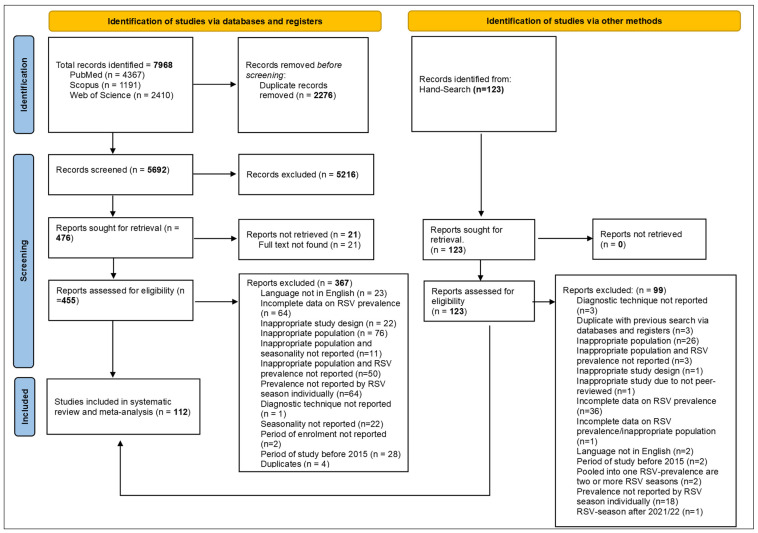
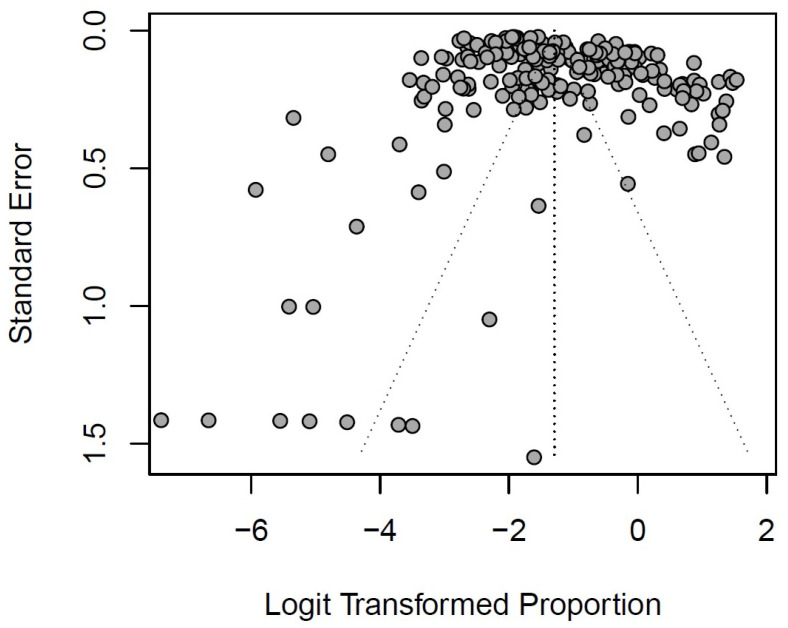
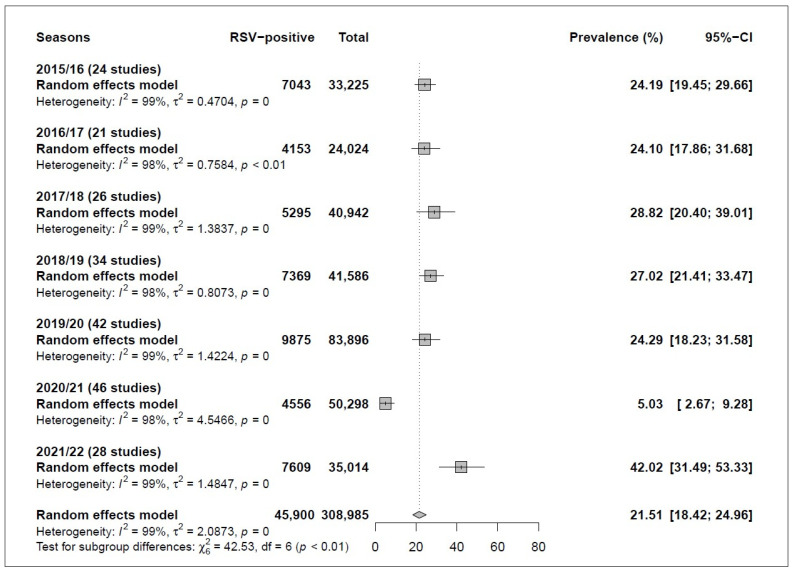
During the COVID-19 pandemic, nonpharmaceutical interventions (NPIs) were implemented in order to control the transmission of SARS-CoV-2, potentially affecting the prevalence of respiratory syncytial virus (RSV). This review evaluated the impact of NPIs on RSV-related hospitalizations in children during the lockdown (2020-2021) compared to the pre-pandemic (2015-2020) and post-lockdown (2021-2022) periods. In this systematic review and meta-analysis, we searched through PubMed, Scopus, and Web of Science for studies published in English between 1 January 2015 and 31 December 2022. Additionally, we conducted hand searches of other records published between 1 January 2023 and 22 January 2024. Our target population was hospitalized children aged 0-18 years with RSV-related lower respiratory tract infections confirmed through immunofluorescence, antigen testing, or molecular assays. We focused on peer-reviewed observational studies, analyzing the primary outcome of pooled RSV prevalence. A generalized linear mixed model with a random-effects model was utilized to pool each RSV prevalence. Heterogeneity was assessed using Cochran's Q and statistics, while publication bias was evaluated through funnel plots and Egger's tests. We identified and analyzed 5815 publications and included 112 studies with 308,985 participants. Notably, RSV prevalence was significantly lower during the lockdown period (5.03% [95% CI: 2.67; 9.28]) than during the pre-pandemic period (25.60% [95% CI: 22.57; 28.88], < 0.0001). However, RSV prevalence increased notably in the post-lockdown period after the relaxation of COVID-19 prevention measures (42.02% [95% CI: 31.49; 53.33] vs. 5.03% [95% CI: 2.67; 9.28], < 0.0001). Most pooled effect estimates exhibited significant heterogeneity (: 91.2% to 99.3%). Our findings emphasize the effectiveness of NPIs in reducing RSV transmission. NPIs should be considered significant public health measures to address RSV outbreaks.
在 COVID-19 大流行期间,采取了非药物干预(NPIs)措施来控制 SARS-CoV-2 的传播,这可能会影响呼吸道合胞病毒(RSV)的流行。本综述评估了与大流行前(2015-2020 年)和大流行后(2021-2022 年)相比,封锁期间(2020-2021 年)NPIs 对儿童因 RSV 相关住院治疗的影响。在这项系统评价和荟萃分析中,我们通过 PubMed、Scopus 和 Web of Science 搜索了 2015 年 1 月 1 日至 2022 年 12 月 31 日期间发表的英文研究。此外,我们还对 2023 年 1 月 1 日至 2024 年 1 月 22 日期间发表的其他记录进行了手工检索。我们的目标人群是年龄在 0-18 岁之间、因 RSV 引起的下呼吸道感染而住院的儿童,这些感染通过免疫荧光、抗原检测或分子检测得到确认。我们重点关注经过同行评审的观察性研究,分析了 RSV 总流行率这一主要结局。使用具有随机效应模型的广义线性混合模型对每个 RSV 流行率进行汇总。通过 Cochran's Q 和 I 2 统计量评估异质性,通过漏斗图和 Egger 检验评估发表偏倚。我们确定并分析了 5815 篇出版物,纳入了 112 项研究,共有 308985 名参与者。值得注意的是,与大流行前时期(25.60%[95%CI:22.57%;28.88%], < 0.0001)相比,封锁期间 RSV 流行率(5.03%[95%CI:2.67%;9.28%])显著降低。然而,在 COVID-19 预防措施放松后的大流行后时期,RSV 流行率显著增加(42.02%[95%CI:31.49%;53.33%] vs. 5.03%[95%CI:2.67%;9.28%], < 0.0001)。大多数汇总的效应估计值存在显著的异质性(I 2 :91.2%至 99.3%)。我们的研究结果强调了 NPIs 在降低 RSV 传播方面的有效性。NPIs 应被视为解决 RSV 爆发的重要公共卫生措施。