Division of Renal Medicine, Department of Clinical Intervention and Technology, Karolinska Institutet, Stockholm, Sweden.
Division of Clinical Nutrition and Dietetics, Department of Orthopedics, Danderyds Hospital, Stockholm, Sweden.
Nephrol Dial Transplant. 2024 Oct 30;39(11):1867-1875. doi: 10.1093/ndt/gfae077.
A low-protein diet (LPD) is recommended to patients with advanced chronic kidney disease (CKD), whereas geriatric guidelines recommend a higher amount of protein. The aim of this study was to evaluate the safety of LPD treatment in older adults with advanced CKD.
The EQUAL study is a prospective, observational study including patients ≥65 years of age with an incident estimated glomerular filtration rate <20 ml/min/1.73 m2 in six European countries with follow-up through 6 years. Nutritional status was assessed by a 7-point subjective global assessment (SGA) every 3-6 months. Prescribed diet (g protein/kg of bodyweight) was recorded on every study visit; measured protein intake was available in three countries. Time to death and decline in nutritional status (SGA decrease of ≥2 points) were analysed using marginal structural models with dynamic inverse probability of treatment and censoring weights.
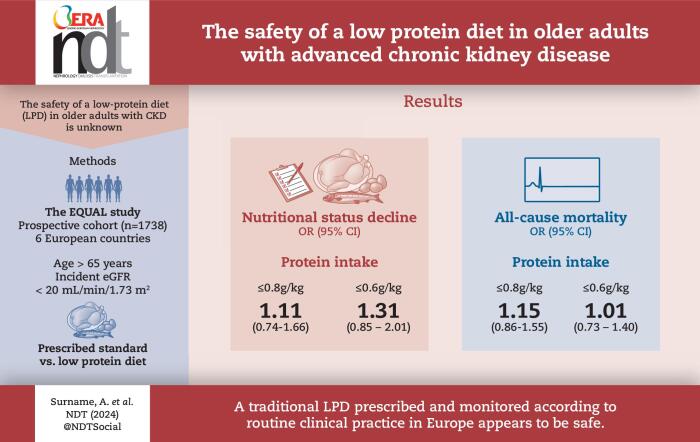
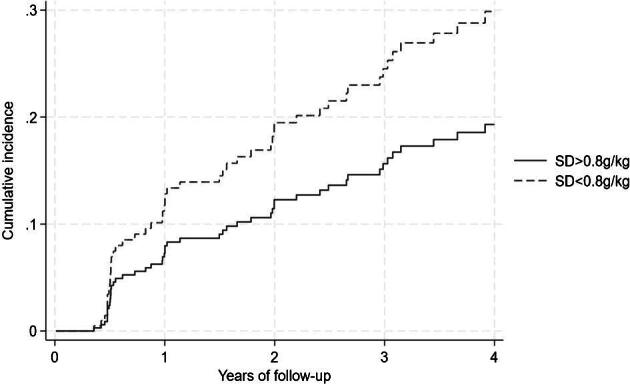
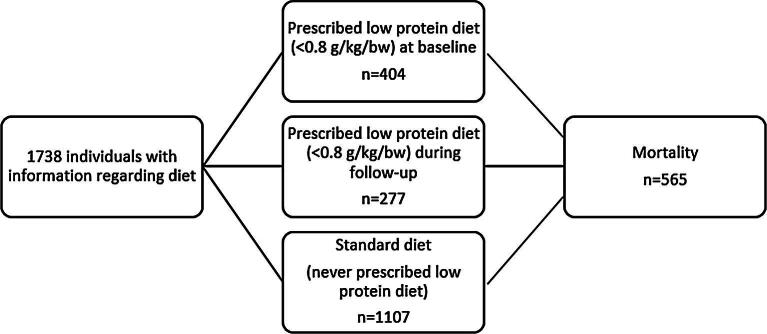
Of 1738 adults (631 prescribed LPD at any point during follow-up), there were 1319 with repeated SGA measurements, of which 267 (20%) decreased in SGA ≥2 points and 565 (32.5%) who died. There was no difference in survival or decrease in nutritional status for patients prescribed a LPD ≤0.8 g/kg ideal bodyweight {odds ratio [OR] for mortality 1.15 [95% confidence interval (CI) 0.86-1.55)] and OR for decrease in SGA 1.11 [95% CI 0.74-1.66]} in the adjusted models. In patients prescribed a LPD <0.6 g/kg ideal bodyweight, the results were similar. There was a significant interaction with LPD and older age >75 years, lower SGA and higher comorbidity burden for both mortality and nutritional status decline.
In older adults with CKD approaching end-stage kidney disease, a traditional LPD prescribed and monitored according to routine clinical practice in Europe appears to be safe.
低蛋白饮食(LPD)推荐用于晚期慢性肾脏病(CKD)患者,而老年医学指南则建议摄入更多的蛋白质。本研究旨在评估 LPD 治疗在欧洲六个国家患有晚期 CKD 的老年人中的安全性。
EQUAL 研究是一项前瞻性、观察性研究,纳入了年龄≥65 岁、肾小球滤过率估计值<20ml/min/1.73m2 的初发患者,随访时间长达 6 年。每 3-6 个月通过 7 分制主观整体评估(SGA)评估营养状况。每次研究就诊时记录规定的饮食(g 蛋白质/kg 体重);在三个国家可获得测量的蛋白质摄入量。使用边缘结构模型,通过动态治疗和随访权重的逆概率进行死亡时间和营养状况下降(SGA 下降≥2 分)的分析。
在 1738 名成年人中(在随访期间的任何时候,有 631 人服用 LPD),有 1319 人重复进行 SGA 测量,其中 267 人(20%)SGA 下降≥2 分,565 人(32.5%)死亡。在调整后的模型中,服用 LPD≤0.8g/kg 理想体重的患者,其生存或营养状况下降无差异[死亡率的比值比(OR)为 1.15(95%可信区间(CI)0.86-1.55)]和 SGA 下降的 OR 为 1.11(95%CI 0.74-1.66)]。在服用 LPD<0.6g/kg 理想体重的患者中,结果相似。对于死亡率和营养状况下降,LPD 与年龄>75 岁、较低的 SGA 和更高的合并症负担之间存在显著交互作用。
在接近终末期肾病的老年 CKD 患者中,根据欧洲常规临床实践规定和监测的传统 LPD 似乎是安全的。