Huang Yuxia, Lee Jim, Jin Lei, Rahman Md Mahabubur, Guerrero Ana, Zhao Meng, Lee Kyoung
Department of Computing Sciences, College of Engineering, Texas A&M University - Corpus Christi, Corpus Christi, TX, USA.
College of Business, Texas A&M University - Corpus Christi, Corpus Christi, TX, USA.
Heliyon. 2024 Mar 13;10(6):e27763. doi: 10.1016/j.heliyon.2024.e27763. eCollection 2024 Mar 30.
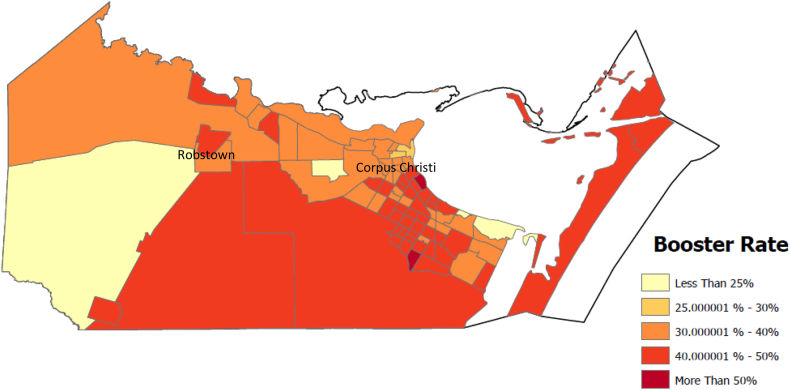
This paper explores sociodemographic determinants and geographic disparities in COVID-19 booster uptake among fully vaccinated adults in Nueces County, Texas, USA with a population of over 353,000.
A logistic generalized additive model was applied to analyze 184,252 official vaccination records of fully vaccinated adults over the period between December 2020 and August 2022. An individual's odds in receiving a booster shot were estimated with a host of sociodemographic characteristics as predictors.
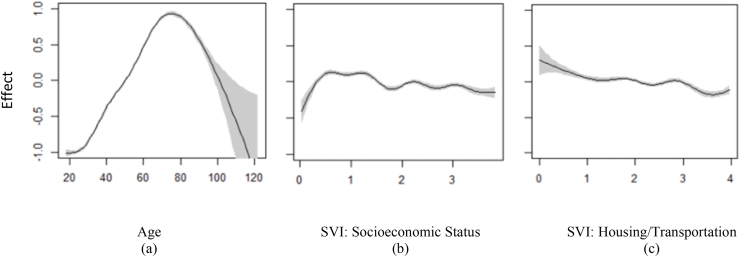
Model estimation results reveal that male (odds ratio 0.836, 95% confidence interval 0.835-0.836, < 0.001) and Hispanic residents (odds ratio 0.944, 95% confidence interval 0.943-0.945, < 0.001) in the county were less likely to take a booster shot. Between the ages of 25 and 75, booster uptake increased with age (age 75 vs. 45 odd ratio 3.058, 95% confidence interval 3.052-3.063, < 0.001). Booster uptake was lower in rural areas (odds ratio 0.804, 95% confidence interval 0.795-0.814, < 0.001) and communities with high social vulnerability (highest vs. moderate vulnerability odd ratio 0.800, 95% confidence interval 0.767-0.836, < 0.001).
Empirical results confirm that booster uptake varied across individuals and communities of different socioeconomic and demographic characteristics. To advance health equity, a more inclusive vaccine campaign should pay particular attention to those underserved populations.
本文探讨了美国得克萨斯州纽埃西斯县35.3万多人口中,完全接种疫苗的成年人在新冠疫苗加强针接种方面的社会人口学决定因素和地理差异。
应用逻辑广义相加模型分析了2020年12月至2022年8月期间184252份完全接种疫苗的成年人的官方接种记录。以一系列社会人口学特征为预测因素,估计个体接种加强针的几率。
模型估计结果显示,该县男性(优势比0.836,95%置信区间0.835 - 0.836,<0.001)和西班牙裔居民(优势比0.944,95%置信区间0.943 - 0.945,<0.001)接种加强针的可能性较小。在25岁至75岁之间,加强针接种率随年龄增长而增加(75岁与45岁相比,优势比3.058,95%置信区间3.052 - 3.063,<0.001)。农村地区(优势比0.804,95%置信区间0.795 - 0.814,<0.001)和社会脆弱性高的社区(高脆弱性与中等脆弱性相比,优势比0.800,95%置信区间0.767 - 0.836,<0.001)的加强针接种率较低。
实证结果证实,不同社会经济和人口特征的个体及社区在加强针接种方面存在差异。为促进健康公平,更具包容性的疫苗接种运动应特别关注那些服务不足的人群。