Faculty of Psychology, Education and Sport Sciences, Universitat Ramon Llul, Blanquerna, Barcelona, Spain.
Department of Public and Occupational Health, Amsterdam Public Health Research Institute, Amsterdam UMC, Vrije Universiteit Amsterdam, Meibergdreef 9, 1105 AZ, Amsterdam, The Netherlands.
Health Res Policy Syst. 2024 Mar 28;22(1):39. doi: 10.1186/s12961-024-01126-6.
By including the needs and perspectives of relevant stakeholders, co-creation is seen as a promising approach for tackling complex public health problems. However, recommendations and guidance on how to plan and implement co-creation are lacking. By identifying and analysing existing implementation and evaluation frameworks for public health, this study aims to offer key recommendations for professional stakeholders and researchers wanting to adopt a co-creation approach to public health interventions.
Firstly, PubMed and CINAHL databases were screened for articles introducing original implementation and evaluation frameworks for public health interventions. Backwards snowballing techniques were applied to the included papers. Secondly, identified frameworks were classified and relevant data extracted, including steps and constructs present in the frameworks. Lastly, recommendations were derived by conducting thematic analysis on the included frameworks.
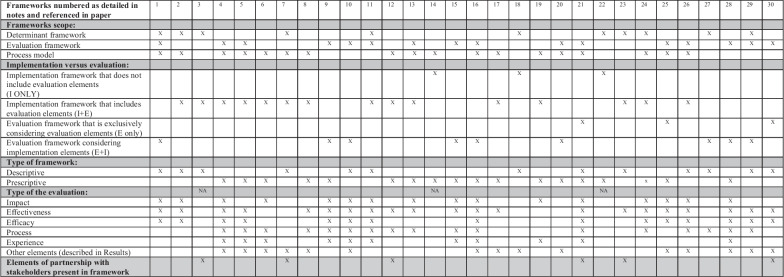
Thirty frameworks were identified and data related to their nature and scope extracted. The frameworks' prominent steps and constructs were also retrieved. Recommendations related to implementation and evaluation in the context of co-creation were included.
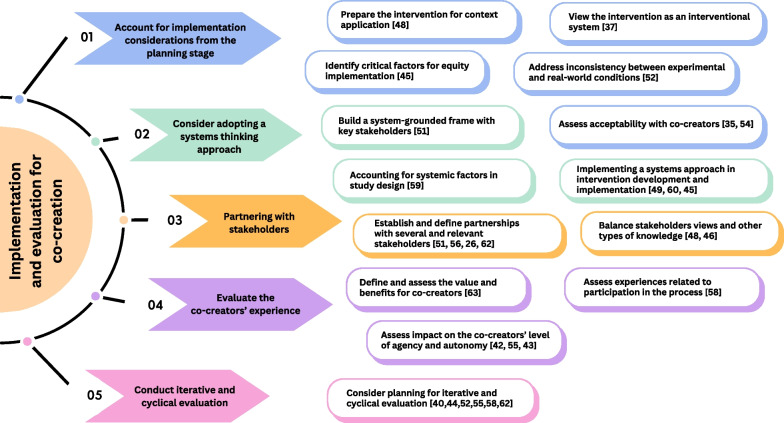
When engaging in co-creation, we recommend including implementation considerations from an early stage and suggest adopting a systems thinking as a way to explore multiple levels of influence, contextual settings and systems from an early planning stage. We highlight the importance of partnering with stakeholders and suggest applying an evaluation design that is iterative and cyclical, which pays particular attention to the experience of the engaged co-creators.
通过纳入相关利益相关者的需求和观点,共同创造被视为解决复杂公共卫生问题的一种有前途的方法。然而,缺乏关于如何规划和实施共同创造的建议和指导。本研究旨在通过识别和分析现有的公共卫生实施和评估框架,为希望采用共同创造方法干预公共卫生的专业利益相关者和研究人员提供关键建议。
首先,在 PubMed 和 CINAHL 数据库中筛选介绍公共卫生干预措施原始实施和评估框架的文章。对纳入的论文采用回溯性滚雪球技术。其次,对确定的框架进行分类,并提取相关数据,包括框架中存在的步骤和结构。最后,通过对纳入框架进行主题分析得出建议。
确定了 30 个框架,并提取了与它们的性质和范围相关的数据。还检索了框架的突出步骤和结构。纳入了与共同创造背景下实施和评估相关的建议。
在进行共同创造时,我们建议从早期阶段纳入实施方面的考虑,并建议采用系统思维作为一种从早期规划阶段探索多个层面影响、背景环境和系统的方法。我们强调与利益相关者合作的重要性,并建议采用迭代和循环的评估设计,特别关注参与共同创造的人员的体验。