Mulder Rosa H, Neumann Alexander, Felix Janine F, Suderman Matthew, Cecil Charlotte A M
Department of Child and Adolescent Psychiatry / Psychology, Erasmus MC, University Medical Center Rotterdam, Rotterdam, The Netherlands.
The Generation R Study Group, Erasmus MC, University Medical Center Rotterdam, Rotterdam, The Netherlands.
bioRxiv. 2024 Mar 14:2024.03.12.584597. doi: 10.1101/2024.03.12.584597.
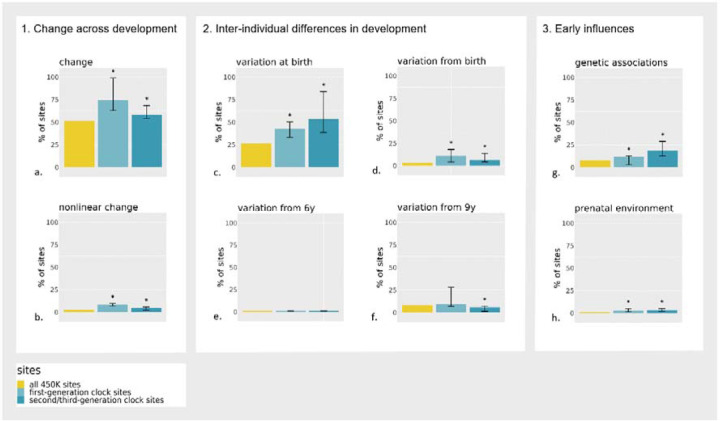
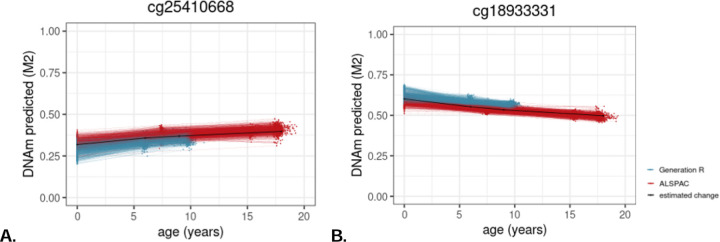
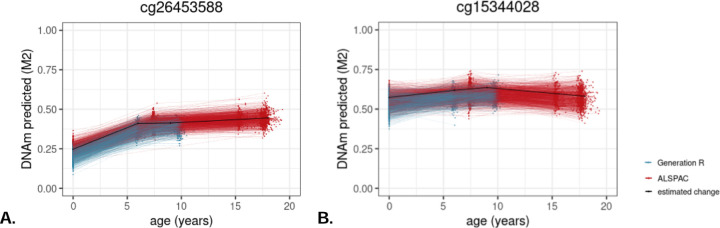
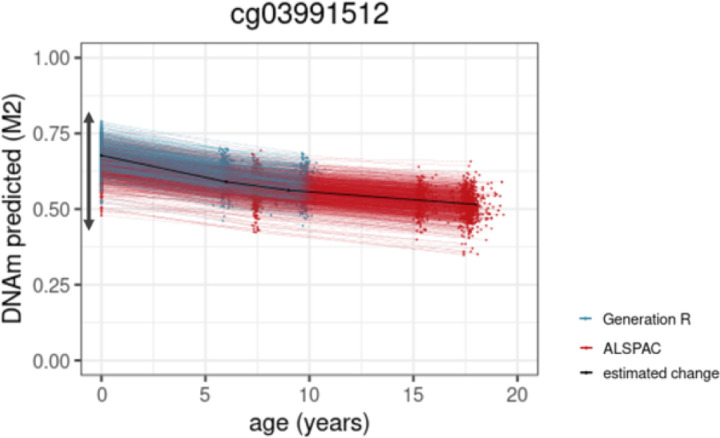
DNA methylation (DNAm) at specific sites can be used to calculate 'epigenetic clocks', which in adulthood are used as indicators of age(). However, little is known about how these clock sites 'behave' during development and what factors influence their variability in early life. This knowledge could be used to optimize healthy aging well before the onset of age-related conditions. Here, we leveraged results from two longitudinal population-based cohorts (=5,019 samples from 2,348 individuals) to characterize trajectories of adult clock sites from birth to early adulthood. We find that clock sites (i) diverge widely in their developmental trajectories, often showing non-linear change over time; (ii) are substantially more likely than non-clock sites to vary between individuals already from birth, differences that are predictive of DNAm variation at later ages; and (iii) show enrichment for genetic and prenatal environmental exposures, supporting an early-origins perspective to epigenetic aging.
特定位点的DNA甲基化(DNAm)可用于计算“表观遗传时钟”,在成年期,这些时钟被用作年龄的指标。然而,对于这些时钟位点在发育过程中的“表现”以及哪些因素影响其在生命早期的变异性,我们知之甚少。这些知识可用于在与年龄相关的疾病发作之前很久就优化健康衰老。在这里,我们利用了两个基于人群的纵向队列的结果(来自2348名个体的5019个样本)来描述成年时钟位点从出生到成年早期的轨迹。我们发现,时钟位点(i)在其发育轨迹上差异很大,通常随时间呈现非线性变化;(ii)与非时钟位点相比,从出生起个体之间就更有可能存在差异,这些差异可预测后期年龄的DNAm变化;(iii)显示出遗传和产前环境暴露的富集,支持了表观遗传衰老的早期起源观点。