The First College of Clinical Medical Sciences, China Three Gorges University, Yichang, China.
Yichang Central People's Hospital, The First College of Clinical Medical Science, China Three Gorges University, Yichang, Hubei, China.
J Cardiovasc Pharmacol. 2024 Jul 1;84(1):1-9. doi: 10.1097/FJC.0000000000001568.
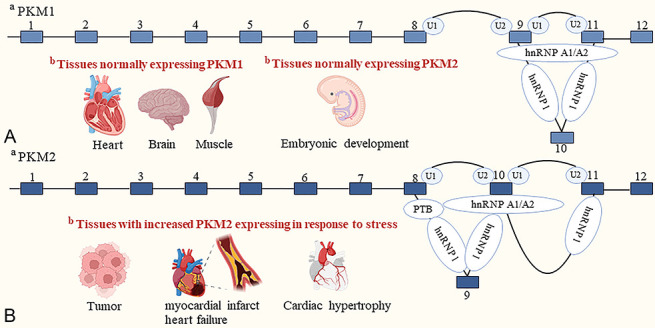
Adult animals are unable to regenerate heart cells due to postnatal cardiomyocyte cycle arrest, leading to higher mortality rates in cardiomyopathy. However, reprogramming of energy metabolism in cardiomyocytes provides a new perspective on the contribution of glycolysis to repair, regeneration, and fibrosis after cardiac injury. Pyruvate kinase (PK) is a key enzyme in the glycolysis process. This review focuses on the glycolysis function of PKM2, although PKM1 and PKM2 both play significant roles in the process after cardiac injury. PKM2 exists in both low-activity dimer and high-activity tetramer forms. PKM2 dimers promote aerobic glycolysis but have low catalytic activity, leading to the accumulation of glycolytic intermediates. These intermediates enter the pentose phosphate pathway to promote cardiomyocyte proliferation and heart regeneration. Additionally, they activate adenosine triphosphate (ATP)-sensitive K + (K ATP ) channels, protecting the heart against ischemic damage. PKM2 tetramers function similar to PKM1 in glycolysis, promoting pyruvate oxidation and subsequently ATP generation to protect the heart from ischemic damage. They also activate KDM5 through the accumulation of αKG, thereby promoting cardiomyocyte proliferation and cardiac regeneration. Apart from glycolysis, PKM2 interacts with transcription factors like Jmjd4, RAC1, β-catenin, and hypoxia-inducible factor (HIF)-1α, playing various roles in homeostasis maintenance, remodeling, survival regulation, and neovascularization promotion. However, PKM2 has also been implicated in promoting cardiac fibrosis through mechanisms like sirtuin (SIRT) 3 deletion, TG2 expression enhancement, and activation of transforming growth factor-β1 (TGF-β1)/Smad2/3 and Jak2/Stat3 signals. Overall, PKM2 shows promising potential as a therapeutic target for promoting cardiomyocyte proliferation and cardiac regeneration and addressing cardiac fibrosis after injury.
成年动物由于出生后心肌细胞周期停滞而无法再生心脏细胞,导致心肌病的死亡率更高。然而,心肌细胞能量代谢的重编程为心脏损伤后糖酵解对修复、再生和纤维化的贡献提供了新的视角。丙酮酸激酶 (PK) 是糖酵解过程中的关键酶。本综述重点介绍 PKM2 的糖酵解功能,尽管 PKM1 和 PKM2 在心脏损伤后都发挥着重要作用。PKM2 存在于低活性二聚体和高活性四聚体两种形式中。PKM2 二聚体促进有氧糖酵解,但催化活性低,导致糖酵解中间产物的积累。这些中间产物进入磷酸戊糖途径,促进心肌细胞增殖和心脏再生。此外,它们激活三磷酸腺苷 (ATP) 敏感的 K + (K ATP ) 通道,保护心脏免受缺血损伤。PKM2 四聚体在糖酵解中的作用类似于 PKM1,促进丙酮酸氧化,随后生成 ATP,以保护心脏免受缺血损伤。它们还通过 αKG 的积累激活 KDM5,从而促进心肌细胞增殖和心脏再生。除了糖酵解,PKM2 还与转录因子如 Jmjd4、RAC1、β-连环蛋白和缺氧诱导因子 (HIF)-1α相互作用,在维持内稳态、重塑、生存调节和促进新血管生成等方面发挥着各种作用。然而,PKM2 也通过 SIRT3 缺失、TG2 表达增强以及激活转化生长因子-β1 (TGF-β1)/Smad2/3 和 Jak2/Stat3 信号等机制,促进心脏纤维化。总的来说,PKM2 作为一种治疗靶点,具有促进心肌细胞增殖和心脏再生以及解决损伤后心脏纤维化的潜力。