Ye Zhipeng, Deng Xinpei, Zhang Jinhui, Shao Ruonan, Song Cailu, Zhao Jianfu, Tang Hailin
State Key Laboratory of Oncology in South China, Guangdong Provincial Clinical Research Center for Cancer, Sun Yat-Sen University Cancer Center, Guangzhou, China.
Department of Oncology, The First Affiliated Hospital of Jinan University, Guangzhou, China.
Front Cell Dev Biol. 2024 Mar 19;12:1381920. doi: 10.3389/fcell.2024.1381920. eCollection 2024.
Despite the abundance of research indicating the participation of immune cells in prostate cancer development, establishing a definitive cause-and-effect relationship has proven to be a difficult undertaking.
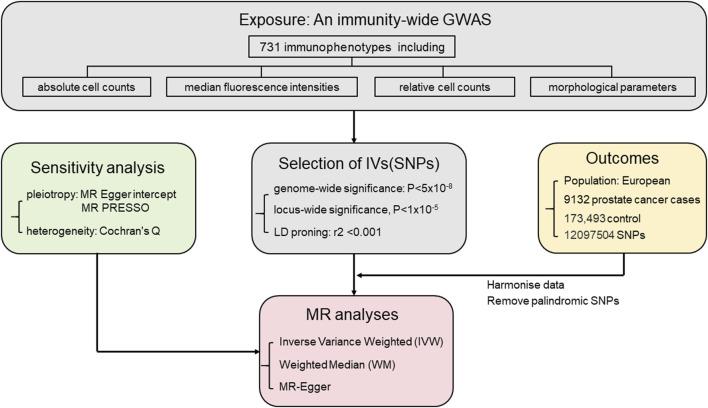
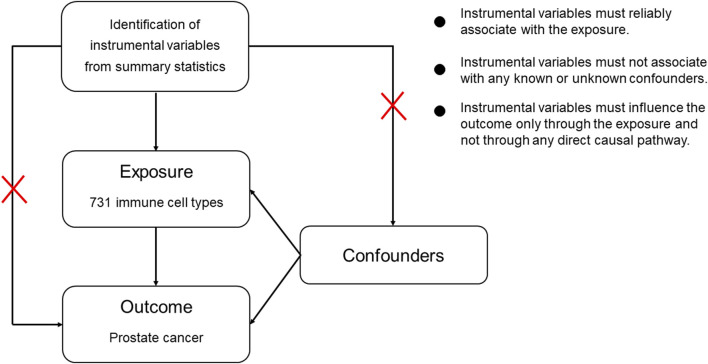
This study employs Mendelian randomization (MR), leveraging genetic variables related to immune cells from publicly available genome-wide association studies (GWAS), to investigate this association. The primary analytical method used in this study is inverse variance weighting (IVW) analysis. Comprehensive sensitivity analyses were conducted to assess the heterogeneity and horizontal pleiotropy of the results.
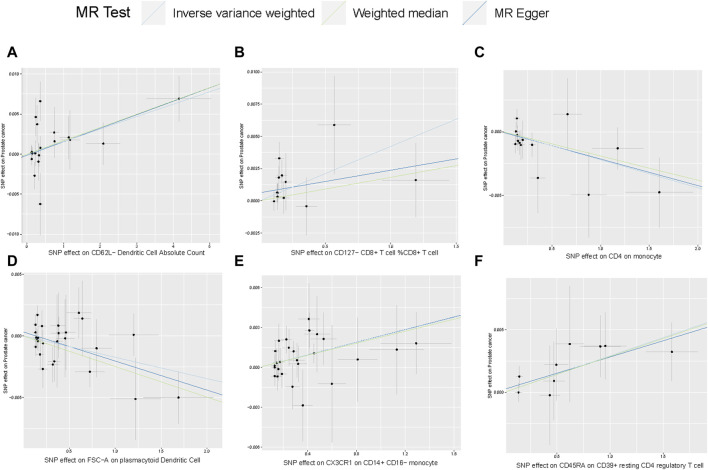
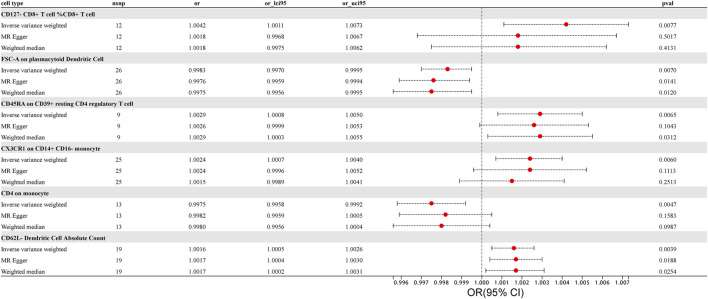
The study identifies four immune cell traits as causally contributing to prostate cancer risk, including CD127- CD8+ T cell %CD8+ T cell (OR = 1.0042, 95%CI:1.0011-1.0073, = 0.0077), CD45RA on CD39+ resting CD4 regulatory T cell (OR = 1.0029, 95%CI:1.0008-1.0050, = 0.0065), CD62L- Dendritic Cell Absolute Count (OR = 1.0016; 95%CI:1.0005-1.0026; = 0.0039), CX3CR1 on CD14+ CD16- monocyte (OR = 1.0024, 95%CI:1.0007-1.0040, = 0.0060). Additionally, two immune cell traits are identified as causally protective factors: CD4 on monocyte (OR = 0.9975, 95%CI:0.9958-0.9992, = 0.0047), FSC-A on plasmacytoid Dendritic Cell (OR = 0.9983, 95%CI:0.9970-0.9995, = 0.0070). Sensitivity analyses indicated no horizontal pleiotropy.
Our MR study provide evidence for a causal relationship between immune cells and prostate cancer, holding implications for clinical diagnosis and treatment.
尽管大量研究表明免疫细胞参与前列腺癌的发展,但要确立明确的因果关系已被证明是一项艰巨的任务。
本研究采用孟德尔随机化(MR)方法,利用公开的全基因组关联研究(GWAS)中与免疫细胞相关的遗传变量来研究这种关联。本研究使用的主要分析方法是逆方差加权(IVW)分析。进行了全面的敏感性分析以评估结果的异质性和水平多效性。
该研究确定了四种免疫细胞特征对前列腺癌风险有因果影响,包括CD127-CD8+T细胞占CD8+T细胞的百分比(比值比=1.0042,95%置信区间:1.0011-1.0073,P=0.0077)、CD39+静息CD4调节性T细胞上的CD45RA(比值比=1.0029,95%置信区间:1.0008-1.0050,P=0.0065)、CD62L-树突状细胞绝对计数(比值比=1.0016;95%置信区间:1.0005-1.0026;P=0.0039)、CD14+CD16-单核细胞上的CX3CR1(比值比=1.0024,95%置信区间:1.0007-1.0040,P=0.0060)。此外,确定了两种免疫细胞特征为因果保护因素:单核细胞上的CD4(比值比=0.9975,95%置信区间:0.9958-0.9992,P=0.0047)、浆细胞样树突状细胞上的前向散射光面积(FSC-A)(比值比=0.9983,95%置信区间:0.9970-0.9995,P=0.0070)。敏感性分析表明不存在水平多效性。
我们的孟德尔随机化研究为免疫细胞与前列腺癌之间的因果关系提供了证据,对临床诊断和治疗具有启示意义。