Tsaulwayo Nokwanda, Omondi Reinner O, Vijayan Paranthaman, Sibuyi Nicole R S, Meyer Miché D, Meyer Mervin, Ojwach Stephen O
School of Chemistry and Physics, University of KwaZulu-Natal Private Bag X01, Scottsville Pietermaritzburg 3209 South Africa
Department of Science and Innovation/Mintek Nanotechnology Innovation Centre, Biolabels Research Node, Department of Biotechnology, University of the Western Cape Bag X17, Bellville 7535 Cape Town South Africa.
RSC Adv. 2024 Mar 11;14(12):8322-8330. doi: 10.1039/d4ra00525b. eCollection 2024 Mar 6.
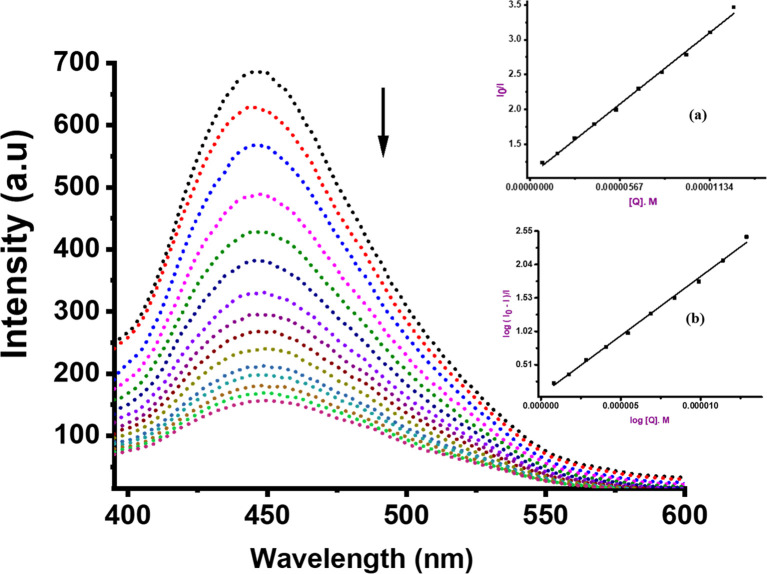
Treatments of -(1-benzo[]imidazol-2-yl)pyrazine-2-carboxamide (HL) and -(benzo[]thiazol-2-yl)pyrazine-2-carboxamide carboxamide ligands (HL) with [Ru(-cymene)Cl] and [Ru(PPh)Cl] precursors afforded the respective Ru(ii) complexes [Ru(L)(-cymene)Cl] (Ru1), [Ru(L)(-cymene)Cl] (Ru2), [Ru(L)(PPh)Cl] (Ru3), and [Ru(L)(PPh)Cl] (Ru4). These complexes were characterized by NMR, FT-IR spectroscopies, mass spectrometry, elemental analyses, and crystal X-ray crystallography for Ru2. The molecular structure of complex Ru2 contains one mono-anionic bidentate bound ligand and display pseudo-octahedral piano stool geometry around the Ru(ii) atom. The interactions with calf thymus DNA (CT-DNA) and bovine serum albumin (BSA) were investigated by spectroscopic techniques. The experimental binding studies suggest that complexes Ru1-Ru4 interact with DNA, primarily through minor groove binding, as supported by molecular docking results. Additionally, these complexes exhibit strong quenching of the fluorescence of tryptophan residues in BSA, displaying static quenching. The cytotoxicity studies of compounds Ru1-Ru4 were assessed in cancer cell lines (A549, PC-3, HT-29, Caco-2, and HeLa), as well as a non-cancer line (KMST-6). Compounds Ru1 and Ru2 exhibited superior cytotoxicity compared to Ru3 and Ru4. The cytotoxicity and selectivity of compounds Ru1 and Ru2 against A549, PC-3, and Caco-2 cell lines surpassed that of cisplatin.
用[Ru(对异丙基苯)Cl₂]和[Ru(PPh₃)₂Cl₂]前体处理-(1-苯并咪唑-2-基)吡嗪-2-甲酰胺(HL)和-(苯并噻唑-2-基)吡嗪-2-甲酰胺配体(HL),分别得到Ru(ii)配合物[Ru(L)(对异丙基苯)Cl] (Ru1)、[Ru(L')(对异丙基苯)Cl] (Ru2)、[Ru(L)(PPh₃)Cl] (Ru3)和[Ru(L')(PPh₃)Cl] (Ru4)。通过核磁共振、傅里叶变换红外光谱、质谱、元素分析以及对Ru2进行晶体X射线晶体学表征了这些配合物。配合物Ru2的分子结构包含一个单阴离子双齿配位配体,并在Ru(ii)原子周围呈现假八面体钢琴凳几何构型。通过光谱技术研究了其与小牛胸腺DNA(CT-DNA)和牛血清白蛋白(BSA)的相互作用。实验结合研究表明,配合物Ru1-Ru4与DNA相互作用,主要通过小沟结合,分子对接结果支持这一点。此外,这些配合物对BSA中色氨酸残基的荧光有很强的猝灭作用,表现出静态猝灭。在癌细胞系(A549、PC-3、HT-29、Caco-2和HeLa)以及非癌细胞系(KMST-6)中评估了化合物Ru1-Ru4的细胞毒性。与Ru3和Ru4相比,化合物Ru1和Ru2表现出更高的细胞毒性。化合物Ru1和Ru2对A549、PC-3和Caco-2细胞系的细胞毒性和选择性超过了顺铂。