• 文献检索
  • 文档翻译
  • 深度研究
  • 学术资讯
  • Suppr Zotero 插件Zotero 插件
  • 邀请有礼
  • 套餐&价格
  • 历史记录
应用&插件
Suppr Zotero 插件Zotero 插件浏览器插件Mac 客户端Windows 客户端微信小程序
定价
高级版会员购买积分包购买API积分包
服务
文献检索文档翻译深度研究API 文档MCP 服务
关于我们
关于 Suppr公司介绍联系我们用户协议隐私条款
关注我们

Suppr 超能文献

核心技术专利:CN118964589B侵权必究
粤ICP备2023148730 号-1Suppr @ 2026

文献检索

告别复杂PubMed语法,用中文像聊天一样搜索,搜遍4000万医学文献。AI智能推荐,让科研检索更轻松。

立即免费搜索

文件翻译

保留排版,准确专业,支持PDF/Word/PPT等文件格式,支持 12+语言互译。

免费翻译文档

深度研究

AI帮你快速写综述,25分钟生成高质量综述,智能提取关键信息,辅助科研写作。

立即免费体验

欧洲 2020-2023 年 COVID-19 大流行的更新监测指标和历史:纵向趋势分析。

Updated Surveillance Metrics and History of the COVID-19 Pandemic (2020-2023) in Europe: Longitudinal Trend Analysis.

机构信息

Buehler Center for Health Policy and Economics, Robert J. Havey, MD Institute for Global Health, Northwestern University, Chicago, IL, United States.

Department of Emergency Medicine, Feinberg School of Medicine, Northwestern University, Chicago, IL, United States.

出版信息

JMIR Public Health Surveill. 2024 Jun 21;10:e53551. doi: 10.2196/53551.

DOI:10.2196/53551
PMID:38568186
原文链接:https://pmc.ncbi.nlm.nih.gov/articles/PMC11226935/
Abstract

BACKGROUND

In this study, we built upon our initial research published in 2020 by incorporating an additional 2 years of data for Europe. We assessed whether COVID-19 had shifted from the pandemic to endemic phase in the region when the World Health Organization (WHO) declared the end of the public health emergency of international concern on May 5, 2023.

OBJECTIVE

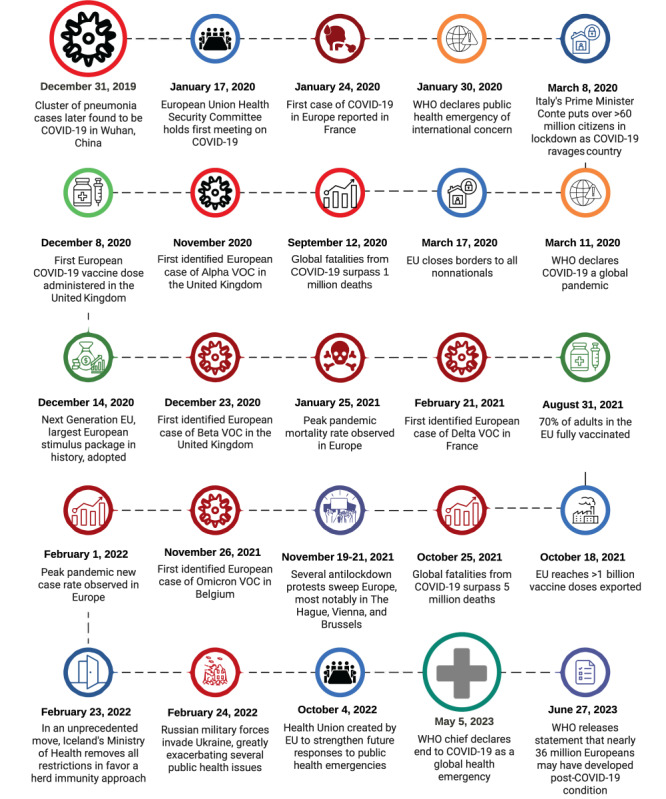
We first aimed to measure whether there was an expansion or contraction in the pandemic in Europe at the time of the WHO declaration. Second, we used dynamic and genomic surveillance methods to describe the history of the pandemic in the region and situate the window of the WHO declaration within the broader history. Third, we provided the historical context for the course of the pandemic in Europe in terms of policy and disease burden at the country and region levels.

METHODS

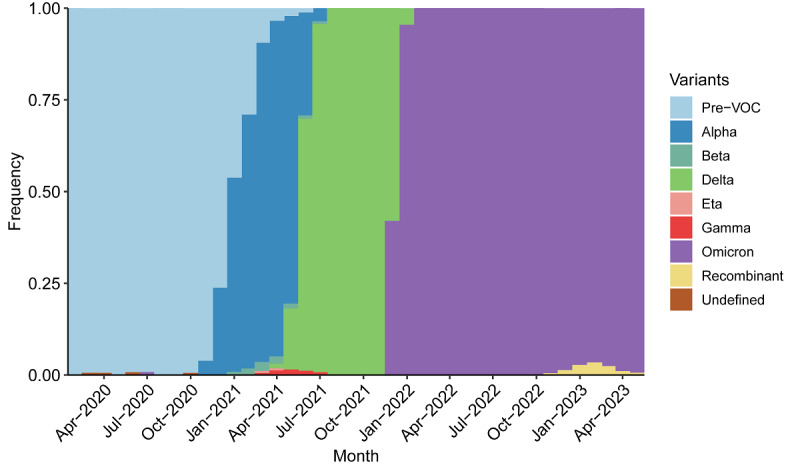
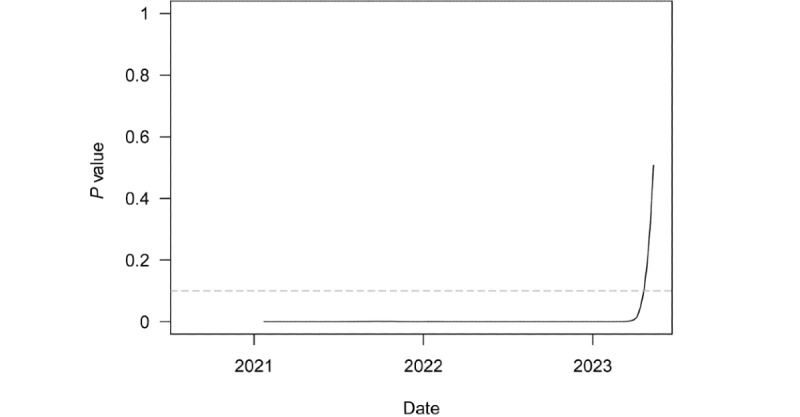
In addition to the updates of traditional surveillance data and dynamic panel estimates from the original study, this study used data on sequenced SARS-CoV-2 variants from the Global Initiative on Sharing All Influenza Data to identify the appearance and duration of variants of concern. We used Nextclade nomenclature to collect clade designations from sequences and Pangolin nomenclature for lineage designations of SARS-CoV-2. Finally, we conducted a 1-tailed t test for whether regional weekly speed was greater than an outbreak threshold of 10. We ran the test iteratively with 6 months of data across the sample period.

RESULTS

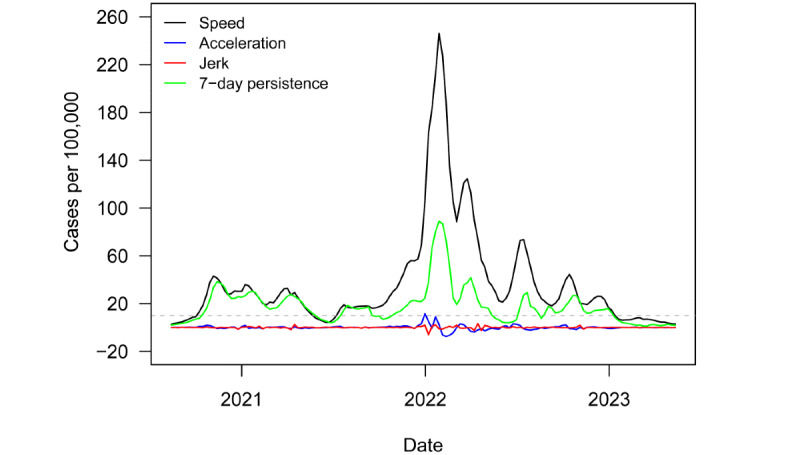
Speed for the region had remained below the outbreak threshold for 4 months by the time of the WHO declaration. Acceleration and jerk were also low and stable. While the 1-day and 7-day persistence coefficients remained statistically significant, the coefficients were moderate in magnitude (0.404 and 0.547, respectively; P<.001 for both). The shift parameters for the 2 weeks around the WHO declaration were small and insignificant, suggesting little change in the clustering effect of cases on future cases at the time. From December 2021 onward, Omicron was the predominant variant of concern in sequenced viral samples. The rolling t test of speed equal to 10 became insignificant for the first time in April 2023.

CONCLUSIONS

While COVID-19 continues to circulate in Europe, the rate of transmission remained below the threshold of an outbreak for 4 months ahead of the WHO declaration. The region had previously been in a nearly continuous state of outbreak. The more recent trend suggested that COVID-19 was endemic in the region and no longer reached the threshold of the pandemic definition. However, several countries remained in a state of outbreak, and the conclusion that COVID-19 was no longer a pandemic in Europe at the time is unclear.

摘要

背景

本研究在我们 2020 年发表的初步研究基础上,纳入了欧洲另外 2 年的数据。我们评估了在世界卫生组织(WHO)于 2023 年 5 月 5 日宣布结束国际关注的突发公共卫生事件时,该地区的 COVID-19 是否已从大流行阶段进入流行阶段。

目的

首先,我们旨在衡量在 WHO 宣布之时,欧洲大流行是否在扩张或收缩。其次,我们使用动态和基因组监测方法来描述该地区大流行的历史,并将 WHO 宣布的窗口期置于更广泛的历史背景中。第三,我们从国家和地区层面的政策和疾病负担方面为欧洲大流行的进程提供历史背景。

方法

除了对原始研究中的传统监测数据和动态面板估计进行更新外,本研究还使用了来自全球共享所有流感数据倡议的 SARS-CoV-2 测序变体数据,以确定关注变体的出现和持续时间。我们使用 Nextclade 命名法从序列中收集分支名称,并使用 Pangolin 命名法对 SARS-CoV-2 的谱系名称进行分类。最后,我们对区域每周速度是否大于 10 的暴发阈值进行了单侧 t 检验。我们使用样本期内 6 个月的数据迭代进行了测试。

结果

到 WHO 宣布之时,该地区的速度已经连续 4 个月低于暴发阈值。加速度和急动度也较低且稳定。虽然 1 天和 7 天的持续系数仍具有统计学意义,但系数的幅度适中(分别为 0.404 和 0.547;两者均 P<.001)。在 WHO 宣布前后的两周内,转移参数很小且无统计学意义,这表明未来病例的病例聚类效应几乎没有变化。自 2021 年 12 月以来,Omicron 一直是测序病毒样本中主要的关注变体。2023 年 4 月,速度的滚动 t 检验首次变得不显著。

结论

尽管 COVID-19 在欧洲继续传播,但在 WHO 宣布前的 4 个月内,传播率仍低于暴发阈值。该地区此前一直处于几乎连续的暴发状态。最近的趋势表明,COVID-19 在该地区已成为流行,不再符合大流行定义的阈值。然而,一些国家仍处于暴发状态,因此当时 COVID-19 在欧洲不再是大流行的结论尚不清楚。
https://cdn.ncbi.nlm.nih.gov/pmc/blobs/7021/11226935/4f254cff8c89/publichealth_v10i1e53551_fig4.jpg
https://cdn.ncbi.nlm.nih.gov/pmc/blobs/7021/11226935/a398dc3bd8d2/publichealth_v10i1e53551_fig1.jpg
https://cdn.ncbi.nlm.nih.gov/pmc/blobs/7021/11226935/ea3a7e2dccd0/publichealth_v10i1e53551_fig2.jpg
https://cdn.ncbi.nlm.nih.gov/pmc/blobs/7021/11226935/6ce665ae3682/publichealth_v10i1e53551_fig3.jpg
https://cdn.ncbi.nlm.nih.gov/pmc/blobs/7021/11226935/4f254cff8c89/publichealth_v10i1e53551_fig4.jpg
https://cdn.ncbi.nlm.nih.gov/pmc/blobs/7021/11226935/a398dc3bd8d2/publichealth_v10i1e53551_fig1.jpg
https://cdn.ncbi.nlm.nih.gov/pmc/blobs/7021/11226935/ea3a7e2dccd0/publichealth_v10i1e53551_fig2.jpg
https://cdn.ncbi.nlm.nih.gov/pmc/blobs/7021/11226935/6ce665ae3682/publichealth_v10i1e53551_fig3.jpg
https://cdn.ncbi.nlm.nih.gov/pmc/blobs/7021/11226935/4f254cff8c89/publichealth_v10i1e53551_fig4.jpg

相似文献

1
Updated Surveillance Metrics and History of the COVID-19 Pandemic (2020-2023) in Europe: Longitudinal Trend Analysis.欧洲 2020-2023 年 COVID-19 大流行的更新监测指标和历史:纵向趋势分析。
JMIR Public Health Surveill. 2024 Jun 21;10:e53551. doi: 10.2196/53551.
2
Surveillance Metrics and History of the COVID-19 Pandemic in Central Asia: Updated Epidemiological Assessment.中亚地区 COVID-19 大流行的监测指标和历史:更新的流行病学评估。
JMIR Public Health Surveill. 2024 Aug 28;10:e52318. doi: 10.2196/52318.
3
Surveillance of the Second Wave of COVID-19 in Europe: Longitudinal Trend Analyses.欧洲 COVID-19 第二波疫情监测:纵向趋势分析。
JMIR Public Health Surveill. 2021 Apr 28;7(4):e25695. doi: 10.2196/25695.
4
South Asia's COVID-19 History and Surveillance: Updated Epidemiological Assessment.南亚的 COVID-19 历史与监测:最新流行病学评估。
JMIR Public Health Surveill. 2024 Aug 26;10:e53331. doi: 10.2196/53331.
5
Updated Surveillance Metrics and History of the COVID-19 Pandemic (2020-2023) in Latin America and the Caribbean: Longitudinal Trend Analysis.拉丁美洲和加勒比地区 COVID-19 大流行(2020-2023 年)的更新监测指标和历史:纵向趋势分析。
JMIR Public Health Surveill. 2024 May 17;10:e44398. doi: 10.2196/44398.
6
Updated Surveillance Metrics and History of the COVID-19 Pandemic (2020-2023) in the Middle East and North Africa: Longitudinal Trend Analysis.中东和北非地区 2020-2023 年 COVID-19 大流行的更新监测指标和历史:纵向趋势分析。
JMIR Public Health Surveill. 2024 Jun 12;10:e53219. doi: 10.2196/53219.
7
Updated Surveillance Metrics and History of the COVID-19 Pandemic (2020-2023) in Sub-Saharan Africa: Longitudinal Trend Analysis.撒哈拉以南非洲地区 2020-2023 年 COVID-19 大流行的更新监测指标和历史:纵向趋势分析。
JMIR Public Health Surveill. 2024 Oct 23;10:e53409. doi: 10.2196/53409.
8
Surveillance Metrics of SARS-CoV-2 Transmission in Central Asia: Longitudinal Trend Analysis.中亚地区 SARS-CoV-2 传播的监测指标:纵向趋势分析。
J Med Internet Res. 2021 Feb 3;23(2):e25799. doi: 10.2196/25799.
9
Moving forward after the COVID-19 pandemic: Lessons learned in primary care from the multi-country PRICOV-19 study.后 COVID-19 大流行时代:多国 PRICOV-19 研究中初级保健的经验教训。
Eur J Gen Pract. 2024 Dec;30(1):2328716. doi: 10.1080/13814788.2024.2328716. Epub 2024 Mar 21.
10
SARS-CoV-2 Wave Two Surveillance in East Asia and the Pacific: Longitudinal Trend Analysis.东亚和太平洋地区的 SARS-CoV-2 第二波监测:纵向趋势分析。
J Med Internet Res. 2021 Feb 1;23(2):e25454. doi: 10.2196/25454.

引用本文的文献

1
Updated Surveillance Metrics and History of the COVID-19 Pandemic (2020-2023) in East Asia and the Pacific Region: Longitudinal Trend Analysis.东亚及太平洋地区2019冠状病毒病大流行(2020 - 2023年)的最新监测指标与历史:纵向趋势分析
JMIR Public Health Surveill. 2025 Feb 21;11:e53214. doi: 10.2196/53214.

本文引用的文献

1
Development and validation of the pandemic fatigue scale.大流行疲劳量表的编制与验证。
Nat Commun. 2023 Oct 10;14(1):6352. doi: 10.1038/s41467-023-42063-2.
2
Policies on children and schools during the SARS-CoV-2 pandemic in Western Europe.西欧 SARS-CoV-2 大流行期间的儿童和学校政策。
Front Public Health. 2023 Jul 25;11:1175444. doi: 10.3389/fpubh.2023.1175444. eCollection 2023.
3
Enhanced surveillance of hospitalised COVID-19 patients in Europe: I-MOVE-COVID-19 surveillance network, February 2020 to December 2021.
欧洲对住院 COVID-19 患者的强化监测:I-MOVE-COVID-19 监测网络,2020 年 2 月至 2021 年 12 月。
Euro Surveill. 2023 Jun;28(26). doi: 10.2807/1560-7917.ES.2023.28.26.2200669.
4
WHO ends the COVID-19 public health emergency.世界卫生组织结束新冠疫情全球公共卫生紧急状态。
Lancet Respir Med. 2023 Jul;11(7):588. doi: 10.1016/S2213-2600(23)00217-5. Epub 2023 May 26.
5
No time for complacency on COVID-19 in Europe.欧洲在新冠疫情问题上没有时间沾沾自喜。
Lancet. 2023 Jun 10;401(10392):1909-1912. doi: 10.1016/S0140-6736(23)01012-7. Epub 2023 May 22.
6
COVID-19 hospitalisations and all-cause mortality by risk group in Finland.芬兰按风险组划分的 COVID-19 住院和全因死亡率。
PLoS One. 2023 May 23;18(5):e0286142. doi: 10.1371/journal.pone.0286142. eCollection 2023.
7
Seasonal trends in COVID-19 cases, hospitalizations, and mortality in the United States and Europe.美国和欧洲 COVID-19 病例、住院和死亡的季节性趋势。
Sci Rep. 2023 Mar 8;13(1):3886. doi: 10.1038/s41598-023-31057-1.
8
COVID-19 in Europe: from outbreak to vaccination.欧洲的 COVID-19 疫情:从爆发到接种疫苗。
BMC Public Health. 2022 Dec 2;22(1):2245. doi: 10.1186/s12889-022-14454-5.
9
The interplay among COVID-19 economic recovery, behavioural changes, and the European Green Deal: An energy-economic modelling perspective.新冠疫情经济复苏、行为变化与欧洲绿色协议之间的相互作用:能源经济建模视角
Energy (Oxf). 2023 Jan 15;263:125798. doi: 10.1016/j.energy.2022.125798. Epub 2022 Oct 31.
10
How the COVID-19 pandemic divides society: Towards a better understanding of differences between supporters and opponents of the COVID-19 pandemic lockdown in Germany.**新冠大流行如何分裂社会**:更好地理解德国支持和反对新冠大流行封锁措施人群之间的差异。
J Psychiatr Res. 2022 Nov;155:232-240. doi: 10.1016/j.jpsychires.2022.09.001. Epub 2022 Sep 7.