The University of Texas MD Anderson Cancer Center, Department of Bioinformatics and Computation Biology, Houston, TX.
Rice University, Department of Statistics, Houston, TX.
J Clin Oncol. 2024 Jun 20;42(18):2186-2195. doi: 10.1200/JCO.23.01926. Epub 2024 Apr 3.
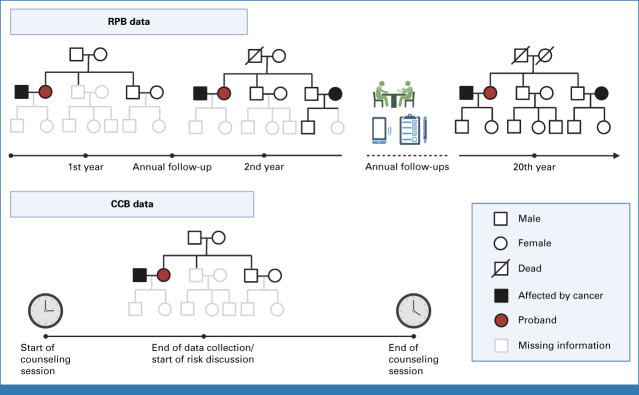
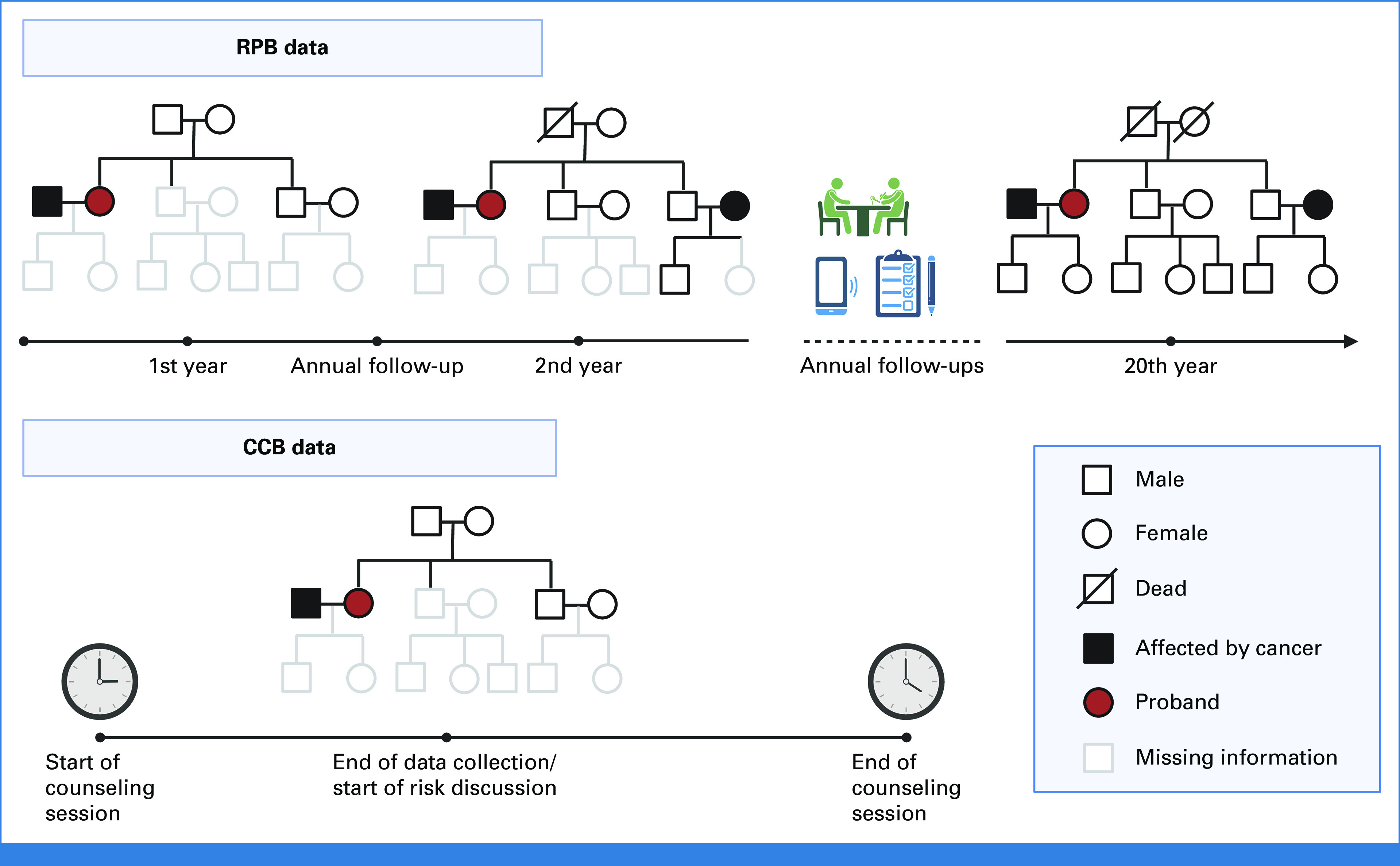
There exists a barrier between developing and disseminating risk prediction models in clinical settings. We hypothesize that this barrier may be lifted by demonstrating the utility of these models using incomplete data that are collected in real clinical sessions, as compared with the commonly used research cohorts that are meticulously collected.
Genetic counselors (GCs) collect family history when patients (ie, probands) come to MD Anderson Cancer Center for risk assessment of Li-Fraumeni syndrome, a genetic disorder characterized by deleterious germline mutations in the gene. Our clinical counseling-based (CCB) cohort consists of 3,297 individuals across 124 families (522 cases of single primary cancer and 125 cases of multiple primary cancers). We applied our software suite LFSPRO to make risk predictions and assessed performance in discrimination using AUC and in calibration using observed/expected (O/E) ratio.
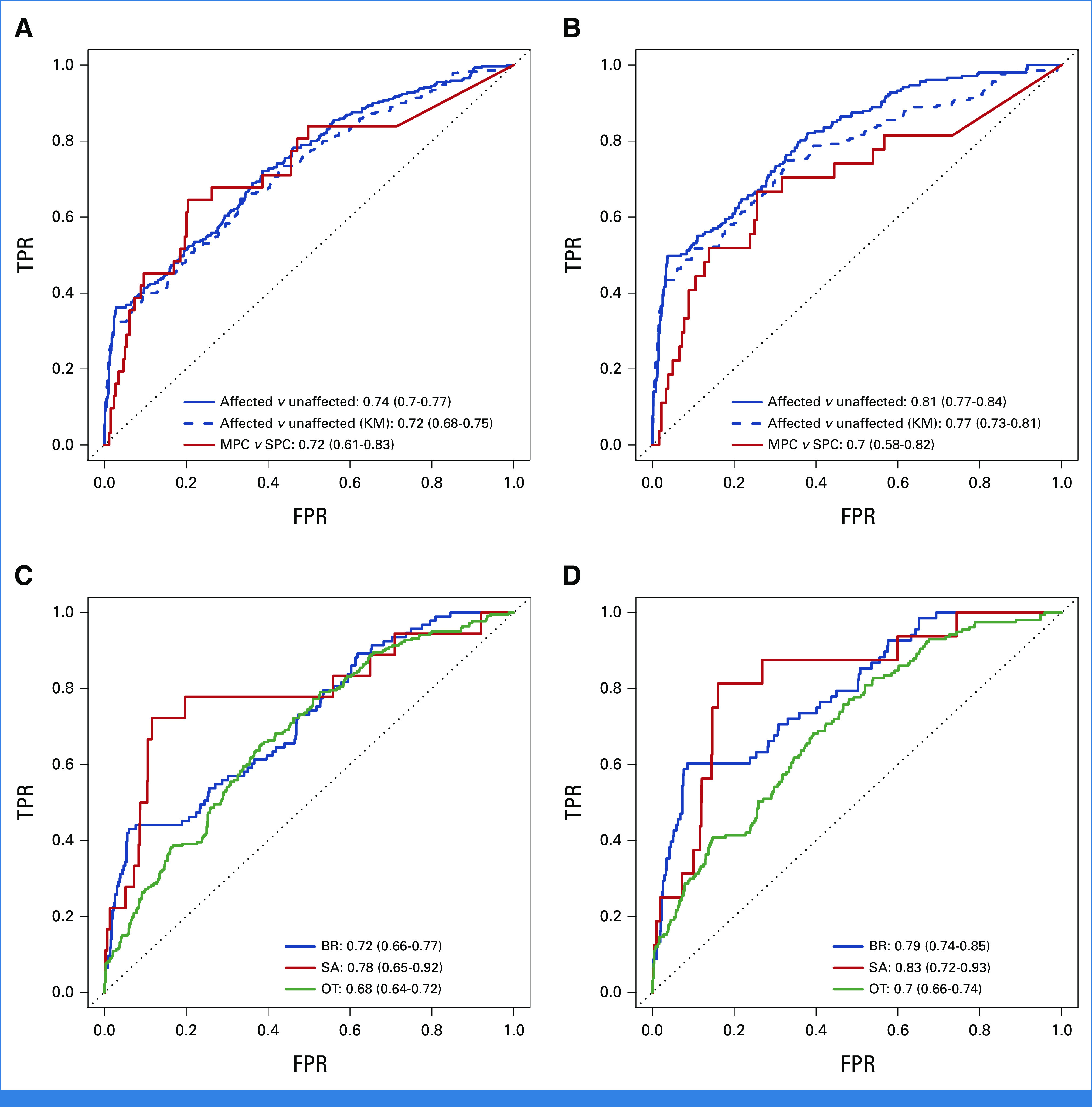
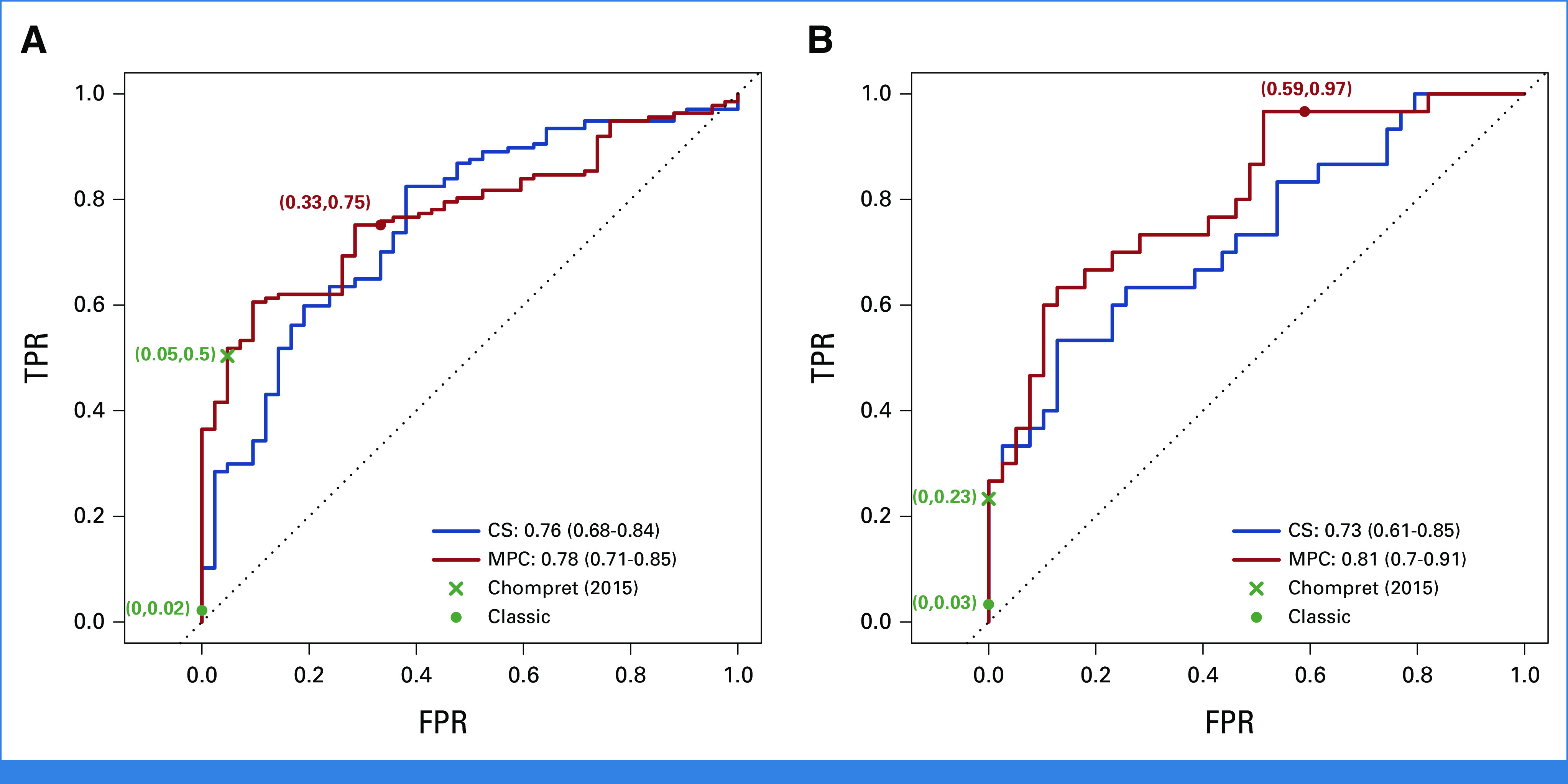
For prediction of deleterious mutations, we achieved an AUC of 0.78 (95% CI, 0.71 to 0.85) and an O/E ratio of 1.66 (95% CI, 1.53 to 1.80). Using the LFSPRO.MPC model to predict the onset of the second cancer, we obtained an AUC of 0.70 (95% CI, 0.58 to 0.82). Using the LFSPRO.CS model to predict the onset of different cancer types as the first primary, we achieved AUCs between 0.70 and 0.83 for sarcoma, breast cancer, or other cancers combined.
We describe a study that fills in the critical gap in knowledge for the utility of risk prediction models. Using a CCB cohort, our previously validated models have demonstrated good performance and outperformed the standard clinical criteria. Our study suggests that better risk counseling may be achieved by GCs using these already-developed mathematical models.
在临床环境中开发和传播风险预测模型存在障碍。我们假设,通过使用在真实临床会议中收集的不完整数据来展示这些模型的实用性,可以消除这一障碍,而不是使用精心收集的常用研究队列。
遗传咨询师 (GC) 在患者(即先证者)来 MD 安德森癌症中心进行 Li-Fraumeni 综合征风险评估时收集家族史,Li-Fraumeni 综合征是一种遗传疾病,其特征是 基因的有害种系突变。我们的基于临床咨询 (CCB) 的队列包括 124 个家庭的 3297 个人(522 例单一原发性癌症和 125 例多原发性癌症)。我们应用我们的 LFSPRO 软件套件进行风险预测,并使用 AUC 评估区分性能,使用观察到的/预期的 (O/E) 比率评估校准性能。
对于有害 突变的预测,我们获得了 0.78(95%CI,0.71 至 0.85)的 AUC 和 1.66(95%CI,1.53 至 1.80)的 O/E 比率。使用 LFSPRO.MPC 模型预测第二癌症的发病,我们得到了 0.70(95%CI,0.58 至 0.82)的 AUC。使用 LFSPRO.CS 模型预测作为第一原发癌的不同癌症类型的发病,我们获得了 0.70 至 0.83 的 AUC 用于肉瘤、乳腺癌或其他癌症的组合。
我们描述了一项研究,该研究填补了风险预测模型实用性方面知识的关键空白。使用 CCB 队列,我们之前验证的模型表现出良好的性能,并优于标准临床标准。我们的研究表明,遗传咨询师通过使用这些已经开发的数学模型,可以实现更好的风险咨询。