Department of Prevention Research and Social Medicine, Institute for Community Medicine, University Medical Center Greifswald, Walther-Rathenau-Str. 48, 17475, Greifswald, Germany.
Department of General Practice, Institute for Community Medicine, University Medical Center Greifswald, Greifswald, Germany.
Trials. 2024 Apr 3;25(1):229. doi: 10.1186/s13063-024-08066-0.
To date, colchicine and prednisolone are two effective therapies for the treatment of acute gout but have never been compared directly in a randomized clinical trial. In addition, in previous trials of treating acute gout patients with concomitant comorbidities were often excluded due to contraindications to naproxen.
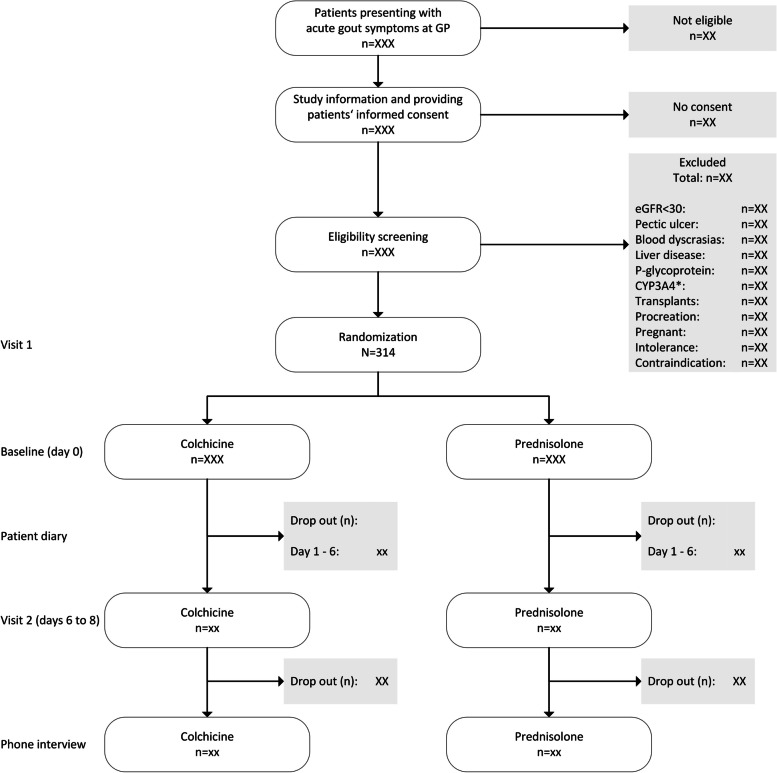
This pragmatic, prospective, double-blind, double-dummy, parallel-group, randomized, non-inferiority trial compares prednisolone with colchicine in terms of non-inferiority in patients with acute gout. Patients presenting to their general practitioner with acute gout can be included if the gout attack has occurred within the last 2 days. A total of 60 practices in the vicinity of three university medical centers (Greifswald, Göttingen, and Würzburg) participate in the study. The intervention group receives 30 mg prednisolone for 5 days, while the group of standard care receives low-dose colchicine (day 1: 1.5 mg; days 2-5: 1 mg). The first dose of treatment is provided at day 0 when patients present to the general practitioner due to an acute gout attack. From day 0 to day 6, patients will be asked to complete a study diary on daily basis regarding pain quantification. For safety reasons, potential side effects and the course of systolic blood pressure are also assessed.
N = 314 patients have to be recruited to compensate for 10% of dropout and to allow for showing non-inferiority of prednisolone compared to colchicine with a power of 90%. We use permuted block randomization with block sizes of 2, 4, and 6 to avoid imbalanced treatment arms in this multi-center study; patients are randomized in a 1:1 ratio. The absolute level of pain on day 3 (in the last 24 h) is the primary outcome and measured on a numerical rating scale (NRS: 0-10). Using a multiple linear regression model adjusted for age, sex, and pain at baseline, prednisolone is considered non-inferior if the effect estimate including the confidence intervals is lower than a margin of 1 unit on the NRS. Average response to treatment, joint swelling and tenderness, physical function of the joint, and patients' global assessment of treatment success are secondary outcomes.
The trial will provide evidence from a direct comparison of colchicine and prednisolone regarding their efficacy of pain reduction in acute gout patients of primary care and to indicate possible safety signals.
ClinicalTrials.gov Identifier: NCT05698680 first posted on January 26, 2023 (retrospectively registered).
迄今为止,秋水仙碱和泼尼松龙是两种治疗急性痛风的有效疗法,但从未在随机临床试验中进行过直接比较。此外,在以前的治疗急性痛风患者的试验中,由于萘普生的禁忌证,往往排除了伴有合并症的患者。
这是一项实用的、前瞻性的、双盲、双模拟、平行组、随机、非劣效性试验,比较了泼尼松龙和秋水仙碱在急性痛风患者中的非劣效性。如果痛风发作发生在过去 2 天内,全科医生就诊的急性痛风患者可以入组。该研究共有来自三家大学医学中心(格赖夫斯瓦尔德、哥廷根和维尔茨堡)附近的 60 家诊所参与。干预组接受 30 mg 泼尼松龙治疗 5 天,而标准治疗组接受小剂量秋水仙碱(第 1 天:1.5 mg;第 2-5 天:1 mg)。当患者因急性痛风发作就诊全科医生时,在第 0 天给予首剂治疗。从第 0 天到第 6 天,患者将每天在研究日记中完成疼痛量化的记录。出于安全原因,还评估了潜在的副作用和收缩压的变化。
需要招募 314 名患者,以弥补 10%的脱落率,并允许用 90%的效力证明泼尼松龙与秋水仙碱相比的非劣效性。我们使用区组随机化,区组大小为 2、4 和 6,以避免在这项多中心研究中出现治疗组不平衡;患者以 1:1 的比例随机分组。第 3 天(最后 24 小时)的绝对疼痛水平(数字评分量表[NRS]:0-10)是主要结局,并进行测量。使用调整年龄、性别和基线疼痛的多元线性回归模型,如果效应估计值包括置信区间低于 NRS 上 1 个单位的边界,则认为泼尼松龙具有非劣效性。平均治疗反应、关节肿胀和压痛、关节的身体功能以及患者对治疗成功的总体评估是次要结局。
该试验将提供秋水仙碱和泼尼松龙在初级保健急性痛风患者中减轻疼痛的疗效的直接比较证据,并提示可能的安全信号。
ClinicalTrials.gov 标识符:NCT05698680 于 2023 年 1 月 26 日首次发布(回顾性注册)。