Department of Research and Evaluation, Kaiser Permanente Southern California, Pasadena, CA, USA.
Department of Epidemiology, University of Alabama at Birmingham, Birmingham, AL, USA.
Hum Vaccin Immunother. 2024 Dec 31;20(1):2335052. doi: 10.1080/21645515.2024.2335052. Epub 2024 Apr 4.
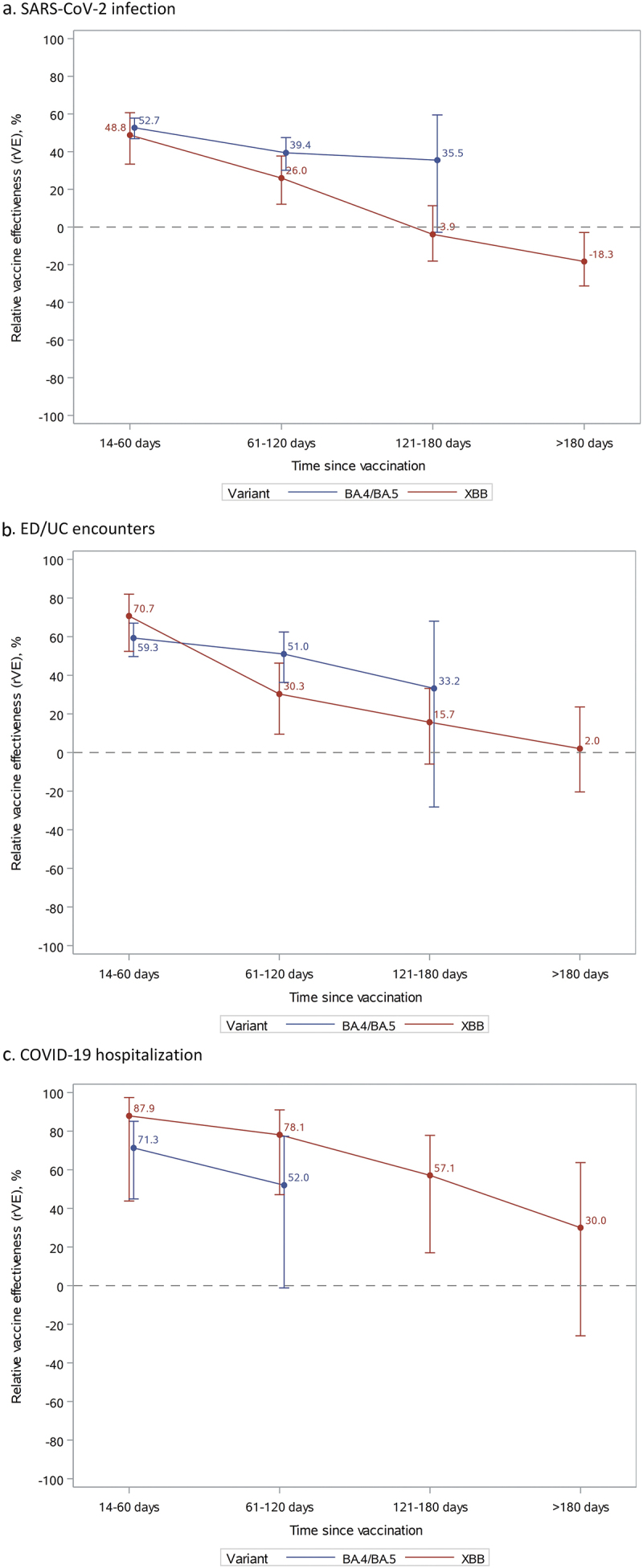
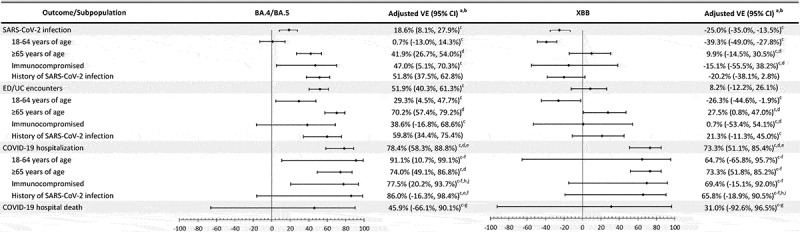
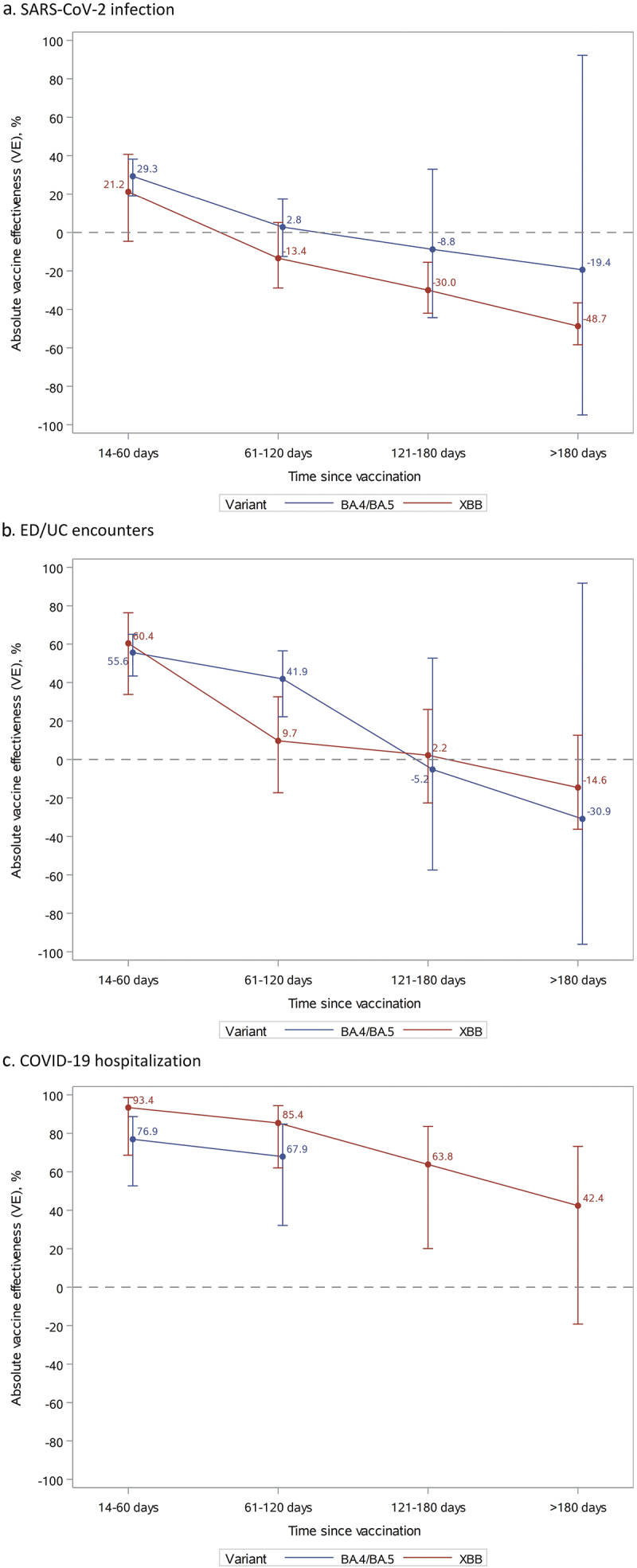
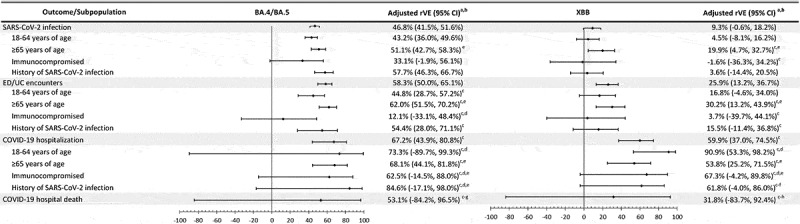
Emerging SARS-CoV-2 sublineages continue to cause serious COVID-19 disease, but most individuals have not received any COVID-19 vaccine for >1 year. Assessment of long-term effectiveness of bivalent COVID-19 vaccines against circulating sublineages is important to inform the potential need for vaccination with updated vaccines. In this test-negative study at Kaiser Permanente Southern California, sequencing-confirmed BA.4/BA.5- or XBB-related SARS-CoV-2-positive cases (September 1, 2022 to June 30, 2023), were matched 1:3 to SARS-CoV-2-negative controls. We assessed mRNA-1273 bivalent relative (rVE) and absolute vaccine effectiveness (VE) compared to ≥2 or 0 doses of original monovalent vaccine, respectively. The rVE analysis included 20,966 cases and 62,898 controls. rVE (95%CI) against BA.4/BA.5 at 14-60 days and 121-180 days was 52.7% (46.9-57.8%) and 35.5% (-2.8-59.5%) for infection, and 59.3% (49.7-67.0%) and 33.2% (-28.2-68.0%) for Emergency Department/Urgent Care (ED/UC) encounters. For BA.4/BA.5-related hospitalizations, rVE was 71.3% (44.9-85.1%) and 52.0% (-1.2-77.3%) at 14-60 days and 61-120 days, respectively. rVE against XBB at 14-60 days and 121-180 days was 48.8% (33.4-60.7%) and -3.9% (-18.1-11.3%) for infection, 70.7% (52.4-82.0%) and 15.7% (-6.0-33.2%) for ED/UC encounters, and 87.9% (43.8-97.4%) and 57.1% (17.0-77.8%) for hospitalization. VE and subgroup analyses (age, immunocompromised status, previous SARS-CoV-2 infection) results were similar to rVE analyses. rVE of mRNA-1273 bivalent vaccine against BA.4/BA.5 and XBB infections, ED/UC encounters, and hospitalizations waned over time. Periodic revaccination with vaccines targeting emerging variants may be important in reducing COVID-19 morbidity and mortality.
在这项由凯撒永久南加州医疗集团进行的病例对照研究中,我们对 2022 年 9 月 1 日至 2023 年 6 月 30 日期间,通过测序确认的 BA.4/BA.5 或 XBB 相关 SARS-CoV-2 阳性病例(病例组)与 SARS-CoV-2 阴性对照(对照组)进行了 1:3 匹配。我们评估了 mRNA-1273 二价疫苗相对于≥2 剂或 0 剂原始单价疫苗的相对疫苗有效性 (rVE) 和绝对疫苗有效性 (VE)。rVE 分析包括 20966 例病例和 62898 例对照。在 14-60 天和 121-180 天,BA.4/BA.5 感染的 rVE(95%CI)为 52.7%(46.9-57.8%)和 35.5%(-2.8-59.5%),急诊/紧急护理(ED/UC)就诊的 rVE 为 59.3%(49.7-67.0%)和 33.2%(-28.2-68.0%)。对于 BA.4/BA.5 相关住院患者,在 14-60 天和 61-120 天,BA.4/BA.5 相关住院的 rVE 分别为 71.3%(44.9-85.1%)和 52.0%(-1.2-77.3%)。在 14-60 天和 121-180 天,XBB 感染的 rVE 为 48.8%(33.4-60.7%)和-3.9%(-18.1-11.3%),ED/UC 就诊的 rVE 为 70.7%(52.4-82.0%)和 15.7%(-6.0-33.2%),住院的 rVE 为 87.9%(43.8-97.4%)和 57.1%(17.0-77.8%)。VE 和亚组分析(年龄、免疫功能低下状态、既往 SARS-CoV-2 感染)的结果与 rVE 分析相似。mRNA-1273 二价疫苗对 BA.4/BA.5 和 XBB 感染、ED/UC 就诊和住院的 rVE 随时间推移而减弱。针对新出现的变异株定期进行疫苗接种可能对降低 COVID-19 的发病率和死亡率非常重要。