School of Biomedical Engineering and Imaging Sciences, King's College London, London, UK.
MRC Unit for Lifelong Health and Ageing at UCL, Department of Population Science and Experimental Medicine, University College London, London, UK.
Eur Respir J. 2024 Jul 18;64(1). doi: 10.1183/13993003.01853-2023. Print 2024 Jul.
Some individuals experience prolonged illness after acute coronavirus disease 2019 (COVID-19). We assessed whether pre-infection symptoms affected post-acute COVID illness duration.
Survival analysis was performed in adults (n=23 452) with community-managed severe acute respiratory syndrome coronavirus 2 (SARS-CoV-2) infection prospectively self-logging data through the ZOE COVID Symptom Study app, at least weekly, from 8 weeks before to 12 weeks after COVID-19 onset, conditioned on presence absence of baseline symptoms (4-8 weeks before COVID-19). A case-control study was performed in 1350 individuals with long illness (≥8 weeks, including 906 individuals (67.1%) with illness ≥12 weeks), matched 1:1 (for age, sex, body mass index, testing week, prior infection, vaccination, smoking, index of multiple deprivation) with 1350 individuals with short illness (<4 weeks). Baseline symptoms were compared between the two groups, and against post-COVID symptoms.
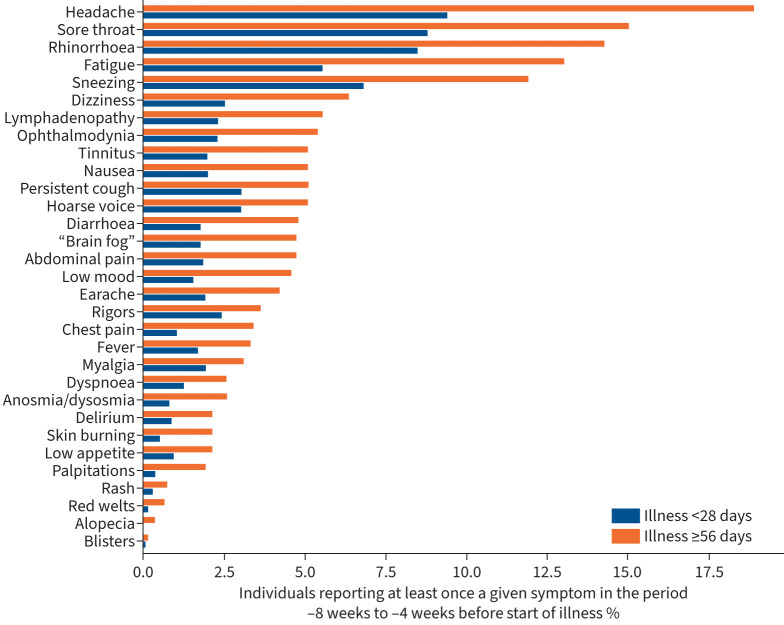
Individuals reporting baseline symptoms had longer COVID-related symptom duration (median 15 days 10 days for individuals without baseline symptoms) with baseline fatigue nearly doubling duration. Two-thirds (910 (67.4%) of 1350) of individuals with long illness were asymptomatic beforehand. However, 440 (32.6%) had baseline symptoms, 255 (18.9%) of 1350 individuals with short illness (p<0.0001). Baseline symptoms doubled the odds ratio for long illness (2.14, 95% CI 1.78-2.57). Prior comorbidities were more common in individuals with long short illness. In individuals with long illness, baseline symptomatic ( asymptomatic) individuals were more likely to be female, younger, and have prior comorbidities; and baseline and post-acute symptoms, and symptom burden, correlated strongly.
Individuals experiencing symptoms before COVID-19 had longer illness duration and increased odds of long illness. However, many individuals with long illness were well before SARS-CoV-2 infection.
一些人在急性冠状病毒病 2019(COVID-19)后会经历长时间的疾病。我们评估了感染前的症状是否会影响急性 COVID 后疾病的持续时间。
对通过 ZOE COVID 症状研究应用程序前瞻性自我记录数据的 23452 名社区管理的严重急性呼吸综合征冠状病毒 2(SARS-CoV-2)感染成年人进行生存分析,时间至少每周一次,从 COVID-19 发病前 4-8 周开始,到 COVID-19 发病后 12 周结束,条件是存在或不存在基线症状(COVID-19 发病前 4-8 周)。对 1350 名患病时间较长(≥8 周,包括 906 名(67.1%)患病时间≥12 周)的个体进行病例对照研究,与 1350 名患病时间较短(<4 周)的个体 1:1 匹配(年龄、性别、体重指数、检测周、既往感染、接种疫苗、吸烟、剥夺指数)。比较两组之间以及与 COVID 后症状的基线症状。
报告基线症状的个体 COVID 相关症状持续时间较长(中位数 15 天 10 天,无基线症状个体),基线疲劳几乎使病程延长一倍。三分之二(1350 人中的 910 人,67.4%)长病患者在此前无症状。然而,440 人(1350 人中有 32.6%)有基线症状,而 255 人(1350 人中有 18.9%)有短期疾病(p<0.0001)。基线症状使长期疾病的优势比翻倍(2.14,95%CI 1.78-2.57)。患有长 短疾病的个体更常见先前的合并症。在长期疾病患者中,基线有症状(无症状)个体更可能是女性、年龄较小且有先前的合并症;并且基线和急性后症状以及症状负担高度相关。
在 COVID-19 之前出现症状的个体疾病持续时间更长,患长期疾病的几率更高。然而,许多患有长期疾病的个体在 SARS-CoV-2 感染之前就已经出现了症状。