Izadi Mahmoud, Ali Tayyiba Akbar, Shurrab Farah M, Aharpour Ebrahim, Pourkarimi Ehsan
Division of Genomics and Translational Medicine, College of Health and Life Sciences, Hamad Bin Khalifa University, Qatar Foundation, Doha, 34110, Qatar.
Kevlarr B.V, Nieuwegein, 3436ZZ, Netherlands.
Cell Death Discov. 2024 Apr 4;10(1):165. doi: 10.1038/s41420-024-01917-4.
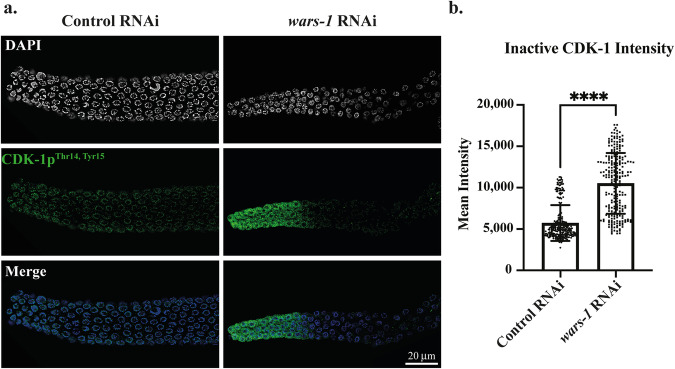
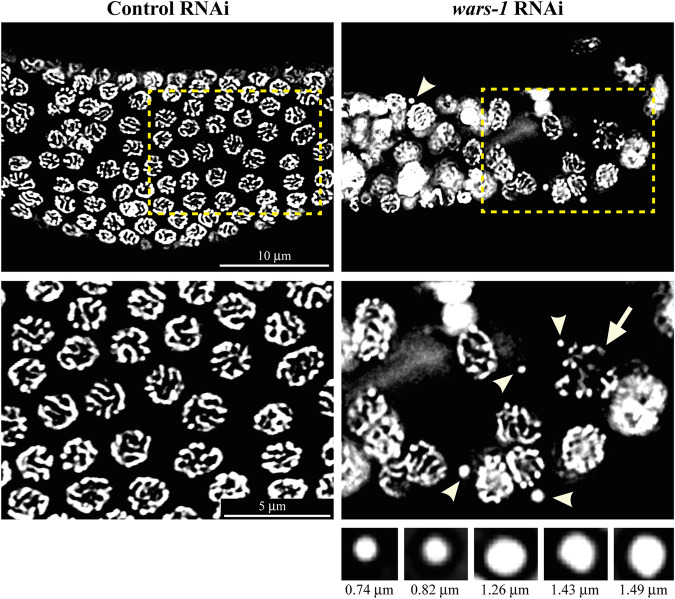
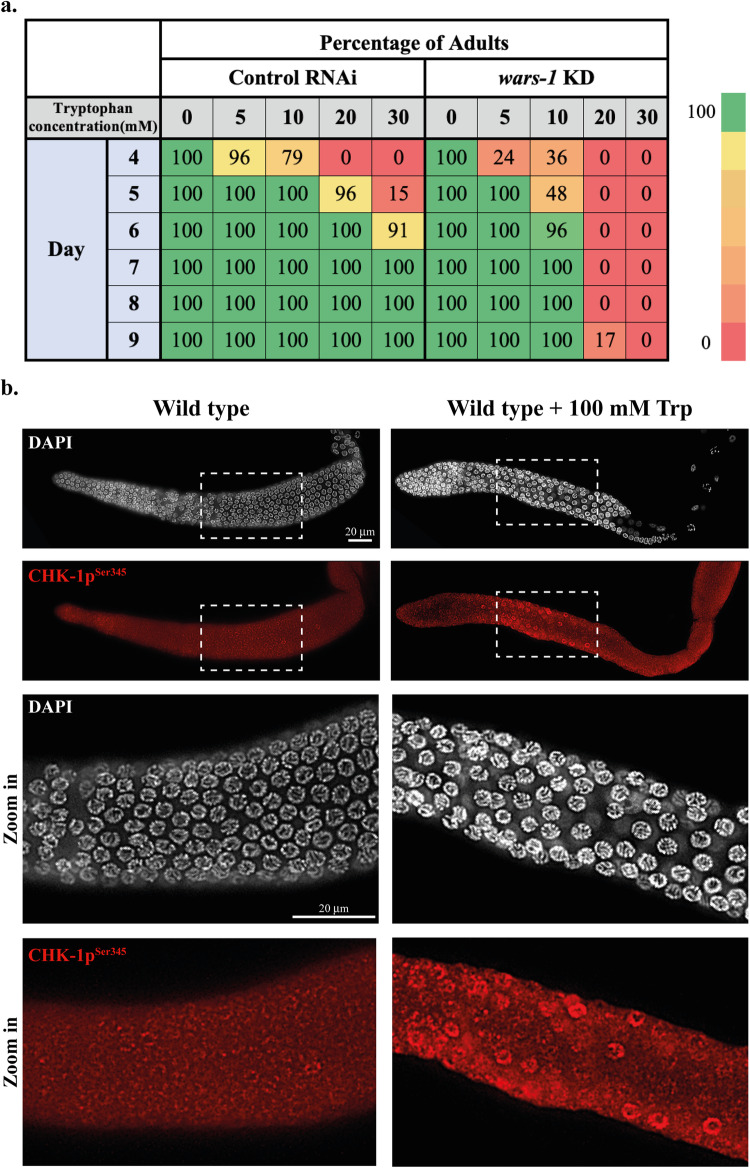
The fidelity of translation is ensured by a family of proteins named aminoacyl-tRNA synthetases (ARSs), making them crucial for development and survival. More recently, mutations in the tryptophanyl-tRNA synthetase 1 (WARS1) have been linked to various human diseases, from intellectual disability to various types of cancer. To understand the function of WARS1, we investigated the effect of WARS-1 depletion during the mitotic and meiotic cell cycle in the developing germline of Caenorhabditis elegans (C. elegans) and demonstrated the role of WARS-1 in genome integrity. wars-1 knockdown results in cell cycle arrest of the mitotically active germ cells. Such mitotic arrest is also associated with canonical DNA damage-induced checkpoint signaling in mitotic and meiotic germ cells. Significantly, such DNA checkpoint activation is associated with the morphological anomalies in chromatin structures that are the hallmarks of genome instability, such as the formation of chromatin bridges, micronuclei, and chromatin buds. We demonstrated that knocking down wars-1 results in an elevation of the intracellular concentration of tryptophan and its catabolites, a surprising finding emphasizing the impact of cellular amino acid availability and organismal/individual dietary uptake on genome integrity. Our result demonstrates that exposing C. elegans to a high tryptophan dosage leads to DNA damage checkpoint activation and a significant increase in the tryptophan metabolites. Targeting tryptophan catabolism, the least utilized amino acid in nature, can be important in developing new cancer therapeutic approaches. All in all, we have strong evidence that knocking down wars-1 results in defects in genomic integrity.
一类名为氨酰 - tRNA合成酶(ARSs)的蛋白质确保了翻译的保真度,这使得它们对发育和生存至关重要。最近,色氨酰 - tRNA合成酶1(WARS1)的突变与从智力残疾到各种类型癌症的多种人类疾病有关。为了了解WARS1的功能,我们研究了秀丽隐杆线虫(C. elegans)发育中的生殖系在有丝分裂和减数分裂细胞周期中WARS - 1缺失的影响,并证明了WARS - 1在基因组完整性中的作用。敲低wars - 1会导致有丝分裂活跃的生殖细胞的细胞周期停滞。这种有丝分裂停滞也与有丝分裂和减数分裂生殖细胞中典型的DNA损伤诱导的检查点信号传导有关。值得注意的是,这种DNA检查点激活与染色质结构的形态异常有关,这些异常是基因组不稳定的标志,例如染色质桥、微核和染色质芽的形成。我们证明敲低wars - 1会导致色氨酸及其代谢产物的细胞内浓度升高,这一惊人发现强调了细胞氨基酸可用性和生物体/个体饮食摄入对基因组完整性的影响。我们的结果表明,将秀丽隐杆线虫暴露于高色氨酸剂量会导致DNA损伤检查点激活和色氨酸代谢产物的显著增加。针对色氨酸分解代谢(自然界中最少被利用的氨基酸),可能对开发新的癌症治疗方法很重要。总而言之,我们有充分的证据表明敲低wars - 1会导致基因组完整性缺陷。