Yu Xueying, Jia Hui, Yang Junjie, Masteghin Mateus G, Beere Harvey, Mtunzi Makhayeni, Deng Huiwen, Huo Suguo, Chen Chong, Chen Siming, Tang Mingchu, Sweeney Stephen J, Ritchie David, Seeds Alwyn, Liu Huiyun
Department of Electronic and Electrical Engineering, University College London, Torrington Place, London, WC1E 7JE, UK.
Advanced Technology Institute, University of Surrey, Guildford, Surrey, GU2 7XH, UK.
Sci Rep. 2024 Apr 4;14(1):7969. doi: 10.1038/s41598-024-57937-8.
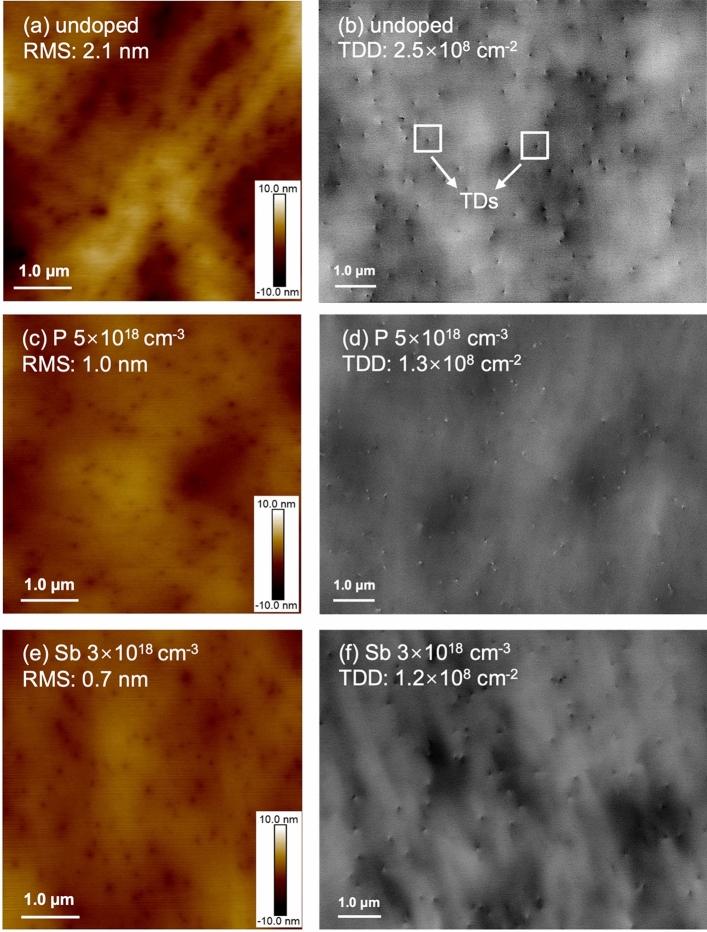
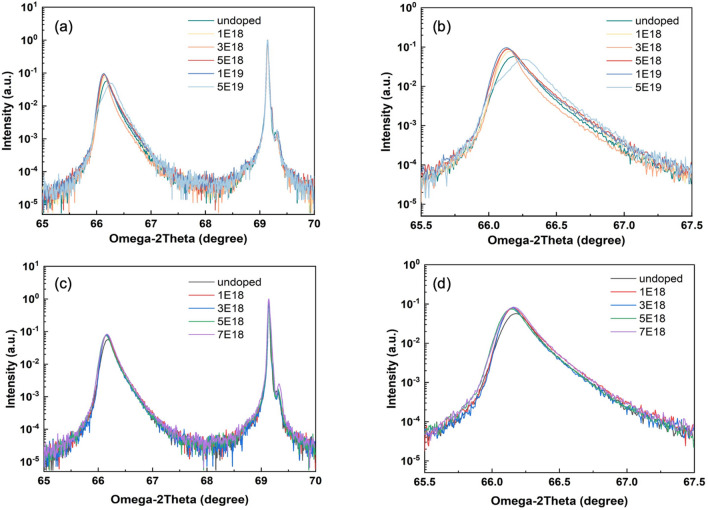
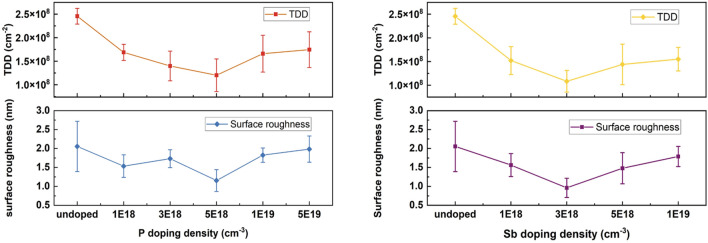
Suppression of threading dislocations (TDs) in thin germanium (Ge) layers grown on silicon (Si) substrates has been critical for realizing high-performance Si-based optoelectronic and electronic devices. An advanced growth strategy is desired to minimize the TD density within a thin Ge buffer layer in Ge-on-Si systems. In this work, we investigate the impact of P dopants in 500-nm thin Ge layers, with doping concentrations from 1 to 50 × 10 cm. The introduction of P dopants has efficiently promoted TD reduction, whose potential mechanism has been explored by comparing it to the well-established Sb-doped Ge-on-Si system. P and Sb dopants reveal different defect-suppression mechanisms in Ge-on-Si samples, inspiring a novel co-doping technique by exploiting the advantages of both dopants. The surface TDD of the Ge buffer has been further reduced by the co-doping technique to the order of 10 cm with a thin Ge layer (of only 500 nm), which could provide a high-quality platform for high-performance Si-based semiconductor devices.
抑制在硅(Si)衬底上生长的锗(Ge)薄层中的穿透位错(TDs)对于实现高性能的硅基光电器件和电子器件至关重要。需要一种先进的生长策略来最小化Ge-on-Si系统中薄Ge缓冲层内的TD密度。在这项工作中,我们研究了磷(P)掺杂剂对500纳米厚的Ge层的影响,其掺杂浓度范围为1至50×10¹⁹厘米⁻³。P掺杂剂的引入有效地促进了TD的减少,通过将其与成熟的Sb掺杂的Ge-on-Si系统进行比较,探索了其潜在机制。P和Sb掺杂剂在Ge-on-Si样品中揭示了不同的缺陷抑制机制,通过利用两种掺杂剂的优点激发了一种新型的共掺杂技术。通过共掺杂技术,Ge缓冲层的表面TDD进一步降低到10¹⁰厘米⁻²的量级,使用的是仅500纳米厚的Ge薄层,这可以为高性能硅基半导体器件提供一个高质量的平台。