Lions Vision Research and Rehabilitation Center, Wilmer Eye Institute, Johns Hopkins University, Baltimore, MD, USA.
Center for Applied and Translational Sensory Sciences, University of Minnesota, Minneapolis, USA.
Sci Rep. 2024 Apr 4;14(1):7911. doi: 10.1038/s41598-024-58363-6.
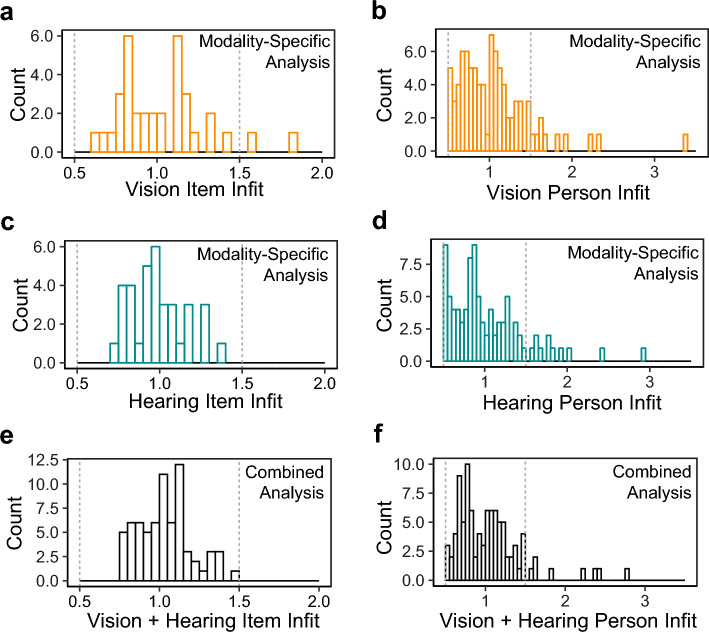
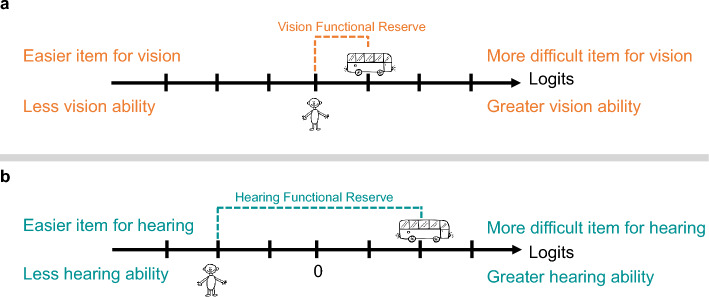
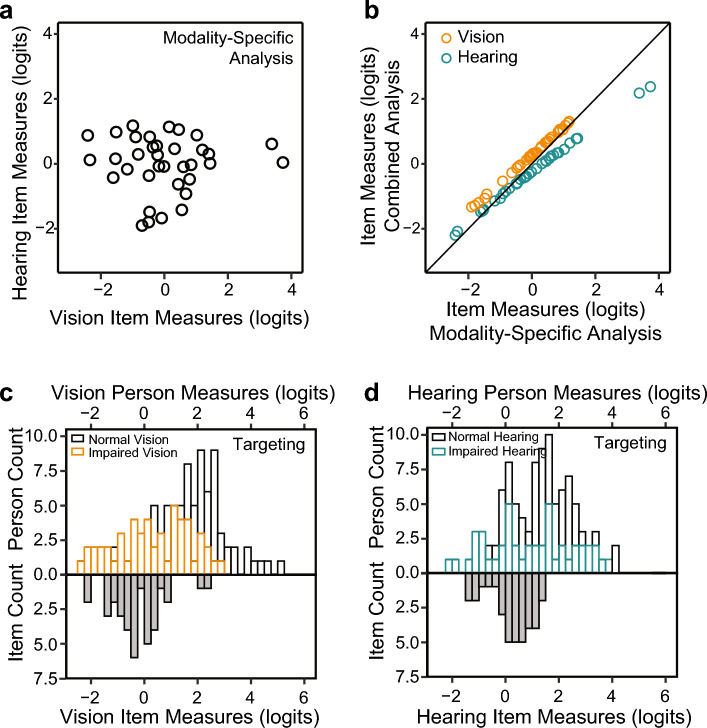
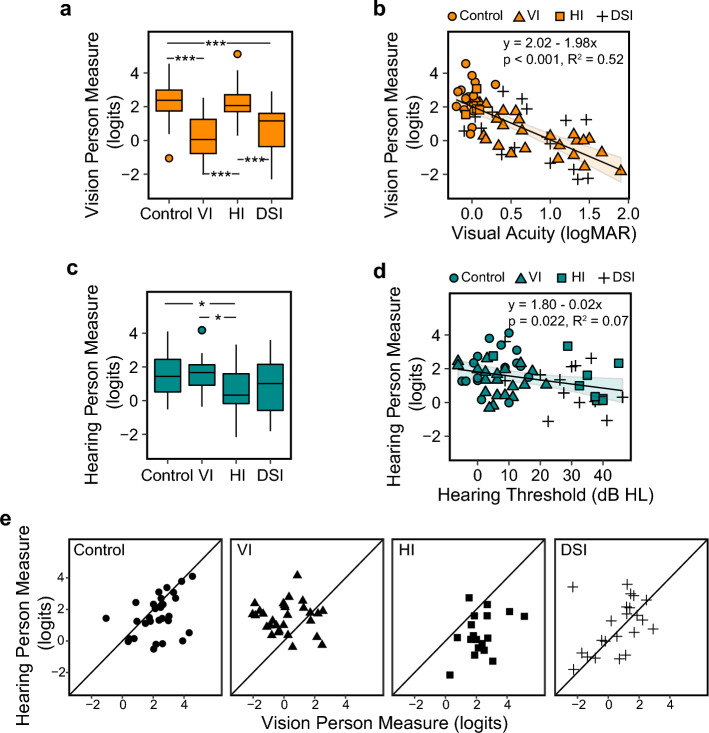
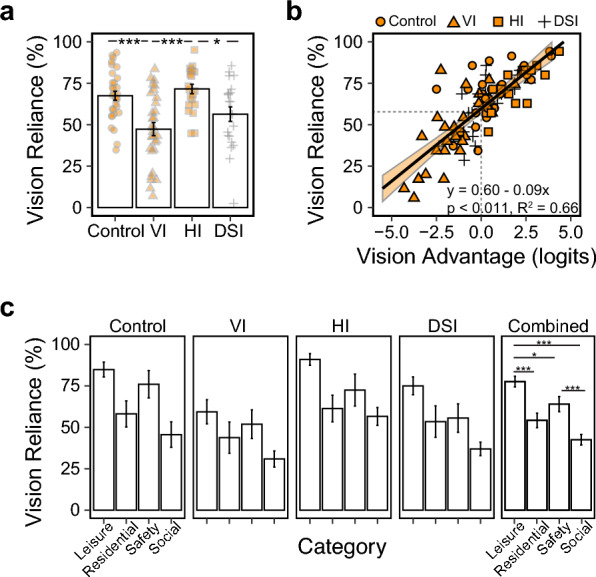
Spatial localization is important for social interaction and safe mobility, and relies heavily on vision and hearing. While people with vision or hearing impairment compensate with their intact sense, people with dual sensory impairment (DSI) may require rehabilitation strategies that take both impairments into account. There is currently no tool for assessing the joint effect of vision and hearing impairment on spatial localization in this large and increasing population. To this end, we developed a novel Dual Sensory Spatial Localization Questionnaire (DS-SLQ) that consists of 35 everyday spatial localization tasks. The DS-SLQ asks participants about their difficulty completing different tasks using only vision or hearing, as well as the primary sense they rely on for each task. We administered the DS-SLQ to 104 participants with heterogenous vision and hearing status. Rasch analysis confirmed the psychometric validity of the DS-SLQ and the feasibility of comparing vision and hearing spatial abilities in a unified framework. Vision and hearing impairment were associated with decreased visual and auditory spatial abilities. Differences between vision and hearing abilities predicted overall sensory reliance patterns. In DSI rehabilitation, DS-SLQ may be useful for measuring vision and hearing spatial localization abilities and predicting the better sense for completing different spatial localization tasks.
空间定位对于社交互动和安全移动至关重要,主要依赖于视觉和听觉。虽然视力或听力受损的人可以通过未受损的感官来补偿,但患有双重感觉障碍(DSI)的人可能需要考虑到两种障碍的康复策略。目前,对于这个庞大且不断增加的人群,还没有一种工具可以评估视力和听力障碍对空间定位的联合影响。为此,我们开发了一种新的双重感觉空间定位问卷(DS-SLQ),其中包含 35 项日常空间定位任务。DS-SLQ 要求参与者仅使用视觉或听觉完成不同任务的难度,以及他们在每项任务中主要依赖的感觉。我们对 104 名具有不同视力和听力状况的参与者进行了 DS-SLQ 测试。Rasch 分析证实了 DS-SLQ 的心理测量有效性,并能够在统一框架中比较视觉和听觉空间能力。视力和听力障碍与视觉和听觉空间能力下降有关。视觉和听觉能力之间的差异预测了整体感觉依赖模式。在 DSI 康复中,DS-SLQ 可用于测量视觉和听觉空间定位能力,并预测完成不同空间定位任务的更佳感觉。