Jackson P D, Felsenfeld G
Proc Natl Acad Sci U S A. 1985 Apr;82(8):2296-300. doi: 10.1073/pnas.82.8.2296.
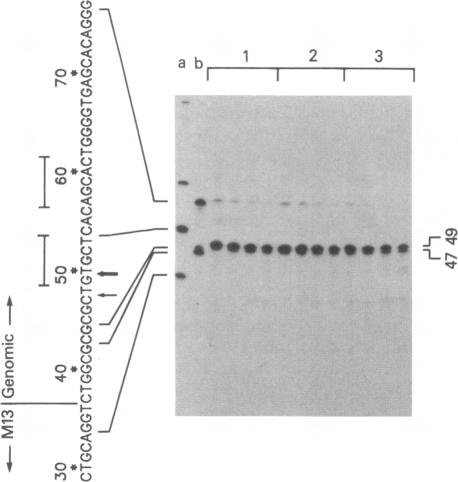
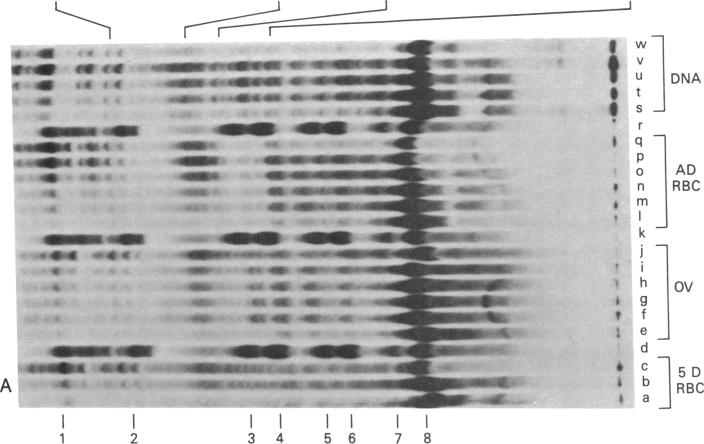
We have devised a method for mapping sites on DNA within the nucleus that are protected against nuclease attack by interaction with bound protein or other factors. This "footprinting" method uses an end-labeled sequence-specific DNA probe, which is annealed to the DNA from nuclear digests under carefully controlled conditions. The annealed complexes are treated with single-strand-specific nuclease, the resulting duplex molecules are electrophoresed on gels, and the gels are autoradiographed. The high sensitivity and resolution of the method have made it possible to obtain a detailed map of DNase I cutting patterns in the 5' flanking sequence of the chicken adult beta (beta A)-globin gene within nuclei from various tissues. In nuclei from adult erythrocytes, this domain is hypersensitive to nucleases. However, we detect within the domain two well-defined regions that are protected against attack, indicating the presence of one or more bound factors. Nuclei from oviduct or 5-day-old embryonic erythrocytes, in which the domain is not hypersensitive, show limited and different patterns of protection.
我们设计了一种方法,用于绘制细胞核内DNA上与结合蛋白或其他因子相互作用而免受核酸酶攻击的位点。这种“足迹”方法使用末端标记的序列特异性DNA探针,该探针在严格控制的条件下与来自核消化物的DNA退火。将退火后的复合物用单链特异性核酸酶处理,所得双链分子在凝胶上进行电泳,然后对凝胶进行放射自显影。该方法的高灵敏度和分辨率使得获得来自各种组织的细胞核内鸡成年β(βA)-珠蛋白基因5'侧翼序列中DNase I切割模式的详细图谱成为可能。在成年红细胞的细胞核中,该区域对核酸酶高度敏感。然而,我们在该区域内检测到两个明确的受保护区域,表明存在一种或多种结合因子。输卵管或5日龄胚胎红细胞的细胞核中,该区域对核酸酶不敏感,显示出有限且不同的保护模式。