Brain and Mind Centre, Faculty of Medicine and Health, University of Sydney, Sydney, NSW, Australia.
Institute for Molecular Bioscience, The University of Queensland, Brisbane, QLD, Australia.
Mol Psychiatry. 2024 Sep;29(9):2765-2773. doi: 10.1038/s41380-024-02492-x. Epub 2024 Apr 4.
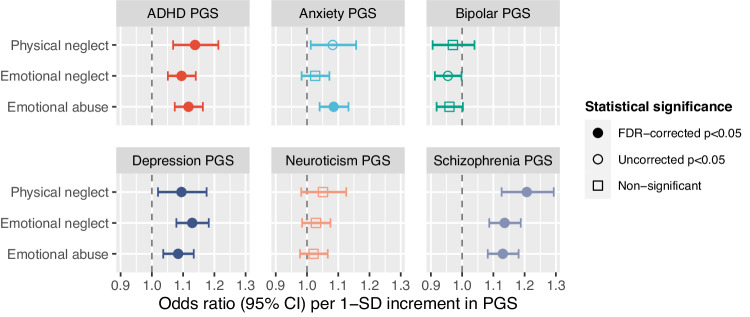
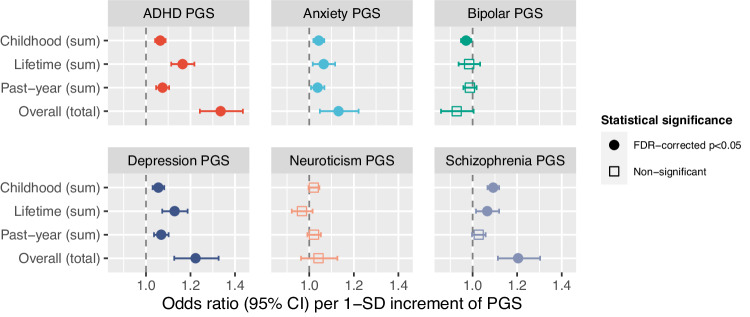
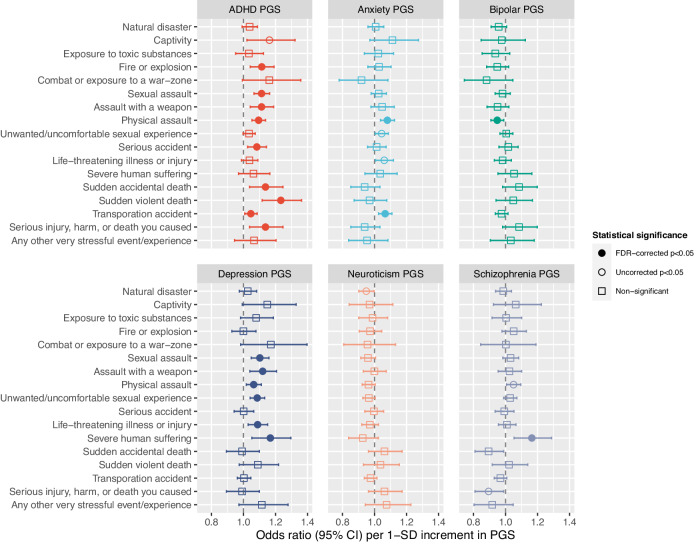
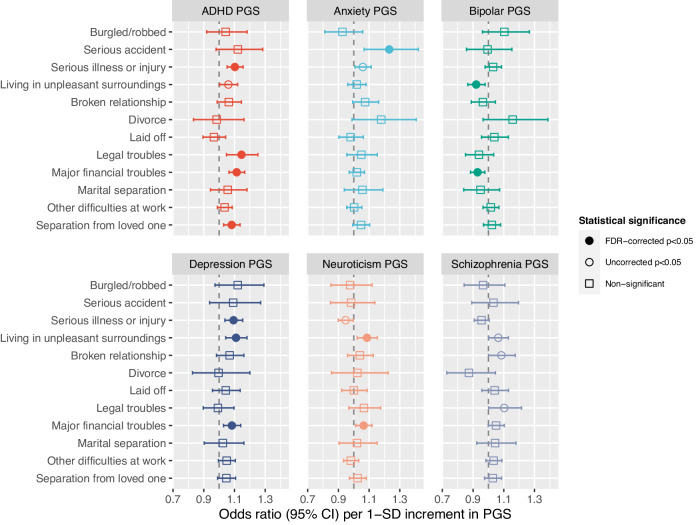
The dominant ('general') version of the diathesis-stress theory of depression views stressors and genetic vulnerability as independent risks. In the Australian Genetics of Depression Study (N = 14,146; 75% female), we tested whether polygenic scores (PGS) for major depression, bipolar disorder, schizophrenia, anxiety, ADHD, and neuroticism were associated with reported exposure to 32 childhood, past-year, lifetime, and accumulated stressful life events (SLEs). In false discovery rate-corrected models, the clearest PGS-SLE relationships were for the ADHD- and depression-PGSs, and to a lesser extent, the anxiety- and schizophrenia-PGSs. We describe the associations for childhood and accumulated SLEs, and the 2-3 strongest past-year/lifetime SLE associations. Higher ADHD-PGS was associated with all childhood SLEs (emotional abuse, emotional neglect, physical neglect; ORs = 1.09-1.14; p's < 1.3 × 10), more accumulated SLEs, and reported exposure to sudden violent death (OR = 1.23; p = 3.6 × 10), legal troubles (OR = 1.15; p = 0.003), and sudden accidental death (OR = 1.14; p = 0.006). Higher depression-PGS was associated with all childhood SLEs (ORs = 1.07-1.12; p's < 0.013), more accumulated SLEs, and severe human suffering (OR = 1.17; p = 0.003), assault with a weapon (OR = 1.12; p = 0.003), and living in unpleasant surroundings (OR = 1.11; p = 0.001). Higher anxiety-PGS was associated with childhood emotional abuse (OR = 1.08; p = 1.6 × 10), more accumulated SLEs, and serious accident (OR = 1.23; p = 0.004), physical assault (OR = 1.08; p = 2.2 × 10), and transportation accident (OR = 1.07; p = 0.001). Higher schizophrenia-PGS was associated with all childhood SLEs (ORs = 1.12-1.19; p's < 9.3), more accumulated SLEs, and severe human suffering (OR = 1.16; p = 0.003). Higher neuroticism-PGS was associated with living in unpleasant surroundings (OR = 1.09; p = 0.007) and major financial troubles (OR = 1.06; p = 0.014). A reversed pattern was seen for the bipolar-PGS, with lower odds of reported physical assault (OR = 0.95; p = 0.014), major financial troubles (OR = 0.93; p = 0.004), and living in unpleasant surroundings (OR = 0.92; p = 0.007). Genetic risk for several mental disorders influences reported exposure to SLEs among adults with moderately severe, recurrent depression. Our findings emphasise that stressors and diatheses are inter-dependent and challenge diagnosis and subtyping (e.g., reactive/endogenous) based on life events.
抑郁症的素质-应激理论的主流(“一般”)版本认为应激源和遗传易感性是独立的风险因素。在澳大利亚抑郁症遗传学研究(N=14146;75%为女性)中,我们测试了主要抑郁症、双相情感障碍、精神分裂症、焦虑症、注意力缺陷多动障碍和神经质的多基因评分(PGS)是否与报告的 32 种儿童期、过去一年、终生和累积的生活应激事件(SLE)有关。在虚假发现率校正模型中,最清晰的 PGS-SLE 关系是 ADHD 和抑郁症 PGS,其次是焦虑症和精神分裂症 PGS。我们描述了儿童期和累积 SLE 以及过去一年/终生 SLE 最强关联的情况。较高的 ADHD-PGS 与所有儿童期 SLE(情感虐待、情感忽视、身体忽视;ORs=1.09-1.14;p's<1.3×10)、更多的累积 SLE 以及报告的突然暴力死亡(OR=1.23;p=3.6×10)、法律纠纷(OR=1.15;p=0.003)和突然意外死亡(OR=1.14;p=0.006)有关。较高的抑郁症 PGS 与所有儿童期 SLE(ORs=1.07-1.12;p's<0.013)、更多的累积 SLE 以及严重的人类苦难(OR=1.17;p=0.003)、武器攻击(OR=1.12;p=0.003)和生活在不愉快的环境中(OR=1.11;p=0.001)有关。较高的焦虑症 PGS 与儿童期情感虐待(OR=1.08;p=1.6×10)、更多的累积 SLE 以及严重事故(OR=1.23;p=0.004)、身体攻击(OR=1.08;p=2.2×10)和交通意外(OR=1.07;p=0.001)有关。较高的精神分裂症 PGS 与所有儿童期 SLE(ORs=1.12-1.19;p's<9.3)、更多的累积 SLE 以及严重的人类苦难(OR=1.16;p=0.003)有关。较高的神经质症 PGS 与生活在不愉快的环境中(OR=1.09;p=0.007)和重大财务困境(OR=1.06;p=0.014)有关。双相情感障碍 PGS 的情况则相反,报告的身体攻击(OR=0.95;p=0.014)、重大财务困境(OR=0.93;p=0.004)和生活在不愉快的环境中(OR=0.92;p=0.007)的几率较低。几种精神障碍的遗传风险会影响到有中度严重、反复发作的抑郁症的成年人报告的 SLE 暴露情况。我们的发现强调了应激源和素质是相互依存的,这对基于生活事件的诊断和亚型(例如,反应性/内源性)提出了挑战。