
探索活动期溃疡性结肠炎的自噬相关发病机制。
Exploring the autophagy-related pathogenesis of active ulcerative colitis.
作者信息
Gong Zhuo-Zhi, Li Teng, Yan He, Xu Min-Hao, Lian Yue, Yang Yi-Xuan, Wei Wei, Liu Tao
机构信息
Wangjing Hospital, China Academy of Chinese Medical Sciences, Beijing 100102, China.
College of Traditional Chinese Medicine, School of Traditional Chinese Medicine, Beijing 100102, China.
出版信息
World J Clin Cases. 2024 Mar 26;12(9):1622-1633. doi: 10.12998/wjcc.v12.i9.1622.
BACKGROUND
The pathogenesis of ulcerative colitis (UC) is complex, and recent therapeutic advances remain unable to fully alleviate the condition.
AIM
To inform the development of novel UC treatments, bioinformatics was used to explore the autophagy-related pathogenesis associated with the active phase of UC.
METHODS
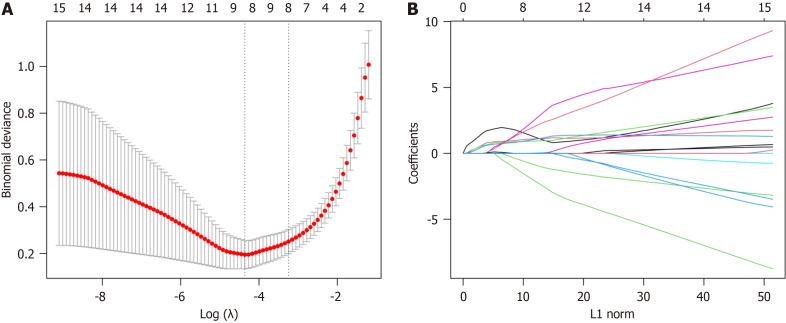
The GEO database was searched for UC-related datasets that included healthy controls who met the screening criteria. Differential analysis was conducted to obtain differentially expressed genes (DEGs). Autophagy-related targets were collected and intersected with the DEGs to identiy differentially expressed autophagy-related genes (DEARGs) associated with active UC. DEARGs were then subjected to KEGG, GO, and DisGeNET disease enrichment analyses using R software. Differential analysis of immune infiltrating cells was performed using the CiberSort algorithm. The least absolute shrinkage and selection operator algorithm and protein-protein interaction network were used to narrow down the DEARGs, and the top five targets in the Dgree ranking were designated as core targets.
RESULTS
A total of 4822 DEGs were obtained, of which 58 were classified as DEARGs. SERPINA1, BAG3, HSPA5, CASP1, and CX3CL1 were identified as core targets. GO enrichment analysis revealed that DEARGs were primarily enriched in processes related to autophagy regulation and macroautophagy. KEGG enrichment analysis showed that DEARGs were predominantly associated with NOD-like receptor signaling and other signaling pathways. Disease enrichment analysis indicated that DEARGs were significantly linked to diseases such as malignant glioma and middle cerebral artery occlusion. Immune infiltration analysis demonstrated a higher presence of immune cells like activated memory CD4 T cells and follicular helper T cells in active UC patients than in healthy controls.
CONCLUSION
Autophagy is closely related to the active phase of UC and the potential targets obtained from the analysis in this study may provide new insight into the treatment of active UC patients.
背景
溃疡性结肠炎(UC)的发病机制复杂,近期的治疗进展仍无法完全缓解病情。
目的
为了推动新型UC治疗方法的开发,利用生物信息学探索与UC活动期相关的自噬相关发病机制。
方法
在基因表达综合数据库(GEO数据库)中搜索符合筛选标准的包含健康对照的UC相关数据集。进行差异分析以获得差异表达基因(DEGs)。收集自噬相关靶点并与DEGs进行交集分析,以鉴定与活动期UC相关的差异表达自噬相关基因(DEARGs)。然后使用R软件对DEARGs进行京都基因与基因组百科全书(KEGG)、基因本体论(GO)和疾病基因网络(DisGeNET)疾病富集分析。使用CiberSort算法对免疫浸润细胞进行差异分析。使用最小绝对收缩和选择算子算法及蛋白质-蛋白质相互作用网络来缩小DEARGs范围,并将度排名前五位的靶点指定为核心靶点。
结果
共获得4822个DEGs,其中58个被归类为DEARGs。丝氨酸蛋白酶抑制剂A1(SERPINA1)、BAG3、热休克蛋白家族A成员5(HSPA5)、半胱天冬酶1(CASP1)和趋化因子CX3CL1被鉴定为核心靶点。GO富集分析显示,DEARGs主要富集于与自噬调节和巨自噬相关的过程。KEGG富集分析表明,DEARGs主要与NOD样受体信号通路和其他信号通路相关。疾病富集分析表明,DEARGs与恶性胶质瘤和大脑中动脉闭塞等疾病显著相关。免疫浸润分析表明,活动期UC患者中活化记忆CD4 T细胞和滤泡辅助性T细胞等免疫细胞的存在高于健康对照。
结论
自噬与UC活动期密切相关,本研究分析获得的潜在靶点可能为活动期UC患者的治疗提供新的见解。


 Zotero 插件