Awuah Wireko Andrew, Adebusoye Favour Tope, Wellington Jack, David Lian, Salam Abdus, Weng Yee Amanda Leong, Lansiaux Edouard, Yarlagadda Rohan, Garg Tulika, Abdul-Rahman Toufik, Kalmanovich Jacob, Miteu Goshen David, Kundu Mrinmoy, Mykolaivna Nikitina Iryna
Sumy State University, Sumy, United Kingdom.
Cardiff University School of Medicine, Cardiff University, Wales, United Kingdom.
World Neurosurg X. 2024 Mar 8;23:100301. doi: 10.1016/j.wnsx.2024.100301. eCollection 2024 Jul.
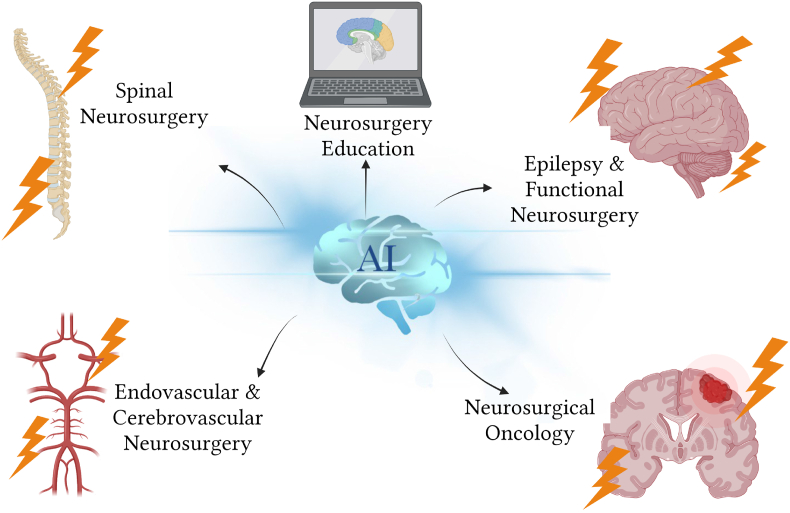
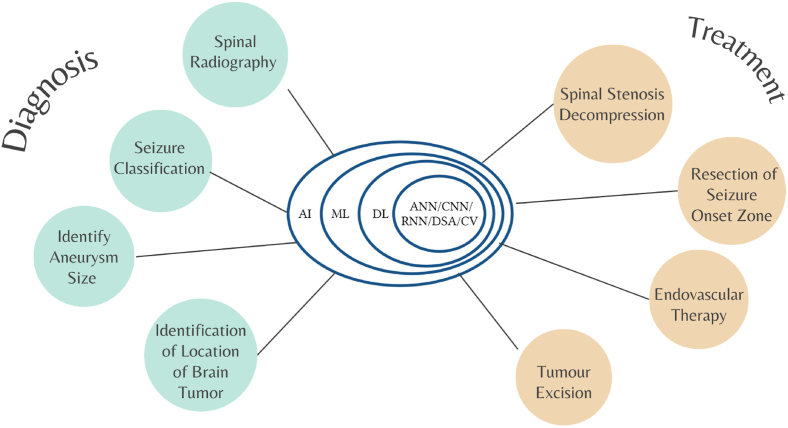
Neurosurgeons receive extensive technical training, which equips them with the knowledge and skills to specialise in various fields and manage the massive amounts of information and decision-making required throughout the various stages of neurosurgery, including preoperative, intraoperative, and postoperative care and recovery. Over the past few years, artificial intelligence (AI) has become more useful in neurosurgery. AI has the potential to improve patient outcomes by augmenting the capabilities of neurosurgeons and ultimately improving diagnostic and prognostic outcomes as well as decision-making during surgical procedures. By incorporating AI into both interventional and non-interventional therapies, neurosurgeons may provide the best care for their patients. AI, machine learning (ML), and deep learning (DL) have made significant progress in the field of neurosurgery. These cutting-edge methods have enhanced patient outcomes, reduced complications, and improved surgical planning.
神经外科医生接受广泛的技术培训,这使他们具备在各个领域进行专业化的知识和技能,并能处理神经外科各个阶段(包括术前、术中和术后护理及康复)所需的大量信息和决策。在过去几年里,人工智能(AI)在神经外科领域变得更加有用。人工智能有潜力通过增强神经外科医生的能力来改善患者的治疗效果,并最终改善诊断和预后结果以及手术过程中的决策。通过将人工智能纳入介入性和非介入性治疗中,神经外科医生可以为患者提供最佳护理。人工智能、机器学习(ML)和深度学习(DL)在神经外科领域取得了重大进展。这些前沿方法改善了患者的治疗效果,减少了并发症,并改进了手术规划。