Keller Arielle S, Moore Tyler M, Luo Audrey, Visoki Elina, Gataviņš Mārtiņš M, Shetty Alisha, Cui Zaixu, Fan Yong, Feczko Eric, Houghton Audrey, Li Hongming, Mackey Allyson P, Miranda-Dominguez Oscar, Pines Adam, Shinohara Russell T, Sun Kevin Y, Fair Damien A, Satterthwaite Theodore D, Barzilay Ran
Penn Lifespan Informatics and Neuroimaging Center, University of Pennsylvania, Philadelphia, PA, USA; Department of Psychiatry, University of Pennsylvania, Philadelphia, PA, USA.
Department of Psychiatry, University of Pennsylvania, Philadelphia, PA, USA; Lifespan Brain Institute, Children's Hospital of Philadelphia and Perelman School of Medicine, University of Pennsylvania, Philadelphia, PA, USA.
Dev Cogn Neurosci. 2024 Apr;66:101370. doi: 10.1016/j.dcn.2024.101370. Epub 2024 Apr 2.
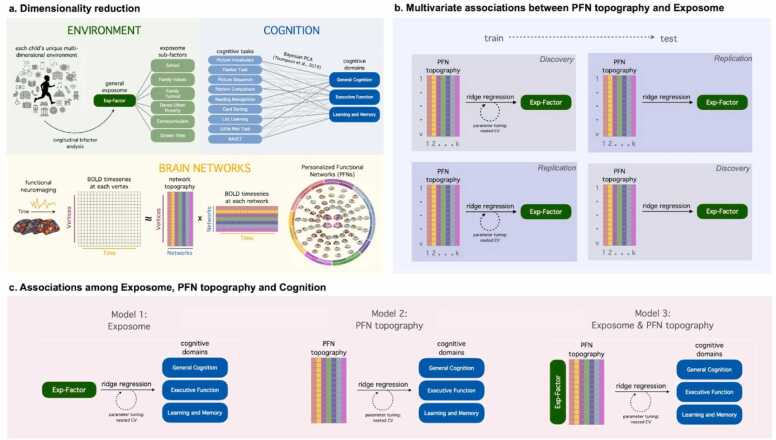
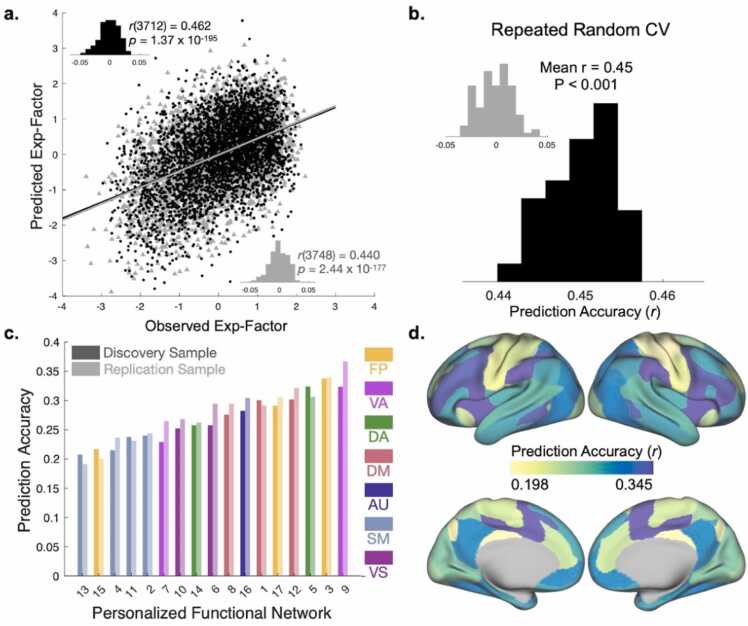
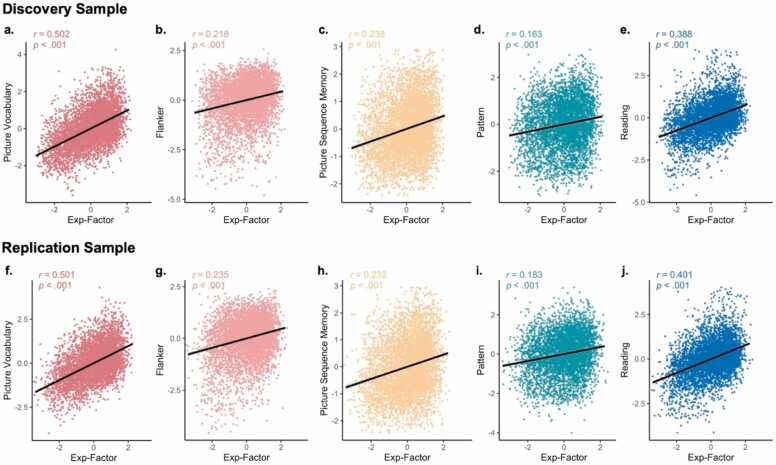
Childhood environments are critical in shaping cognitive neurodevelopment. With the increasing availability of large-scale neuroimaging datasets with deep phenotyping of childhood environments, we can now build upon prior studies that have considered relationships between one or a handful of environmental and neuroimaging features at a time. Here, we characterize the combined effects of hundreds of inter-connected and co-occurring features of a child's environment ("exposome") and investigate associations with each child's unique, multidimensional pattern of functional brain network organization ("functional topography") and cognition. We apply data-driven computational models to measure the exposome and define personalized functional brain networks in pre-registered analyses. Across matched discovery (n=5139, 48.5% female) and replication (n=5137, 47.1% female) samples from the Adolescent Brain Cognitive Development study, the exposome was associated with current (ages 9-10) and future (ages 11-12) cognition. Changes in the exposome were also associated with changes in cognition after accounting for baseline scores. Cross-validated ridge regressions revealed that the exposome is reflected in functional topography and can predict performance across cognitive domains. Importantly, a single measure capturing a child's exposome could more accurately and parsimoniously predict cognition than a wealth of personalized neuroimaging data, highlighting the importance of children's complex, multidimensional environments in cognitive neurodevelopment.
童年环境对塑造认知神经发育至关重要。随着大规模神经影像数据集的日益丰富,这些数据集对童年环境进行了深度表型分析,我们现在可以在先前研究的基础上展开进一步研究,此前的研究一次只考虑一种或少数几种环境与神经影像特征之间的关系。在此,我们描述了儿童环境中数百个相互关联且同时出现的特征(“暴露组”)的综合影响,并研究其与每个儿童独特的、多维的功能性脑网络组织模式(“功能拓扑结构”)及认知之间的关联。我们应用数据驱动的计算模型来测量暴露组,并在预先注册的分析中定义个性化的功能性脑网络。在来自青少年大脑认知发展研究的匹配发现样本(n = 5139,48.5%为女性)和复制样本(n = 5137,47.1%为女性)中,暴露组与当前(9 - 10岁)和未来(11 - 12岁)的认知相关。在考虑基线分数后,暴露组的变化也与认知变化相关。交叉验证的岭回归显示,暴露组反映在功能拓扑结构中,并且可以预测跨认知领域的表现。重要的是,与大量个性化神经影像数据相比,单一的衡量儿童暴露组的指标能够更准确、更简洁地预测认知,这凸显了儿童复杂的多维环境在认知神经发育中的重要性。