Pold Grace, Bonilla-Rosso Germán, Saghaï Aurélien, Strous Marc, Jones Christopher M, Hallin Sara
Department of Forest Mycology and Plant Pathology, Swedish University of Agricultural Sciences, 750 07 Uppsala, Sweden.
Department of Earth, Energy, and Environment, University of Calgary, Calgary, Alberta, T2N 1N4, Canada.
ISME Commun. 2024 Feb 2;4(1):ycae020. doi: 10.1093/ismeco/ycae020. eCollection 2024 Jan.
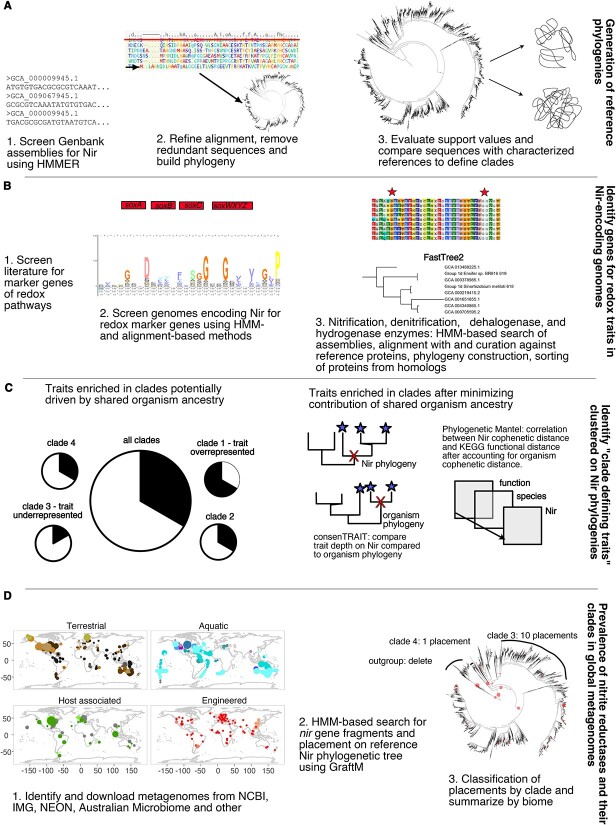
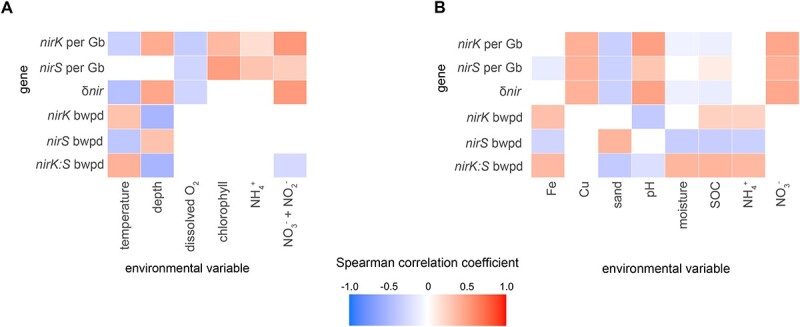
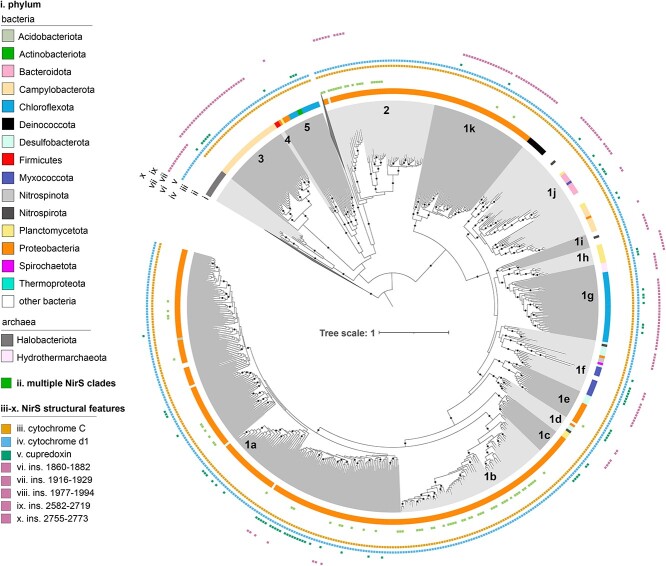
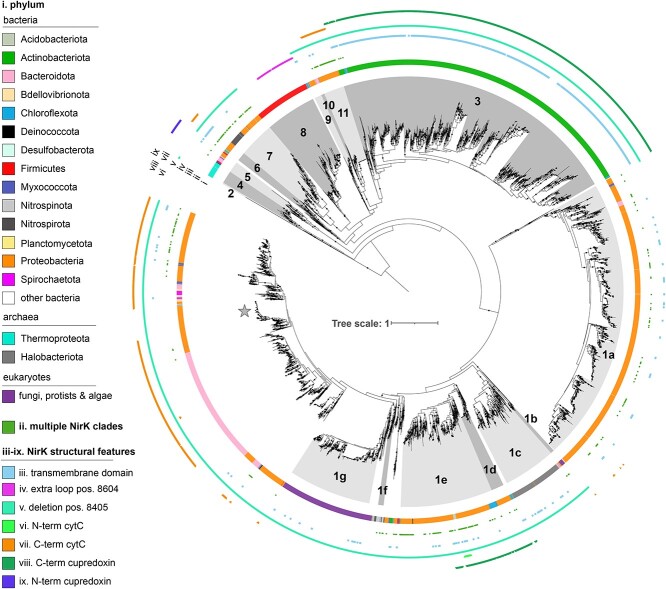
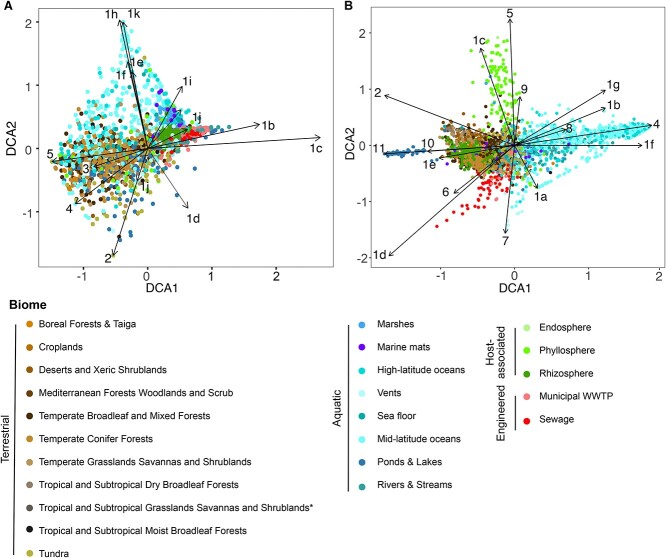
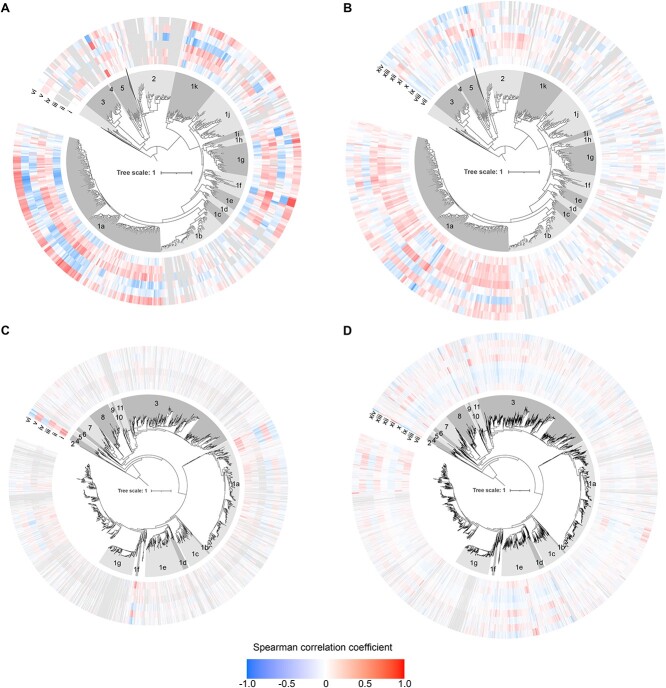
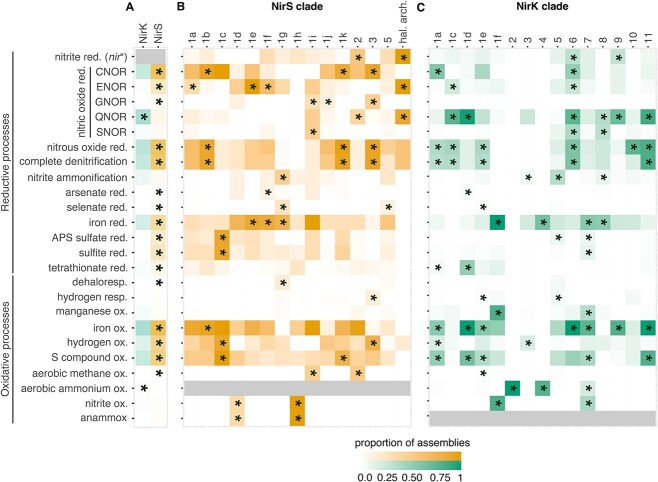
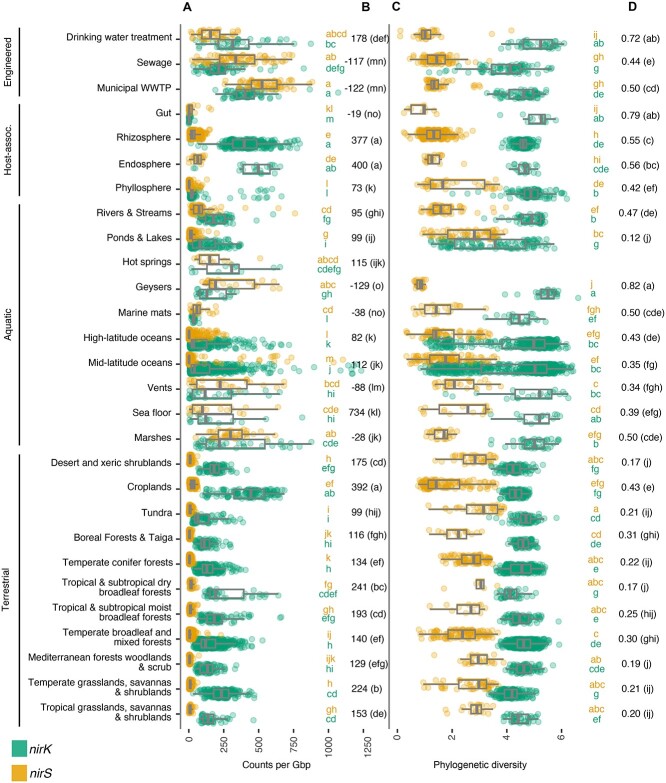
The two evolutionarily unrelated nitric oxide-producing nitrite reductases, NirK and NirS, are best known for their redundant role in denitrification. They are also often found in organisms that do not perform denitrification. To assess the functional roles of the two enzymes and to address the sequence and structural variation within each, we reconstructed robust phylogenies of both proteins with sequences recovered from 6973 isolate and metagenome-assembled genomes and identified 32 well-supported clades of structurally distinct protein lineages. We then inferred the potential niche of each clade by considering other functional genes of the organisms carrying them as well as the relative abundances of each gene in 4082 environmental metagenomes across diverse aquatic, terrestrial, host-associated, and engineered biomes. We demonstrate that Nir phylogenies recapitulate ecology distinctly from the corresponding organismal phylogeny. While some clades of the nitrite reductase were equally prevalent across biomes, others had more restricted ranges. Nitrifiers make up a sizeable proportion of the nitrite-reducing community, especially for NirK in marine waters and dry soils. Furthermore, the two reductases showed distinct associations with genes involved in oxidizing and reducing other compounds, indicating that the NirS and NirK activities may be linked to different elemental cycles. Accordingly, the relative abundance and diversity of NirS versus NirK vary between biomes. Our results show the divergent ecological roles NirK and NirS-encoding organisms may play in the environment and provide a phylogenetic framework to distinguish the traits associated with organisms encoding the different lineages of nitrite reductases.
两种在进化上不相关的产一氧化氮亚硝酸还原酶NirK和NirS,因其在反硝化作用中的冗余作用而最为人所知。它们也经常在不进行反硝化作用的生物体中被发现。为了评估这两种酶的功能作用,并解决每种酶内部的序列和结构变异问题,我们用从6973个分离基因组和宏基因组组装基因组中获得的序列重建了这两种蛋白质的可靠系统发育树,并确定了32个结构上不同的蛋白质谱系的得到充分支持的分支。然后,我们通过考虑携带这些基因的生物体的其他功能基因以及它们在4082个跨越不同水生、陆地、宿主相关和工程生物群落的环境宏基因组中的相对丰度,推断出每个分支的潜在生态位。我们证明,Nir系统发育树与相应的生物体系统发育树在生态学上有明显的概括。虽然亚硝酸还原酶的一些分支在各生物群落中同样普遍,但其他分支的范围则更受限制。硝化细菌在亚硝酸盐还原群落中占相当大的比例,特别是在海水中和干燥土壤中的NirK。此外,这两种还原酶与参与氧化和还原其他化合物的基因表现出不同的关联,表明NirS和NirK的活性可能与不同的元素循环有关。因此,NirS与NirK的相对丰度和多样性在不同生物群落之间有所不同。我们的结果显示了编码NirK和NirS的生物体在环境中可能发挥的不同生态作用,并提供了一个系统发育框架,以区分与编码不同谱系亚硝酸还原酶的生物体相关的特征。