Department of Cardiology, All India Institute of Medical Sciences Raipur, Chhattisgarh, India.
Department of Cardiology, Government Medical College Kozhikode, Kerala, India.
Indian Heart J. 2024 Mar-Apr;76(2):139-145. doi: 10.1016/j.ihj.2024.04.003. Epub 2024 Apr 9.
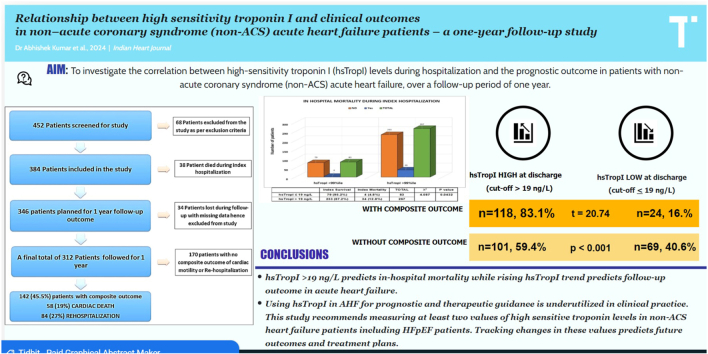
The primary objective of the study was to investigate the correlation between high-sensitivity troponin I (hsTropI) levels during hospitalization and the prognostic outcome in patients with non-acute coronary syndrome (non-ACS) acute heart failure, over a follow-up period of one year. The secondary objective was to assess and characterize acute heart failure during index hospitalization.
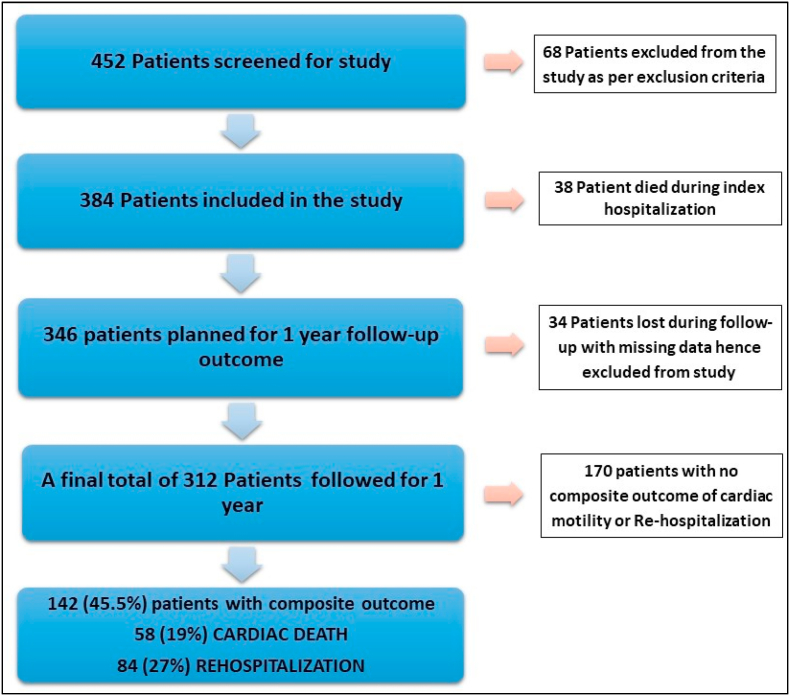
High sensitivity troponin I value was noted both at the time of admission and discharge. The correlation of admission hsTropI along with other parameters and risk factors with in-hospital mortality was studied. Patients of index hospitalization after discharge were followed up for one year and the composite endpoint of cardiovascular death or re-hospitalization for heart failure was noted. The correlation between admission and discharge hsTropI values with the composite endpoint was then analyzed.
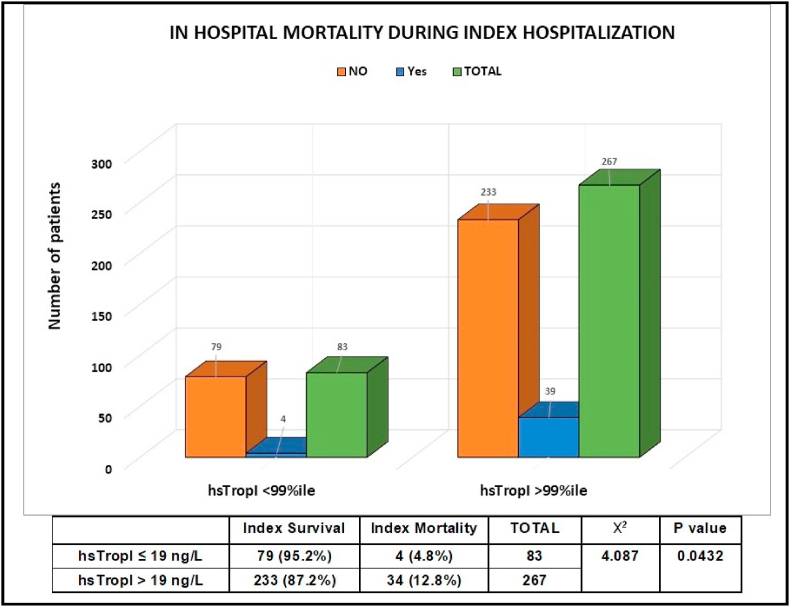
Out of 350 patients, 38 (10.8 %) patients died during index hospitalization while 142 patients (46 %) developed composite outcomes during follow-up. Age, previous history of heart failure, atrial fibrillation, low left ventricular ejection fraction, systolic blood pressure, and high values of hsTropI above 99th percentiles were independent in-hospital mortality predictors. The value of hsTropI at the time of admission was not associated with poor composite outcome during follow-up. However, patients who showed an increasing trend of hsTropI value at the time of discharge were found to have a significant increase in the composite outcome.
High-sensitivity troponin I is a valuable biomarker that can predict in-hospital mortality and long-term follow-up outcomes in patients with acute heart failure. It plays a crucial role in developing improved strategies for heart failure surveillance and management in the community.
本研究的主要目的是探讨非急性冠脉综合征(非 ACS)急性心力衰竭患者住院期间高敏肌钙蛋白 I(hsTropI)水平与预后的相关性,随访时间为 1 年。次要目的是评估和描述指数住院期间的急性心力衰竭。
在入院时和出院时均记录高敏肌钙蛋白 I 值。研究入院 hsTropI 与其他参数和危险因素与院内死亡率的相关性。对出院后指数住院的患者进行为期 1 年的随访,记录心血管死亡或因心力衰竭再次住院的复合终点。然后分析入院和出院 hsTropI 值与复合终点的相关性。
在 350 例患者中,38 例(10.8%)患者在指数住院期间死亡,142 例(46%)患者在随访期间发生复合结局。年龄、既往心力衰竭史、心房颤动、左心室射血分数低、收缩压和 hsTropI 值高于第 99 百分位数较高是院内死亡的独立预测因素。入院时 hsTropI 值与随访期间不良复合结局无关。然而,出院时 hsTropI 值呈上升趋势的患者发现复合结局显著增加。
高敏肌钙蛋白 I 是一种有价值的生物标志物,可预测急性心力衰竭患者的院内死亡率和长期随访结局。它在制定改善社区心力衰竭监测和管理的策略方面发挥着至关重要的作用。