Kumar Abhishek, Gupta Manisha, Kohat Abhijeet K, Agrawal Arpit, Varshney Amratansh, Chugh Ankit, Koshy Deepak I, Gurjar Ramesh, Kumar Pritish
Cardiology, All India Institute of Medical Sciences, Raipur, Raipur, IND.
Neurology, DKSPGI (Dau Kalyan Singh Postgraduate Institute) Raipur, Raipur, IND.
Cureus. 2024 Nov 18;16(11):e73910. doi: 10.7759/cureus.73910. eCollection 2024 Nov.
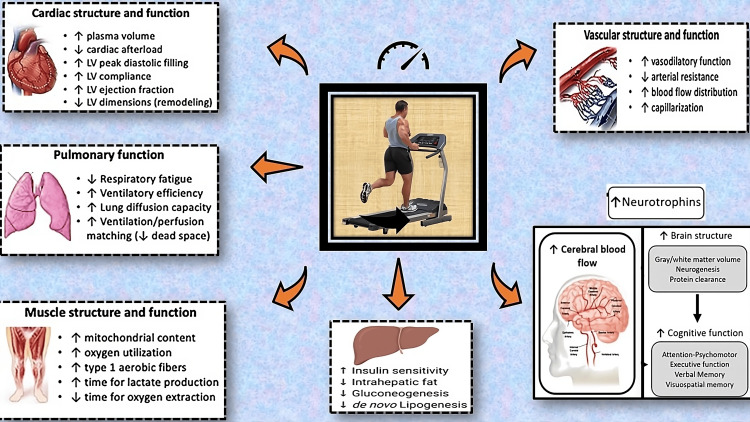
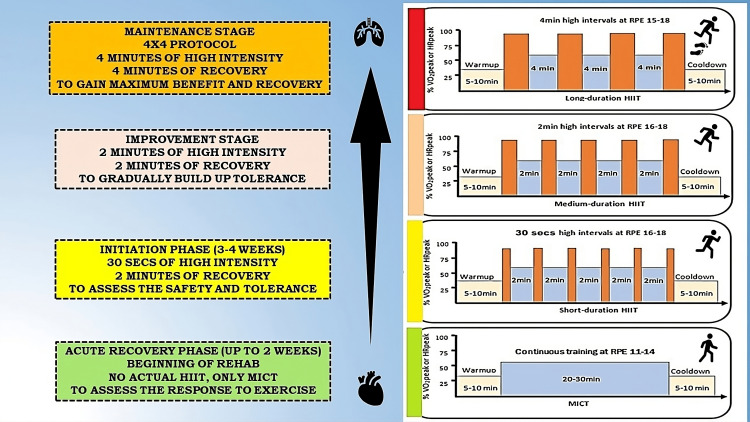
Regular exercise leads to various adaptations and many pathophysiological changes that significantly benefit exercise stamina and overall health, both in the general population and in patients with chronic cardiovascular diseases. High-intensity interval training (HIIT) is a form of exercise training that consists of short repetitive bursts of intense workouts that push the body to more than 90 percent of its maximal oxygen consumption (VO2 max) and more than 75 percent of maximal power, with in between periods of low-intensity exercise for recovery, followed by a cool-down period. HIIT has unquestionably emerged as a powerful and effective intervention in rehabilitating patients, particularly those recovering from heart attacks and strokes. HIIT significantly enhances cardiovascular fitness by improving parameters such as VO2 max, endothelial function, and overall cardiac output. In addition to these cardiovascular benefits, HIIT also contributes to improved metabolic health, including better glycemic control and lipid profile regulation, which are often compromised in patients with cardiovascular conditions. Furthermore, HIIT has a positive impact on stroke patient's functional recovery and quality of life, allowing them to regain mobility, independence, and a sense of well-being more quickly. While concerns about the safety of high-intensity exercises in individuals with compromised heart function remain, current evidence suggests that when properly supervised, HIIT is both safe and well-tolerated in these populations. As healthcare continues to evolve, the incorporation of innovative and evidence-based approaches such as HIIT may redefine the future of cardiovascular rehabilitation, ultimately providing long-term health benefits for patients recovering from MI and stroke.
规律运动能带来多种适应性变化以及许多病理生理改变,这对普通人群和慢性心血管疾病患者的运动耐力及整体健康均有显著益处。高强度间歇训练(HIIT)是一种运动训练形式,它由短时间重复的高强度锻炼组成,能使身体的耗氧量超过其最大摄氧量(VO₂ max)的90%,功率超过最大功率的75%,期间穿插低强度运动用于恢复,之后还有一个冷却期。HIIT无疑已成为康复治疗中一种强大且有效的干预手段,尤其是对那些从心脏病发作和中风中恢复的患者。HIIT通过改善诸如VO₂ max、内皮功能和整体心输出量等参数,显著提高心血管健康水平。除了这些心血管益处外,HIIT还有助于改善代谢健康,包括更好地控制血糖和调节血脂,而心血管疾病患者的这些方面往往会受到损害。此外,HIIT对中风患者的功能恢复和生活质量有积极影响,使他们能够更快地恢复活动能力、独立性和幸福感。虽然对于心功能受损个体进行高强度运动的安全性仍存在担忧,但目前的证据表明,在适当监督下,HIIT在这些人群中既安全又耐受性良好。随着医疗保健的不断发展,采用HIIT等创新且基于证据的方法可能会重新定义心血管康复的未来,最终为从心肌梗死和中风中恢复的患者带来长期健康益处。